
I have looked at plenty of these squad value breakdowns over the years and normally they confirm what you already suspected rather than surprise you. This season’s numbers are different. They do not just confirm the financial gap in English football, they make it look almost absurd when you see it laid out club by club.
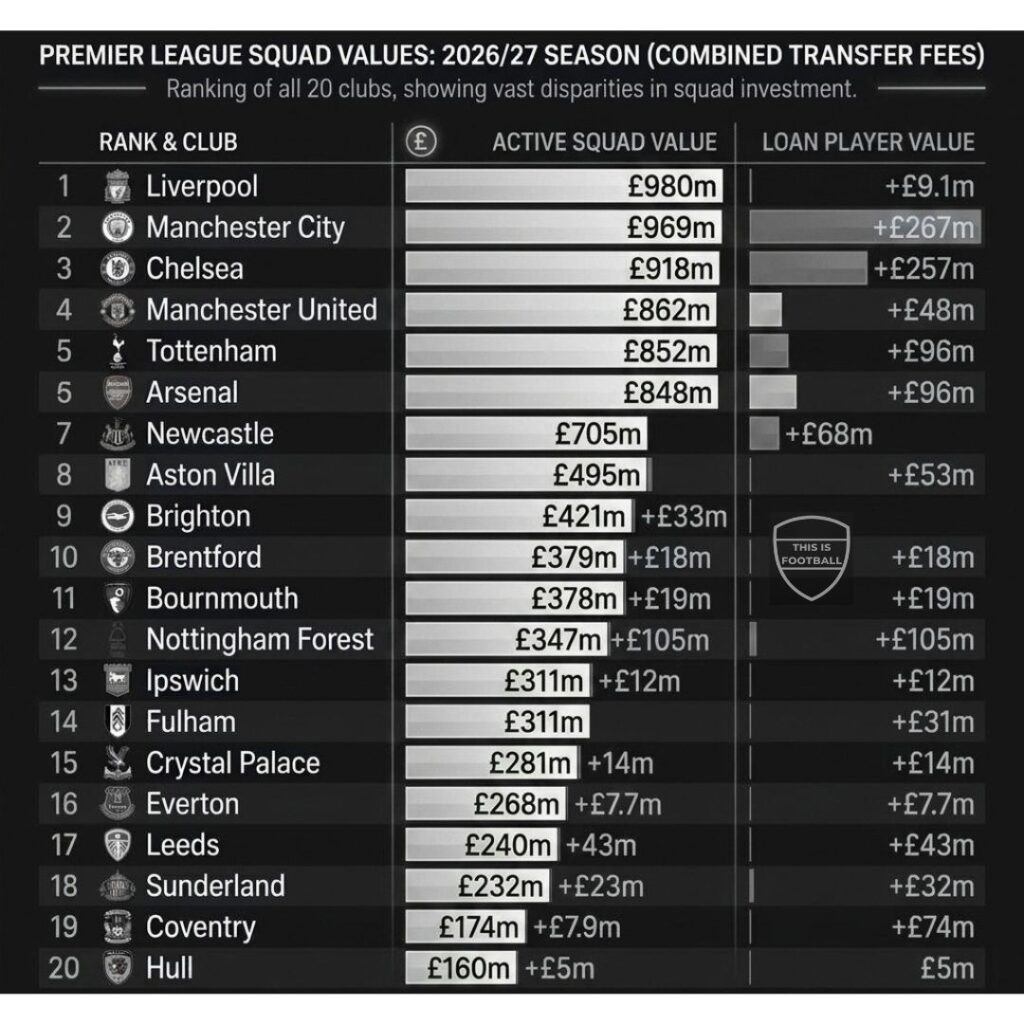
Liverpool sit top with an active squad value of nine hundred and eighty million pounds. Crystal Palace, my club, sit fifteenth with two hundred and eighty one million. That gap alone, between one club and another in the same division playing by the same rules, is roughly seven hundred million pounds. Read that back slowly and tell me football is still a level playing field in any meaningful sense.
The Top of the Table Looks Like a Different Sport
Liverpool, Manchester City and Chelsea occupy the top three spots with squad values north of nine hundred million pounds each. Manchester United follow at eight hundred and sixty two million, with Tottenham and Arsenal tied at the next tier down around eight hundred and fifty million apiece.
What strikes me looking at this grouping is not that these clubs are expensive, everyone already knew that, but how tightly bunched they are against each other and how sharply the numbers fall away once you move past them. Newcastle, sitting seventh, come in at seven hundred and five million, which sounds like a huge figure until you realise it represents a gap of over one hundred and fifty million pounds to sixth placed Arsenal. That is not a small step down. That is a cliff edge.
Chelsea’s position is particularly interesting to me. Their active squad value of nine hundred and eighteen million pounds sits them third overall, but their loan player value of two hundred and fifty seven million pounds is enormous relative to most of the rest of the division. Chelsea have built a model in recent years around signing enormous numbers of young players and loaning many of them out across Europe, and this figure suggests that approach has not slowed down.
It raises a genuine question about how you even value a squad like that. Is the true footballing resource of the club the nine hundred and eighteen million on the pitch, or does the loan army effectively function as a second squad worth over a quarter of a billion pounds sitting in reserve.
Manchester City’s numbers tell a slightly different story. Nine hundred and sixty nine million in active squad value plus another two hundred and sixty seven million in loan value puts their total financial footprint close to one and a quarter billion pounds when you combine both figures. For a club that has been operating under the shadow of ongoing financial regulation scrutiny for years, that is a staggering amount of resource still tied up in playing assets.
Here’s the full table:
The Middle of the Table Is Where the Real Story Sits
I think the most revealing part of this list is not the top three, which everyone expects, but the drop off from seventh to eighth. Newcastle at seven hundred and five million represent the last club with what you might call genuinely elite level resources. Aston Villa, sitting eighth, come in at four hundred and ninety five million, a gap of over two hundred million pounds to the club directly above them.
From Villa downwards you are essentially watching a completely different financial universe operate. Brighton, Brentford, Bournmouth and Nottingham Forest are all clustered in a tight band between roughly three hundred and forty and four hundred and twenty million. These are clubs that have built reputations in recent seasons for smart recruitment and coaching, competing respectably in a league where their financial firepower is genuinely a fraction of what the clubs above them can call upon.
Forest’s numbers are worth a specific mention because their loan player value of one hundred and five million pounds is unusually high for a club of their overall size, suggesting a recruitment strategy leaning heavily on young talent parked out on loan, not unlike Chelsea’s approach but at a completely different financial scale.
Palace, and the Reality of Competing on a Fraction of the Resource
I will be honest about where my own club sits in all this. Crystal Palace, fifteenth on this list with two hundred and eighty one million pounds in active squad value, are working with roughly a quarter of what Newcastle have and less than a third of what Tottenham or Arsenal can call upon. That is not a complaint, it is simply the reality Palace have operated within for years, and it is exactly why performances that get the club into cup finals or steady mid table Premier League seasons deserve more credit than they generally receive.
When Palace beat a club with two or three times their financial resource, and it has happened plenty of times over recent seasons, that is not an upset in the way the football media likes to frame these things. It is closer to a structural anomaly, a brief moment where coaching, team spirit and tactical discipline temporarily override financial gravity. The gravity always reasserts itself eventually, which is why consistency at the very top of the table remains so difficult for clubs outside the traditional elite bracket to sustain across a full season.
The Bottom of the Table Tells You Everything About Premier League Survival
At the other end of the list, Hull sit twentieth with an active squad value of one hundred and sixty million pounds. Coventry are nineteenth at one hundred and seventy four million. Sunderland, Leeds and Everton occupy the next positions up, all working with squad values under two hundred and seventy million.
What these figures really represent is the brutal reality facing any club promoted into the Premier League without substantial parachute payments or wealthy new ownership behind them. Hull’s squad value is roughly one sixth of Liverpool’s. In a division where television revenue is shared relatively evenly but squad investment clearly is not, that gap in playing resource before a ball is even kicked tells you most of what you need to know about why relegation battles tend to involve the same handful of clubs cycling in and out of the division year after year.
What These Numbers Actually Mean for the Season Ahead
I do not think squad value is destiny in football, and there are enough examples across recent Premier League seasons of financially outgunned teams punching above their weight to prove that coaching and man management still matter enormously. But what this list does confirm is the shape of the season before it has properly begun. Liverpool, Manchester City and Chelsea have the resources to compete for the title regardless of how their transfer business is judged in isolation. Manchester United, Tottenham and Arsenal sit in a clear second bracket with the financial capacity to challenge if results and form align.
Below that, Newcastle look increasingly like the closest thing English football has to a genuine seventh force, financially separated from the rest of the pack even if they are not yet operating at the level of the traditional big six. And everyone from Aston Villa downwards is essentially fighting a different competition entirely, one where smart recruitment, effective coaching and moments of individual quality have to compensate for financial gaps that in some cases run into hundreds of millions of pounds.
Does my own club’s position on this list surprise me. Not really. It confirms what every Palace supporter already understands about the environment we compete in. What is more surprising, looking at the full list from top to bottom, is just how starkly the numbers lay out a hierarchy that football conversations often talk around without actually quantifying. Seeing it in black and white, club by club, top to bottom, makes the scale of the imbalance considerably harder to ignore.