
I have never really warmed to Harry Kane as a player, if I am honest. There is something about a Tottenham legend finding his greatest individual glory at Bayern Munich that sits slightly wrong for anyone who grew up watching English football before he left, and as a Palace fan I have spent enough afternoons at Selhurst Park watching him quietly dismantle us over the years to hold a mild grudge. But looking properly at the numbers behind this year’s Ballon d’Or race, I cannot find a serious argument against him winning it, and that is coming from someone who would rather it went to almost anyone else.
The shortlist of 30 nominees was released this week ahead of the ceremony on October 26, and the qualifying period covers roughly a year of football including last summer’s World Cup. That tournament tends to distort these votes more than people like to admit, and this year looks no different. But strip away the sentiment and the tournament theatre, and the raw numbers still point in one clear direction.
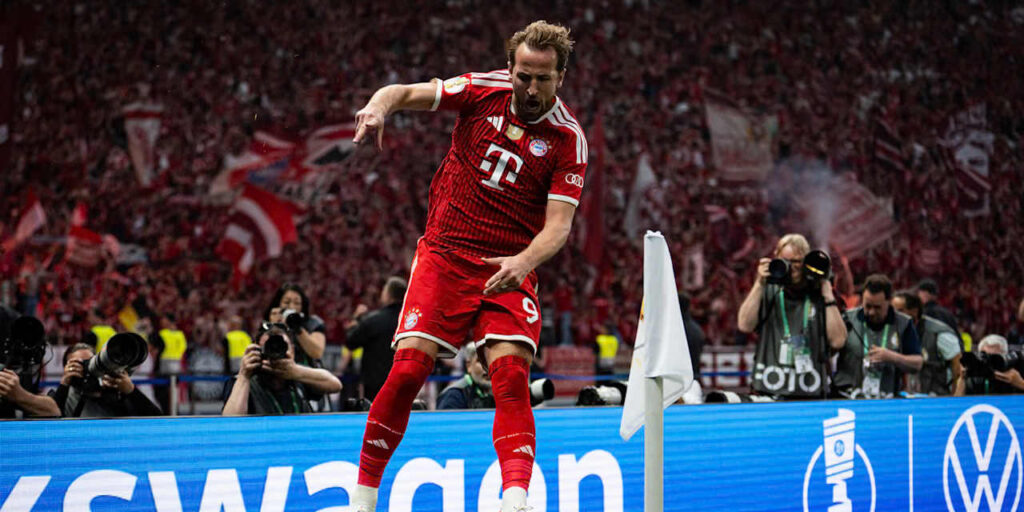
Kane’s Season Was Genuinely Absurd
Seventy three goal contributions in 65 games. Let that sit for a second. Fifty six goals and eight assists across the Bundesliga, Champions League and World Cup alone, with a further 11 goals in other competitions for Bayern and six more for England in qualifiers and friendlies. I have watched football long enough to know when a number is impressive and when a number is simply not normal, and this is the second category.
What separates Kane’s case from a pure stat padding exercise is that he apparently delivered in the moments that actually mattered. Six goals in five Champions League knockout games. A hat-trick in the German Cup final. Two brilliant goals to help England past DR Congo in the World Cup’s round of 32, then a goal and an assist against Mexico in the round after that. This was not a striker feasting on weaker opposition while going missing against the sides that count. This was, by most accounts, a genuinely dominant campaign sustained across an entire season.
The case against him, and it does exist, centres on his reported anonymity in England’s semi final defeat to Argentina and Bayern’s Champions League exit to Paris Saint-Germain despite a goal-filled tie. Those are fair criticisms in isolation. But Ballon d’Or voting has never demanded perfection across every single fixture, otherwise nobody would ever win it. The question is whether the body of work across a full season outweighs a couple of quiet nights on the biggest stages, and for Kane I think it clearly does.
The Case for Olise Is More Interesting Than It Looks
Michael Olise’s numbers genuinely stopped me in my tracks reading through this list. Excluding penalties, no player in Europe’s top five leagues produced more combined goals and assists across league, Champions League and World Cup football than Olise, including a reported seven assists at the World Cup itself, the most anyone has managed at a single tournament.
I think Olise’s case actually deserves more attention than it will probably get, purely because he is not the most famous name on this list and voters have a habit of defaulting to recognition over raw output. Twenty goals and 32 assists in 53 matches is an extraordinary season by any measure, and the reports of him being the best or second best player on the pitch for both Bayern and France in most matches this season suggests this was not simply a product of playing alongside superior talent. If anything, Kane and the rest of that Bayern front line owe a fair chunk of their own numbers to what Olise was creating.
Rodri’s World Cup Changes Everything About His Case
Rodri’s season is a fascinating one to assess because the raw minutes tell one story and the outcome tells a completely different one. He reportedly missed 11 of Manchester City’s first 17 Premier League matches this season while recovering from a long term ACL injury, hardly the platform most Ballon d’Or winners build their case from.
But then the World Cup happened, and by most accounts Rodri returned to something close to his pre-injury peak, controlling matches for a Spain side that went on to win the tournament, with Rodri himself picking up the Golden Ball as the competition’s outstanding player. That single month arguably outweighs the rest of his club season in the eyes of voters, and given how heavily the Ballon d’Or has historically rewarded major international tournament success, I would not be remotely surprised to see him finish inside the top three regardless of those early season absences.
Mbappe and Haaland: Brilliant, But Ultimately Behind
Kylian Mbappe scored 10 goals at the World Cup to win back to back Golden Boots and became the tournament’s all time leading scorer with 22 goals from 22 matches, a genuinely staggering piece of history. Add 40 goals in 42 appearances for Real Madrid across La Liga and the Champions League and you have another season of pure individual brilliance.
The problem for Mbappe’s case, as it has been for a couple of seasons now, is context. A second consecutive trophyless campaign at club level, reportedly played out amid managerial upheaval between Xabi Alonso and Alvaro Arbeloa, combined with France finishing fourth at the World Cup rather than winning it, makes his path to the actual trophy difficult regardless of how good he individually was.
Haaland’s numbers are similarly eye watering. Twenty seven Premier League goals, 47 total goal contributions in 52 club matches, and then a genuinely remarkable international campaign for Norway including 13 goals in seven qualifying and friendly matches, five of them in an 11-1 demolition of Moldova. He reportedly drove Norway to the World Cup quarter finals alongside Martin Odegaard, scoring seven goals from just 13 shots on target in the tournament itself. That is finishing of the highest possible calibre. But without major club silverware or a World Cup title to point to, I suspect voters will admire Haaland’s season more than they reward it.
The Wildcards Worth Watching
Khvicha Kvaratskhelia’s case is an unusual one built almost entirely around Champions League form rather than volume, given Georgia’s absence from the World Cup removed his biggest potential stage. Eighteen goals and 10 assists from just 2,623 minutes is efficient rather than eye catching on paper, but reports of him scoring twice and assisting once in PSG’s semi final against Bayern, then winning the penalty that levelled the final against Arsenal, suggest a player who delivered precisely when the stakes were highest. In a World Cup year, that kind of Champions League impact should not be dismissed lightly.
Lamine Yamal remains a teenager and still put up 22 goals and 15 assists in just 38 appearances despite reported injury interruptions from pubalgia and a hamstring problem. His World Cup itself was reportedly quieter than the hype around him suggested it might be, but the fact he is still a teenager producing numbers like this tells you everything about where his ceiling eventually sits.
And then there is Messi. Even acknowledging he is 39 and almost certainly no longer among the world’s ten best players week to week, his qualifying period numbers are still absurd on paper, a reported 78 goal contributions across club and country including a stretch of 17 goals and 19 assists in his final 16 MLS matches as Inter Miami won the title. Whether voters take MLS output as seriously as European football is a fair question, but as a farewell campaign in his final World Cup, there is a sentimental case here that should not be entirely dismissed either.
Why It Should Still Be Kane
Coming back to where I started, I think Kane wins this because his season combines everything voters are supposedly weighing, individual output, collective success and delivery on the biggest occasions, more completely than anyone else on this list. Olise arguably had the more elegant, more creative season. Rodri has the World Cup winner’s medal and individual tournament honour. But Kane’s sheer weight of goals, sustained across domestic football, Europe and international duty, sitting inside a Bayern side that reportedly scored 184 times in 55 matches this season, is difficult to look past.
There is also something to be said for a player who has spent his entire career being told he was not quite good enough for the very top individual honours, despite years of relentless goalscoring at Tottenham that somehow never translated into major trophies or serious Ballon d’Or contention. Whatever my own feelings about him as a Palace supporter who has suffered at his hands more times than I care to remember, football rewarding a genuinely once in a generation goalscorer for finally putting together the complete season, at a club actually winning things, would be difficult to argue with.
If not now, for Kane, when.