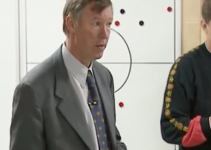
Most footballers leave the sport the same way. A statement goes out, a farewell lap is arranged, a tribute video plays on the big screen, and then the player disappears into punditry, coaching badges or a quiet life somewhere warm. Santi Cazorla has gone about retirement differently. Weeks after hanging up his boots, he was back on the streets outside the Carlos Tartiere, jumping up and down with the supporters, welcoming the Real Oviedo team bus ahead of the Asturian derby.
It is a short clip, and it will not win any awards for production value. But I think it explains something about football that no tactical analysis ever could, and it explains why Cazorla is one of the few players of his generation whose story feels complete.
What the Clip Shows
The footage is simple. It is derby day in Oviedo, and the fans have turned the streets around the stadium into a wall of noise, with scarves, chants and flares lighting the way for the bus carrying the squad. In the middle of it, Cazorla is not standing at the edge of the crowd with a polite wave. He is right in it, leaping, shouting and giving everything he has, a man who finished a 23 year career this July and has instantly become what he always was underneath, a supporter.
The detail that made me smile is that this is not new behaviour. During earlier derbies, while he was still a registered Oviedo player, he was spotted among the fans outside, getting carried away and banging on the glass of the team bus. He was meant to be on the bus. Instead he kept ending up on the other side of the window with the people who stand in the street for three hours to watch it go past. This time he simply did it from the right side of the barrier.
Watch here:
A Club That Nearly Disappeared
To understand why this moment carries weight, you need to know what Oviedo have been through. When Cazorla was a ballboy at the club, Oviedo were a top flight side. They were relegated in 2001, and then they kept falling. Financial trouble became severe enough that the club could not pay its players, and at one stage the city’s politicians were pushing for a winding up order and backing a replacement team started from scratch.
The fans refused to let it happen. Supporters rescued Oviedo from folding, and the club that came out the other side has been rebuilt on the back of that loyalty, with Mexican ownership under the Pachuca Group bringing stability that would have sounded like fantasy during the worst years. At one point the Asturian derby, one of the most passionate fixtures in Spanish football, was played against Sporting’s B team because Oviedo had dropped so far down the pyramid.
That is the backdrop to everything Cazorla does for this club. He did not arrive at Oviedo as a famous name chasing a final payday. He came home to a club he grew up around, at a point when it badly needed a figure the supporters could rally behind, and he stayed until the end.
The Career Behind the Celebrations
It is easy to forget how good he was, because the Oviedo chapter is so warm that it can overshadow everything else. Cazorla won the European Championship with Spain in 2008 and again in 2012, playing in the midfield of one of the finest international sides ever assembled. He then moved to Arsenal, where he spent six years as one of the most technically gifted players in the Premier League, left footed and right footed in equal measure, a player who could receive the ball in tight spaces under pressure and make it look ridiculously easy. He won two FA Cups with the Gunners.
Then came the injury that would have ended most careers. A serious problem with his Achilles tendon kept him out for around two years and required a long run of operations, and at one stage there were genuine fears he would never walk normally again, let alone play. He came back, rebuilt his game at Villarreal, spent time in Qatar, and eventually returned home to Oviedo, a player who had been written off more than once and kept refusing to go quietly.
I watched him play against sides like Palace through his Arsenal years, and the thing that struck me then was how calm he looked in situations where everyone around him was panicking. That calmness is why the scenes outside the Tartiere feel so different. This is a man famous for composure, and he is bouncing around in the street like a teenager.
Why It Matters More Than a Farewell Lap
Football likes grand gestures at the end of a career. Shirts are framed, banners are unfurled, and a stadium full of people stands to applaud. Those moments are genuine, and I would never dismiss them. But they are also organised, with microphones, cameras and a script.
What Cazorla did outside the Tartiere had no script. Nobody asked him to be there. He was not paid, not announced, and not obliged. He went because that is where a fan of Real Oviedo goes on derby day, and he has never stopped being one.
I think there is a real lesson in that for the modern game. We spend a lot of time lamenting how distant players feel from supporters, with their security teams, their agents and their private lives lived in gated worlds. Cazorla is proof that the gap is not inevitable. It exists when players choose to let it, and it closes the moment one of them decides to stand in the street with everybody else.
The Difference Between a Legend and a Mercenary
The word legend gets used far too loosely in football. Players earn it by winning trophies, and fair enough, Cazorla has plenty of those. But there is another version of the word, the one supporters use when they are talking about someone who understood what the club meant to them, and who never treated it as a stepping stone or a brand.
By that measure, Cazorla belongs to a smaller group than the trophy cabinet suggests. He grew up around Oviedo, left to build a career at the highest level, and came back when the club was still fighting to be taken seriously. He gave his final years to them, and then he kept turning up, long after anyone could ask him to.
The clip of him jumping outside the stadium will be forgotten by most people within a week. For the supporters who were standing next to him, I suspect it will last a good deal longer.