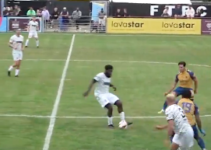
Most penalties take about five seconds. The player puts the ball down, takes a few steps back, runs up and hits it. In a Caribbean Cup semi-final, Mount Pleasant’s taker decided that was far too quick. He started his run-up from the edge of the area, took loads of steps, and made everyone wait. Then the goalkeeper saved it.
It is funny, it is a bit daft, and I think it also tells us something about how pressure works in football.
What the Clip Shows
This is the first leg of the Concacaf Caribbean Cup semi-final between Club Sando and Mount Pleasant at the Hasely Crawford Stadium in Port of Spain. The scoreboard reads 34:57, and Mount Pleasant are already 1-0 up. A second goal would have put them in a very strong position.
The ball is on the spot, and the goalkeeper is on his line. The taker walks back, and he keeps walking until he reaches the start of the D at the edge of the area. Then the run-up begins, and it is slow, deliberate and made up of loads of steps, as though he has all the time in the world.
Everyone else in the ground is waiting. The goalkeeper stands still. When the taker finally reaches the ball and strikes it, the goalkeeper saves it.
Watch here:
What the Rules Allow
My first question was whether he was allowed to do it, and the answer is yes. The Laws of the Game say nothing about the length of a run-up. A player can start as far back as he likes and take as many steps as he wants, as long as he is not obviously wasting time.
What the Laws do control is the end of the run. A taker can feint during the approach, which is why we have seen stutters, hops and pauses from players like Jorginho and Neymar. But once he has completed the run-up, he cannot feint to kick the ball. That is an offence for unsporting behaviour.
So a long, slow, step-by-step approach is completely legal. Whether it is wise is a different question.
Why Take a Slow Run-Up?
There is a logic to it. A goalkeeper has to stay on his line until the ball is struck, so he cannot move forward or start to guess early. A taker who draws out the run-up is trying to make him wait, and waiting makes goalkeepers nervous. The hope is that he twitches, shifts his weight or commits to a side before the kick.
It is a mind game, and when it works, the taker looks like a genius. He controls the tempo, and the goalkeeper is a spectator in his own penalty.
Why It Backfires
The trouble is that a mind game only works if you win it, and a slow run-up gives the goalkeeper plenty of time to win it himself.
A short run-up gives him almost nothing to read. A slow one gives him a film. He can watch the angle of the approach, the position of the hips and the glance at the corner, and every extra step gives him another clue.
It also creates a problem for the taker. The longer he takes, the longer he has to think, and the longer his nerves have to catch up with him. A penalty is already a pressure moment, and a slow run-up makes the pressure more visible. That is what happened here. All that time to think, and the goalkeeper used it better.
The Goalkeeper Wins the Mind Game
I want to give the goalkeeper his credit. Standing on your line while someone takes a leisurely stroll towards you is not easy. The temptation to fidget, to move early or to guess is enormous.
He did none of it. He stayed calm, he waited, and he made the save. In a sense, the taker did him a favour, because it gave him the time he needed to settle.
I have always thought penalties are cruel on goalkeepers, who are expected to be heroes and are almost always the fall guys. When one comes out on top after being made to wait, I think it deserves to be recognised.
Why This Save Mattered
It was a bigger moment than it looks. Mount Pleasant are the defending champions, and they are trying to become the first team to retain the Caribbean Cup. They arrived in Port of Spain as the only semi-finalist not making its tournament debut, and they had to go through a difficult group stage, opening with a loss and a draw.
Club Sando, by contrast, are in their first ever Caribbean Cup, and this is the first semi-final in the club’s history. Their coach Angus Eve is a good friend of Mount Pleasant boss Theodore Whitmore, the Jamaica hero of the 1998 World Cup, so there was plenty of respect and plenty of pride on both benches.
The stakes were high too. The winners of the semi-finals qualify for the 2027 Concacaf Champions Cup. And the away-goals rule is still in force in this competition. A second goal for Mount Pleasant in Trinidad would have been worth far more than a single goal in an ordinary match, because it would have given them a cushion to take back to Jamaica. The save kept Club Sando in the tie, with the second leg at Sabina Park in Kingston on 22 October.
A Lesson for Penalty Takers
If I had one piece of advice for anyone taking a penalty, it would be to keep it simple. Choose a corner, hit it hard and trust your technique. The best penalties are rarely the ones with the most theatre.
History remembers the showmen who score. Antonin Panenka’s chip in the 1976 European Championship final is a legend. History is much less kind to the ones who try something clever and fail.
My Verdict
I enjoyed it, and I would not want to ban it. Football would be poorer without the odd player who tries something different, and a slow run-up is harmless fun when it works.
But the best moment in the clip is the one at the end. After all the steps, all the waiting and all the tension, the goalkeeper stands up and saves it. The taker did everything to unsettle him, and the goalkeeper did everything right.
At Selhurst Park, the Holmesdale would have started counting his steps by the sixth. In Port of Spain, he took his time, and the goalkeeper used it better.