I need to tell you something about my dad before I tell you about the 1999 treble.
He is not a Manchester United fan. Never has been. He grew up in South London watching Crystal Palace with his father and he passed that particular burden on to me without apology. Manchester United were the club that won everything, the club that the rest of us measured ourselves against and found ourselves lacking, the club whose success was so relentless and so comprehensive that supporting anyone else sometimes felt like a voluntary exercise in futility.
And yet on the night of May 26 1999, my dad sat in our living room and watched Manchester United play Bayern Munich in the Champions League final at the Nou Camp and experienced something that had nothing to do with club allegiance and everything to do with what football is capable of producing when it decides to ignore the script.
He has told me about that night more than once. Not with the reverence he reserves for Keegan or the sadness he carries about Best. With something closer to disbelief. The disbelief of a man who watched something happen on a football pitch that should not have been possible and that fundamentally changed his understanding of what the sport could do.
I was not old enough to watch it live. I have seen the footage hundreds of times since. I know every second of injury time at the Nou Camp the way every football fan in this country knows it, frame by frame, goal by goal, the commentary burned into the memory even if the memory is borrowed rather than first hand.
But the story of the 1999 treble is not just the story of three minutes in Barcelona. It is the story of an entire season, the most remarkable season any English club has ever produced, that built toward those three minutes with a relentlessness and a refusal to accept defeat that makes the ending feel, in retrospect, not just dramatic but inevitable.
What the Treble Actually Meant
Before the 1998/99 season, no English club had ever won the treble. The Premier League, the FA Cup and the Champions League in a single season. Three competitions pursued simultaneously across nine months, each demanding excellence, each requiring squad depth and physical resilience and mental fortitude at a level that the English game had never previously produced.
The scale of the achievement needs to be understood before the individual components are examined because it is the combination that makes it extraordinary rather than any single element in isolation.
Winning the Premier League requires consistency across thirty eight games over nine months. Winning the FA Cup requires surviving six knockout rounds where a single bad performance eliminates you. Winning the Champions League requires beating the best clubs in Europe across a group stage and four knockout rounds in which the margins are so fine that a single mistake can end the campaign.
Doing all three simultaneously means playing over sixty competitive matches in a single season. It means managing injuries, suspensions, fatigue and form across three separate competitions with three separate demands. It means winning when you are tired, when key players are missing, when the schedule is so congested that recovery time between matches is measured in hours rather than days.
No English club had done it before 1999. Only Manchester City have done it since, in 2023. The rarity of the achievement tells you everything about its difficulty. The fact that United did it with the squad they had and in the manner they did it elevates it beyond difficulty into the realm of the genuinely historic.
The Premier League Title Race
The league campaign was defined by the rivalry with Arsenal that had become the central narrative of English football during the late 1990s.
Arsenal were defending champions, having won the Double the previous season under Arsene Wenger with football of a quality that had announced them as genuine long term challengers to United’s dominance. The expectation was that the 1998/99 title race would be another two horse contest between the two best teams in the country.
It was. And it went to the final day.
United’s league season was characterised by the quality that defined Ferguson’s great teams. The ability to win matches they were not playing well in. The capacity to find a goal when the game was drifting away from them. The mentality of a squad that genuinely believed, at a collective level that went beyond individual talent, that they would not be beaten.
The margins were extraordinary. United finished on seventy nine points. Arsenal finished on seventy eight. A single point across thirty eight games. The title decided by the accumulated weight of individual moments across nine months, each one contributing to a margin so fine that the removal of any single result would have changed the outcome.
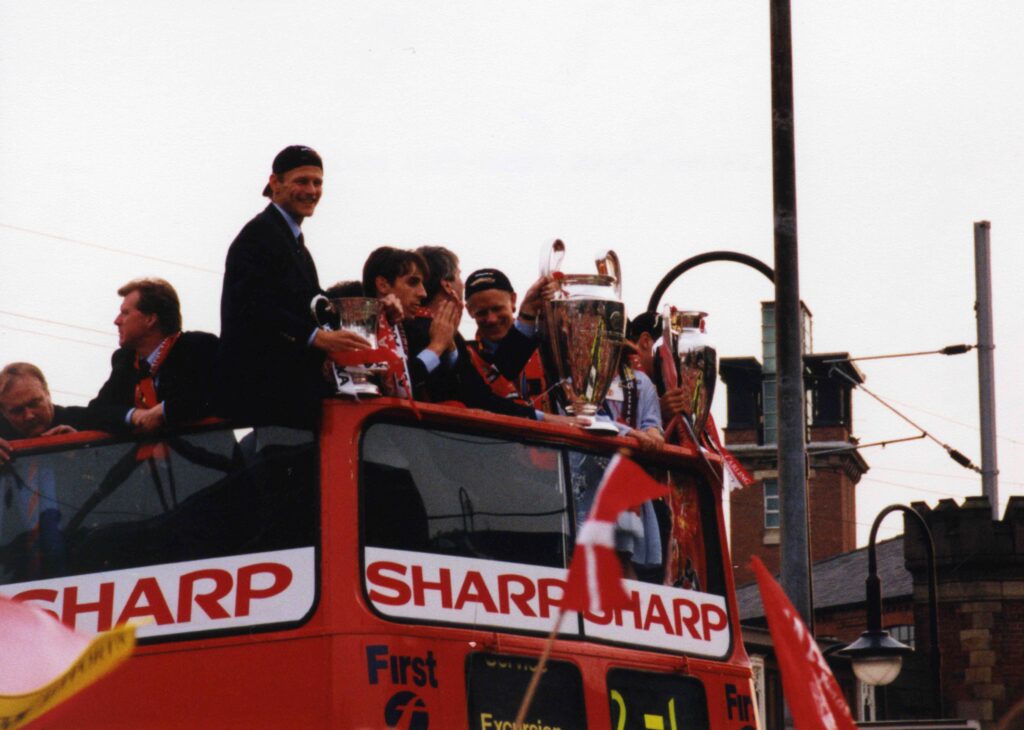
The Premiership trophy was secured on the final day of the season with a 2-1 win at Old Trafford. The first piece of the treble was in place. The FA Cup final was four days away. The Champions League final was ten days after that.
The FA Cup and the Goal That Defied Belief
The FA Cup run produced the single most iconic individual moment of the entire treble season and it did not happen in the final.
The semi final replay against Arsenal at Villa Park on April 14 1999 was the match that the treble could have died in. Arsenal were brilliant. United were under pressure. The match went to extra time with the score level and the exhaustion of a squad pursuing three trophies simultaneously becoming visibly apparent.
And then Ryan Giggs received the ball in his own half.
What followed is one of the greatest individual goals in the history of football, not just the FA Cup, and it needs to be described properly because the footage alone does not fully communicate what happened.
Giggs picked the ball up inside his own half. He ran. Past one Arsenal defender. Then another. Then another. Then another. Through the entire Arsenal defence, past players who were trying to stop him and could not get close, the ball at his feet and his legs carrying him forward with a pace and a determination that looked almost angry in its intensity.
He reached the edge of the penalty area. He shot. The ball flew past David Seaman and into the roof of the net. Giggs ripped his shirt off and swung it above his head as he ran toward the corner flag with his chest hair exposed and his teammates chasing him in a celebration so wild and so completely uninhibited that it has become one of the defining images of the Premier League era.
Patrick Vieira had been sent off earlier in the match. Peter Schmeichel had saved a Dennis Bergkamp penalty. The match had contained enough drama for an entire season before Giggs decided to end it with the most extraordinary piece of individual brilliance the FA Cup has ever seen.
The final against Newcastle was almost an anticlimax by comparison. United won 2-0 with goals from Teddy Sheringham and Paul Scholes in a performance of controlled authority that reflected the confidence of a squad that knew it was doing something historic.
Two trophies. One to go. Barcelona was waiting.
The Road to the Nou Camp
The Champions League campaign that preceded the final was itself so dramatic that it could sustain an entire article without ever reaching the Nou Camp.
The group stage nearly ended the treble before it began. United needed a result in their final group match against Bayern Munich, the same opponents they would meet in the final, to progress. They drew 1-1. The margin between elimination and continuation was a single goal.
The quarter final against Inter Milan was won over two legs with a performance in the second leg at Old Trafford that demonstrated the squad’s ability to produce their best football when the stakes were highest. United won 2-0 to progress 3-1 on aggregate against an Inter side containing Ronaldo.
And then came Juventus.
The semi final against Juventus in Turin on April 21 1999 is, by the assessment of many people who were there and many more who watched it, the greatest single performance by an English club in European competition.
United went behind after eleven minutes. Juventus, playing at home, with a squad containing Zidane, Davids, Inzaghi and Del Piero, were in complete control. The treble was dying in the Stadio delle Alpi.
Roy Keane headed United level after twenty four minutes. The goal itself was important. What Keane did for the remaining sixty six minutes was something else entirely. He had been booked in the first half. The yellow card meant he was suspended for the final. He knew, from the moment the card was shown, that he was playing to send his teammates to a final he would not be part of.
What followed was the defining captaincy performance in English football history. Keane drove United forward through sheer force of will and competitive fury, winning every battle in midfield, demanding more from every player around him, refusing to accept that the situation was beyond them. Dwight Yorke and Andy Cole scored to give United a 3-2 victory on the night and a place in the final.
Keane walked off the pitch in Turin knowing he had produced the greatest performance of his career in a match he had nothing personal to gain from beyond the knowledge that he had given everything for his teammates. Ferguson later described it as the most stirring individual display he had witnessed in his years as a manager.
Keane would not play in the final. Neither would Paul Scholes, also suspended. The two absences meant that United would face Bayern Munich at the Nou Camp without their captain and one of their most important midfielders.
Three Minutes at the Nou Camp
May 26 1999. The Champions League final. Manchester United versus Bayern Munich at the Nou Camp in Barcelona.
Bayern scored after six minutes through Mario Basler’s free kick. The ball went through the United wall and past Peter Schmeichel, who was playing the final match of his career.
For the next eighty four minutes United chased the game. They created chances. They hit the woodwork. They dominated possession in periods. But the ball would not go in. Bayern defended with the discipline and the organisation that German football is built on. The clock ran down. The minutes disappeared. The treble was slipping away.
By the time the fourth official held up the board showing three minutes of injury time, the narrative appeared to have been written. Bayern were champions. United’s extraordinary season was going to end in defeat at the final hurdle. The commentator, Clive Tyldesley, prepared the audience for the Bayern celebrations. Alex Ferguson stood on the touchline with the expression of a man watching something he could not control and could not change.
Ninety minutes and thirty six seconds. United won a corner. David Beckham swung it in. The ball reached Sheringham at the far post. He poked it into the net. One all.
The Nou Camp erupted. Not the Bayern end. The United end and the neutral sections and the press box and everyone who was watching at home and who had resigned themselves to defeat and suddenly found themselves dragged back from the edge by a goal that arrived at the last possible moment.
The celebrations were barely complete before United kicked off again. Seconds later another corner. Beckham again. The ball came in. Sheringham headed it across goal. Ole Gunnar Solskjaer stuck out his right foot and stabbed it into the roof of the net.
Ninety two minutes and seventeen seconds. Manchester United 2 Bayern Munich 1.
Tyldesley’s commentary has become as famous as the goals themselves. And Solskjaer has won it. The words delivered with a disbelief that matched the disbelief of everyone watching. The impossibility of what had just happened, two goals in injury time to turn a Champions League final from defeat to victory, from heartbreak to history, produced a reaction that went beyond the normal emotional range of a football match and into something that people who experienced it have never fully recovered from.
Schmeichel, in his last ever game, fell to his knees. Ferguson stood on the touchline looking like a man who had seen something he could not explain. The United players piled on top of Solskjaer in a celebration so delirious and so completely unhinged that it looked like a group of people who had collectively lost their minds.
They had not lost their minds. They had won the treble. The Premier League, the FA Cup and the Champions League in a single season. The first English club to achieve it. Done in the most dramatic circumstances the sport has ever produced in a single match.
What Would Have Been Sir Matt Busby’s Birthday
There is a detail about the date of the Champions League final that deserves mention because it adds a layer of meaning that could not have been scripted.
May 26 1999 was what would have been Sir Matt Busby’s ninetieth birthday. The man who built Manchester United, who survived the Munich air disaster in 1958 that killed eight of his players and nearly killed him, who rebuilt the club from that tragedy and led them to the European Cup in 1968, would have turned ninety on the day his club completed the treble.
Busby had died in 1994. He was not there to see it. But the symmetry of the date, the fact that United won the biggest trophy in European football on the birthday of the man who had first taken them into European competition and whose vision for the club had survived a plane crash and thirty years of history, gives the achievement a resonance that goes beyond sport.
Ferguson was conscious of it. The players were conscious of it. The United supporters in the Nou Camp singing Busby’s name after the final whistle were conscious of it. The treble was not just a sporting achievement. It was the fulfilment of something that had been started decades earlier by a man who believed Manchester United belonged at the top of European football and who paid an unimaginable personal price for that belief.
Why Nothing Will Ever Top It
I have watched the footage of those three minutes at the Nou Camp more times than I can count. I am a Crystal Palace fan. I have no emotional connection to Manchester United. And yet every time I watch Sheringham equalise and Solskjaer score the winner I feel the same thing.
Not joy for United. Something bigger than club allegiance. The recognition that football, at its absolute peak, is capable of producing moments that defy every rational expectation and every logical prediction and every piece of evidence that the preceding ninety minutes have provided.
United were losing. The treble was gone. The season was ending in defeat. Everything pointed to Bayern lifting the trophy. And in the space of two minutes and forty one seconds the entire story was rewritten.
The 1999 treble is the greatest achievement in English football history. The Premier League title won by a single point. The FA Cup won with Giggs producing the greatest individual goal the competition has ever seen. The Champions League won with two goals in injury time in the final after trailing for eighty four minutes.
Three trophies. Sixty three matches. A squad that refused to accept defeat at every single point across nine months of the most demanding campaign any English club has ever undertaken.
My dad is not a Manchester United fan. He watched the final in our living room in South London with no personal stake in the result. He still talks about those three minutes with the expression of someone who is not entirely sure what they witnessed was real.
I understand. Some things in football go beyond rivalry and allegiance and into the territory of pure, undeniable, completely irrational sporting miracle.
The Nou Camp on May 26 1999 was one of those things. The greatest night in English club football. The night that proved, beyond any argument, that in this sport it is never over.
Not even when it is.