
I want to tell you something about Selhurst Park that you only really understand if you grew up near it.
It is not the biggest ground. It is not the most modern. The away end is famously uncomfortable and the sight lines in certain parts of the ground have been generously described as characterful by people trying to be kind. On a cold Tuesday night in January with the rain coming sideways off the South London streets it can feel like the most exposed place on earth.
And I have loved every single second I have ever spent inside it.
My dad took me to my first game at Selhurst when I was seven years old. I could not tell you who Palace played or what the score was. What I remember is the noise when we came up the steps from the concourse and the pitch appeared in front of me for the first time. The green of the grass under the floodlights. The red and blue of the shirts. The sound of twenty thousand people doing something together that felt enormous and communal and completely unlike anything else I had ever experienced.
I did not choose Crystal Palace. Nobody who grows up in South London really chooses. The club chooses you. It is in the streets and the accents and the conversations in the corner shops and the pub on a match day. My dad went because his dad went. I went because my dad went. That is how it works in football and that is how it worked for me.
What I did not know, standing on the terraces as a seven year old holding my dad’s hand while the noise washed over me, was that I was signing up for decades of lower mid table mediocrity, survival battles, managers who promised something different and delivered something familiar, and the particular kind of hope that Crystal Palace fans develop over years of experience.
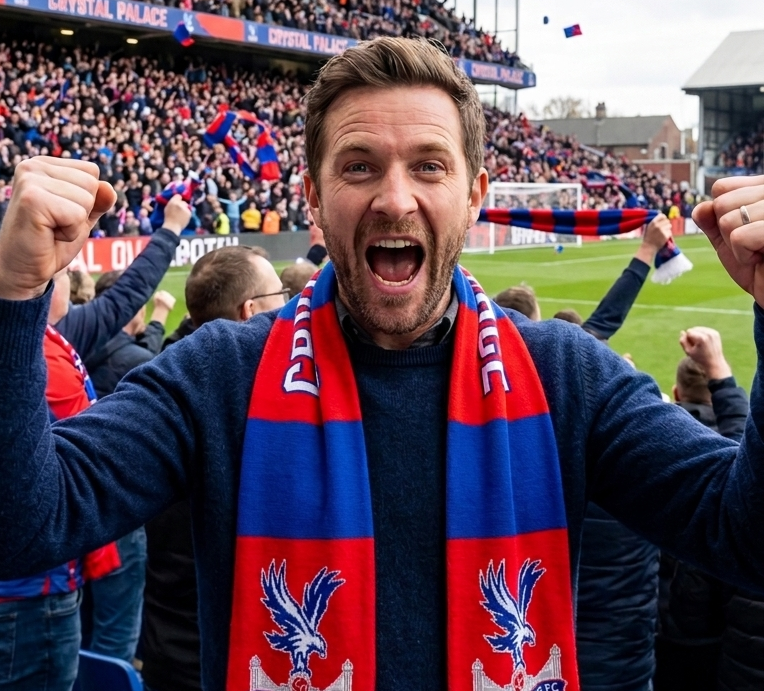
Not optimism exactly. More a quiet, stubborn refusal to stop believing even when the evidence strongly suggests you probably should.
And then came this season. And Florence. And everything changed.
How We Got Here
Oliver Glasner arrived at Crystal Palace in February 2024 and immediately felt different to what had come before. Not in a loud or demonstrative way. Glasner is not a manager who fills press conferences with grand promises or builds narratives around himself. He is quiet, precise, genuinely intelligent about football in a way that comes through in how his teams play rather than what he says about them.
What he did to Palace in the second half of that first season was remarkable. A club that had been drifting, that had lost its identity and its energy, suddenly had both back. The players looked like they wanted to be there. The football had a purpose and a tempo that Selhurst Park responded to immediately.
This season he went further. Palace started playing with a freedom and a confidence that I had not seen from them in years. Michael Olise leaving for Bayern Munich in the summer felt like a body blow and I am not going to pretend it did not. He was the most exciting Crystal Palace player I had watched in a long time and watching him go was painful in the way that losing a player you genuinely love always is.
But Glasner rebuilt. Eberechi Eze stepped into the creative responsibility with a maturity that surprised even those of us who had watched him develop over several seasons. Jean Philippe Mateta became one of the most dangerous centre forwards in the Premier League. The defensive structure became genuinely difficult to break down.
And then came the Europa League. A competition that Palace approached without expectation and without the weight of history that clubs with European pedigree carry into every game. They were free in a way that only a club playing without fear can be free. And they used that freedom magnificently.
The Florence Night
I have to be honest with you about where I was when Palace confirmed their place in the Europa League semi finals against Fiorentina.
I was in my living room. Alone. And I cried.
Not dramatically, not for long, but genuinely and without embarrassment because what had just happened on a football pitch in Florence was something I had absolutely no framework for processing. Crystal Palace. A European semi final. Those two phrases have never belonged in the same sentence in my lifetime and the collision of them produced an emotion I genuinely did not see coming.
I thought about my dad immediately. About the first game he took me to at Selhurst. About all the Tuesday nights and wet Saturday afternoons and moments of crushing disappointment that sat between that first game and this one. About what he would have said watching Palace’s players pouring out onto the streets of Florence at Glasner’s invitation, celebrating with the supporters who had made the trip, singing and laughing in the Tuscan night air.
He would have shaken his head slowly. The way he always did when Palace did something he had not allowed himself to expect. And then he would have smiled the smile of someone who had been going to Selhurst Park long enough to know that moments like this do not come around often and need to be held carefully when they do.
The images from Florence were extraordinary. Crystal Palace players, our players, wandering through one of the most beautiful cities in Europe with their manager’s blessing, soaking in something that none of them had ever experienced before at this club. Oliver Glasner standing there watching them with what looked like genuine pride. Not pride in a result or a performance but pride in people. In what they had built together.
I have watched a lot of football in my life. I have seen a lot of celebrated moments from clubs with histories full of them. I am not sure I have ever seen a set of players celebrate a result with quite that combination of disbelief and pure joy. Because they knew, the same way every Palace fan watching knew, that this was not supposed to happen to us.
What This Means for Crystal Palace
Context matters here and I want to give it properly because the magnitude of what Glasner has achieved only makes sense if you understand what Crystal Palace actually is as a football club.
Palace are not a glamour club. They do not have the financial muscle of the top six, do not have a global fanbase, do not have a history littered with trophies and legendary players. What they have is a community, a ground that sits in the heart of South London, and a supporter base that has given the club fierce and unconditional loyalty through periods that tested that loyalty severely.
They spent time in the Championship not so long ago. Their Premier League survival has been the primary ambition in more seasons than fans would care to count. The club has consistently lost its best players to wealthier rivals and rebuilt with less, relying on smart recruitment and good coaching to compete in a division that spends more money every season.

A European semi final does not just represent a result. It represents a shift in what Crystal Palace can credibly claim to be. Clubs that reach European semi finals attract better players, better coaches, better investment. The trajectory of the club beyond this season looks fundamentally different because of what has happened in the Europa League this year.
Glasner has not just won matches. He has changed the ceiling of what Crystal Palace can aspire to. And for a club that has spent so long simply trying to stay in the Premier League, that change in ceiling is worth more than any individual result.
The Dream
I am going to say something now that Crystal Palace fans will understand and non Palace fans will probably find disproportionate.
I think we can win it.
I know. I know. The rational part of my brain, the journalist part, the part that has watched enough football to understand the difference between hope and probability, is raising its hand and asking me to be sensible.
I am not being sensible right now. I am being a Crystal Palace fan who went to Selhurst Park as a seven year old with his dad and has never really stopped being that seven year old when it comes to this football club.
The Europa League semi final is two legs against opponents that Palace have every right to face without fear. Glasner has built a side that is tactically flexible, physically imposing and mentally strong in ways that were not obvious at the start of the season. Eze is in the form of his life. Mateta is a handful for any defence in Europe. The team believe in what they are doing in a way that is visible from the stands.
Could it happen? Could Crystal Palace Football Club, the club my dad took me to see for the first time when I was seven years old on a street in South London, lift a European trophy?
I am not saying it will. I am saying I cannot rule it out. And the fact that I cannot rule it out is already the most extraordinary thing that has happened to me as a football supporter in my entire life.
Whatever Happens Next
Here is what I know for certain regardless of what the semi final and whatever might follow it produces.
This is already the greatest season in Crystal Palace’s history. Full stop, no argument, not even close. A European semi final is something that no previous Palace side has achieved and something that the majority of Premier League clubs will never achieve regardless of how long they exist.
Glasner has built something real at Selhurst Park. The players have delivered performances that will be talked about by Palace fans for decades. The supporters who travelled to Florence and watched their team celebrate in the streets of one of Europe’s most beautiful cities have a memory that no result can take away from them.
And somewhere, a seven year old in South London is going to their first game at Selhurst Park this season, holding their dad’s hand, looking up at the floodlights and the red and blue shirts and feeling something they do not yet have the words for.
They are going to be a Crystal Palace fan for the rest of their life. They have no idea how lucky they are to be starting right now.
Come on you Eagles.