There is a specific type of football tragedy that goes beyond a bad season or a poor run of results. The kind that unfolds over years, that involves decisions compounding on decisions, that takes a club from the summit of the game to a place so far below it that the distance becomes almost impossible to comprehend.
Leeds United is that tragedy. The definitive version of it. The one that every other club’s boardroom should be forced to study before making any significant financial or footballing decision, not as entertainment but as a warning.
I grew up hearing about Leeds United the way you hear about something that ended badly. The stories arrived pre-loaded with consequence, the brilliance always accompanied by the knowledge of what came after. The great Revie side. The Clough disaster. The O’Leary years and the Champions League nights that preceded the collapse. The debt, the relegation, the League One years that nobody who cared about football wanted to believe were actually happening.
It is the greatest cautionary tale English football has ever produced. And it is still being written.
The Revie Foundation
Don Revie arrived at Leeds United as manager in 1961 and inherited a club that was struggling in the Second Division with a crumbling ground, limited finances and no particular reason to expect anything other than continued mediocrity.
What he built over the following thirteen years was one of the most formidable football operations in the history of English football. Leeds under Revie won two First Division titles, an FA Cup, a League Cup and two Inter-Cities Fairs Cups. They reached the European Cup final in 1975, losing controversially to Bayern Munich in a match that remains one of the most disputed results in European football history. They were finalists in European competitions on multiple occasions and were, for a sustained period through the late 1960s and early 1970s, the most physically and tactically intimidating side in England.
The players Revie assembled and developed were extraordinary. Billy Bremner, combative and brilliant and utterly relentless in his commitment. Johnny Giles, one of the most complete midfielders the English game has ever produced. Jack Charlton, the World Cup winner who became a defensive colossus at Elland Road. Peter Lorimer, Eddie Gray, Norman Hunter, Allan Clarke. A squad of genuine quality and genuine hardness in equal measure.
The culture Revie created was tight, insular and deeply loyal. The players were his. They had been built by him, shaped by him, and their identity as footballers was inseparable from what he had made them. That culture was the source of their greatness and, when Revie left for the England job in 1974, it became the source of the first great catastrophe.
Forty Four Days and the Clough Disaster
The decision to appoint Brian Clough as Revie’s replacement at Leeds United was, as I have written elsewhere, the most obviously wrong appointment in football management history. A dressing room of players built entirely in one man’s image, fiercely loyal to that man and deeply suspicious of anyone who was not him, handed to a manager whose entire philosophy was the antithesis of everything Revie represented.
Clough walked into that dressing room and told the players they could throw their medals in the bin because they had won them by cheating. He was not entirely wrong about the methods that had sometimes accompanied Leeds’s success. He was catastrophically wrong about the approach of saying so to the players themselves on his first day in the building.
The dressing room turned against him before a competitive game had been played. The players who had won titles and European trophies under Revie had no interest in being dismantled and rebuilt by a man they had not chosen and did not trust. Bremner and Giles, the heartbeat of the squad, were openly hostile. The atmosphere became impossible within weeks.
Forty four days after his appointment, Clough was gone. Dismissed with a compensation package and a humiliation that no amount of subsequent success at Nottingham Forest could entirely erase from the public memory of his career.
Leeds never properly recovered from the disruption. The great Revie side was aging and the structure that had sustained it was fractured. Through the late 1970s and into the 1980s the club declined steadily, dropping out of the First Division in 1982 and spending years in the second tier while the world moved on without them.
Wilkinson and the Last Title
Howard Wilkinson arrived at Leeds in 1988 and did something that required both intelligence and courage. He did not try to recreate the Revie era. He built something new, with different players and a different philosophy, accepting that the past was the past and that the only way forward was to start again properly.
It worked. Leeds won promotion to the First Division in 1990 and two years later, in 1992, they won the league title. The last First Division championship before the Premier League era began, won with a squad that included Gordon Strachan, Gary Speed, Lee Chapman and a young Eric Cantona who would, within months, be sold to Manchester United in the transfer that haunts Leeds supporters to this day.
The 1992 title should have been the foundation for a sustained return to the top of English football. Instead it became a high point that was not revisited for nearly three decades. Cantona went to United and immediately helped them to multiple titles. Leeds continued under Wilkinson for another three years without ever threatening to replicate the title winning season, and he was eventually replaced as the club searched for a new direction.
The new direction, when it arrived, was the most intoxicating and ultimately the most destructive period in the club’s modern history.
O’Leary, the Champions League and the Dream
David O’Leary took over as manager in 1998 and built something at Leeds that a generation of supporters still speak about with the combination of pride and grief that only comes from having witnessed something genuinely special that ended in the worst possible way.
The squad O’Leary assembled was young, gifted and playing football of a quality that announced Leeds as genuine contenders not just domestically but in Europe. Harry Kewell, the Australian winger with the ability to change a game in a moment. Mark Viduka, the powerful, technically gifted centre forward who made defending against him an exhausting and largely unsuccessful exercise. Alan Smith, the young English striker whose commitment and aggression made him a fans favourite from the moment he arrived. Rio Ferdinand, who was developing into one of the best centre backs in Europe before he was sold to fund the mounting debts.
And then there were the Champions League nights.
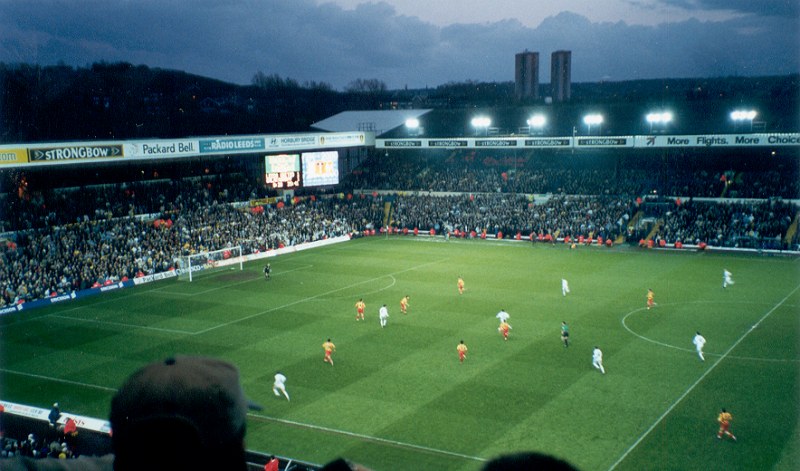
The 2000/01 Champions League campaign took Leeds to the semi finals, further than any English club had gone in years. Victories over AC Milan, Lazio and Deportivo La Coruna along the way. Elland Road packed and deafening for European nights that gave the supporters a taste of the kind of football they had been promised since the Revie era. The semi final against Valencia was lost but the achievement was real and the belief that this was the beginning of something sustained was entirely understandable.
It was not the beginning of something sustained. It was the peak before the cliff edge.
The financial model that had funded O’Leary’s squad was built on the assumption that Champions League football would continue indefinitely. The television money, the gate receipts, the commercial revenue from sustained European participation were all factored into financial projections that left no margin for the possibility of failure.
When Leeds failed to qualify for the Champions League the following season, the projections became fiction and the debt became a crisis.
The Fall and How Far It Went
What happened to Leeds United between 2002 and 2007 is one of the most dramatic financial and footballing collapses English football has ever witnessed.
The players who had built the Champions League run were sold, one by one, to service debts that kept growing regardless of what was sold to address them. Ferdinand went to United for £30 million. Kewell went to Liverpool. Viduka went to Middlesbrough. Robbie Fowler, Olivier Dacourt, Lee Bowyer, Jonathan Woodgate, all moved on as the financial reality of what the club had built on borrowed money became undeniable.
O’Leary was replaced by Terry Venables, then Peter Reid, then Eddie Gray in a caretaker capacity, then Kevin Blackwell. The quality of the squad diminished with each departure and each failure to adequately replace what was lost. The Premier League position that had seemed secure became precarious and then untenable.
Leeds were relegated from the Premier League in 2004. The wounds were deep but the Championship felt, at least initially, like a temporary setback rather than the beginning of something worse.
It was the beginning of something worse.
The financial problems continued to compound. Administration followed in 2007. And with administration came a fifteen point deduction that dragged the club toward a relegation to League One that felt, when it finally happened, like something that should not be possible for a club of Leeds United’s history and stature.
League One. The third tier of English football. A club that had been in the Champions League semi finals six years earlier, that had won league titles and FA Cups and competed in European finals, was playing against clubs that most people outside their immediate regions had barely heard of.
I remember watching the news of the League One relegation being confirmed and feeling something that I can only describe as the football equivalent of vertigo. The distance from where Leeds had been to where they now were was so vast that the brain struggled to process it as a linear journey rather than two entirely separate realities existing in different universes.
The supporters who had filled Elland Road for European nights against Milan and Lazio were now watching their club at grounds that those same players would never have visited in their professional careers. The loyalty those supporters showed during those years deserves acknowledgement that it rarely receives. They kept going. They kept filling Elland Road as well as it could be filled given the circumstances. They kept believing that the journey back was possible even when the evidence was limited.
Bielsa and the Resurrection
The return to the Premier League was a long time coming. Leeds spent years in the Championship under various managers, occasionally threatening promotion before falling short, building and rebuilding squads without ever quite finding the combination that could sustain a promotion challenge over a full season.
Then in 2018 Marcelo Bielsa arrived. And everything changed.
The Argentine is one of the most singular figures in world football management, a coaching philosopher whose influence on the game stretches far beyond his own managerial record and who counts Pep Guardiola and Mauricio Pochettino among the coaches who cite him as their primary intellectual influence. He is obsessive, meticulous, physically demanding of his players and completely uncompromising in his pursuit of a specific vision of how football should be played.
What he did to Leeds in two years was extraordinary. He transformed not just the team but the culture, the training methods, the physical conditioning and the collective belief of a squad that had been performing below its potential for years. The football Leeds played under Bielsa was intense, direct, physically exhausting to play against and genuinely exciting to watch.
In 2020, two years after his arrival, Leeds United were promoted to the Premier League as Championship champions. The scenes at Elland Road when promotion was confirmed were among the most emotional I have ever seen from a football fanbase. Supporters who had been through the debts and the administration and the League One years and the long Championship exile finally watching their club return to the top flight after sixteen years away.
Bielsa’s first Premier League season produced a ninth place finish that was received at Elland Road with the kind of joy usually reserved for a title win. The football was brilliant and exhausting and completely recognisable as Bielsa’s creation, his players running further and pressing harder than almost any other side in the division.
The subsequent seasons have been more turbulent. Bielsa was eventually replaced, the Premier League proved a difficult environment to sustain his methods over multiple campaigns, and Leeds have continued to experience the kind of instability that seems to follow the club regardless of the era or the circumstances.
The Warning That Football Never Heeds
The story of Leeds United should be required reading for every football club chairman, every chief executive, every owner who is tempted to gamble on future success to fund present ambition.
The financial model that built the O’Leary era was not reckless by accident. It was reckless by design, a deliberate decision to borrow against a future that was assumed rather than secured. The assumption that Champions League football would continue, that the revenue projections would be met, that the investment in players would generate returns that justified the debt, was not unreasonable given the trajectory of the club in 2001.
What it lacked was any acknowledgment of risk. Any recognition that football does not guarantee outcomes regardless of investment, that the gap between a Champions League semi final and a group stage exit is smaller than the financial models assumed, that a single bad season can trigger a cascade that takes a decade to recover from.
Leeds United fell further and faster than almost anyone believed was possible because the structure beneath them was not built to withstand failure. When failure arrived, as it always eventually does in football, there was nothing to catch them.
The club is still finding its way back to the level it occupied before the fall. The Premier League years under Bielsa felt like genuine progress. The subsequent seasons have felt more uncertain. Whether Leeds can build the kind of sustained, financially stable top flight presence that their supporters deserve remains an open question.
What is not an open question is the lesson their story teaches. In football, ambition without foundation is not vision. It is a countdown.
Leeds United counted down faster than most. And the game has never produced a more complete illustration of how far and how fast a club can fall when the foundations give way.