
Somewhere in the build up to the 2026 World Cup, every one of the 1,248 players selected in the forty eight squad lists walked into a scanning chamber during their pre-tournament photo shoot.
One second. That is all it took.
In that one second a hyper realistic three dimensional digital avatar of their entire body was created. Every limb length. Every body dimension. Every physical proportion captured with a precision that no camera system operating in real time during a football match could previously achieve. Erling Haaland’s avatar has his exact arm length. Kylian Mbappe’s avatar has his precise shoulder width. Every player at this World Cup exists in the system not as a generic approximation of a human body but as an accurate digital replica of their specific physical dimensions.
Those avatars are now incorporated into a semi automated offside technology system that can detect an offside position of as little as ten centimetres and deliver the decision directly to the assistant referee’s earpiece in real time, bypassing VAR entirely for positional offside calls and allowing the flag to go up faster than any previous system has managed.
I want to be clear about something before we go any further. As a piece of technology, this is genuinely extraordinary. The engineering involved, the data processing, the real time synthesis of ball sensor information and body tracking and individual avatar dimensions into a decision delivered to a human being’s ear within seconds, is remarkable by any measure.
The question I cannot stop asking is whether any of it actually fixes the problem it is designed to address. And the honest answer is more complicated than the press releases suggest.
What the Technology Actually Does
Let me explain the system properly because the way it works is genuinely fascinating and deserves more than a headline.
Players at the World Cup will be digitally scanned to create a precise 3D model. Each scan takes approximately one second and captures what FIFA describes as highly accurate body part dimensions, allowing the system to track players reliably during fast or obstructed movements.
Those models are then integrated with the tracking infrastructure inside each World Cup stadium. The tournament will utilise sixteen optical tracking cameras in each stadium, generating more than 150 million tracking data points per match. One hundred and fifty million data points. Per match. The system knows where every player is, where every part of every player is, and where the ball is, at every moment throughout the ninety minutes.
The ball itself is contributing to the precision. Each player’s avatar is synced with the Trionda’s 500Hz sensor and stadium wide tracking cameras. When a VAR decision is made, the system generates a life-like 3D reconstruction of the play. By pinpointing the exact kick point from the ball’s sensor and combining it with the precise limb positions of the 3D avatars, the system can determine offside positions in seconds rather than minutes.
The result is a system that knows, with a precision that was simply not available at any previous World Cup, exactly where the ball left the kicker’s foot and exactly where every relevant body part of every relevant player was at that precise moment. The offside decision flows from that data almost instantaneously.
Clear offsides will now be sent directly to the match officials on the pitch rather than routing through VAR first. So that means instantly the assistant referees can flag for positional offsides, allowing a much quicker decision.
Faster, more precise, based on individual body data rather than generic approximations. On the technology’s own terms, it is a significant step forward.
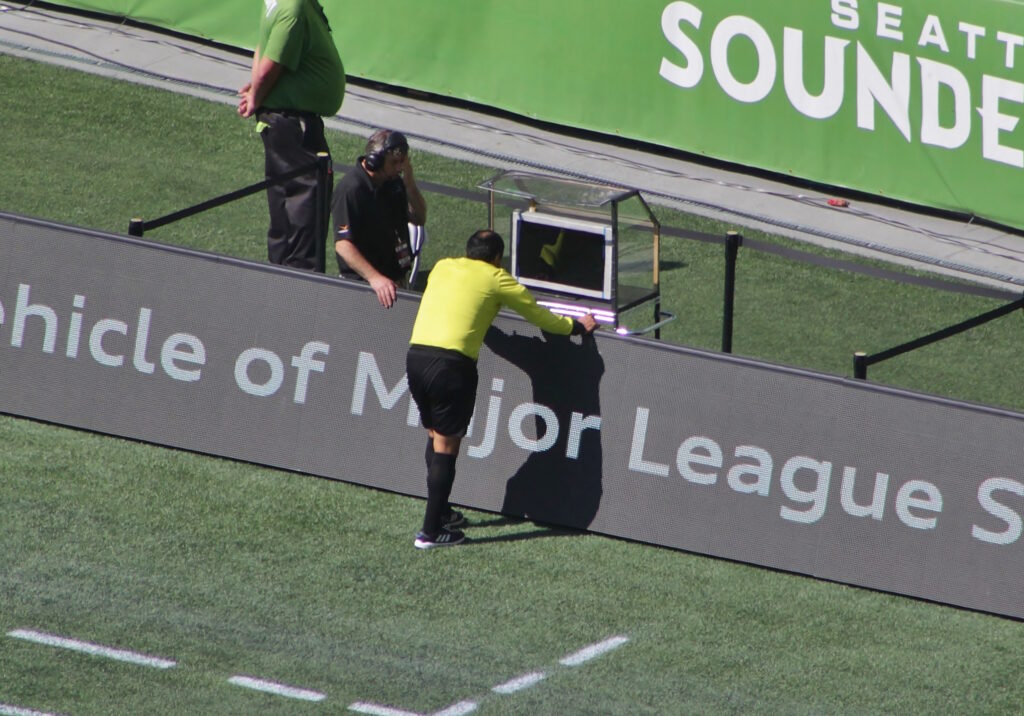
How It Improves on What Came Before
The semi automated offside technology used at the 2022 World Cup in Qatar was the first version of this system and it was, by the standards of what preceded it, already a significant improvement on traditional VAR offside reviews.
But it had limitations that the new system directly addresses. The previous system only alerted officials if a player was more than 50cm offside. However in its revamped version it can now help deliver more accurate decisions by signalling when a player is more than 10cm offside. Officials will receive a real time audio alert directly to their earpiece rather than having to wait for VAR to communicate it to them.
The 50cm threshold in the Qatar system was a practical acknowledgement of the previous technology’s limitations. If the system could not reliably distinguish between a player who was 30cm offside and a player who was onside, applying a 50cm minimum threshold reduced the risk of incorrect calls based on imprecise data. It was a sensible workaround for a technology that was not yet precise enough to be trusted at lower margins.
The individual body scanning changes that calculation. Every participating player at the FIFA World Cup 2026 will be 3D scanned with their images and digital avatars incorporated into the semi automated offside technology system to further enhance accuracy. With player specific body dimensions built into the system rather than generic human proportions applied uniformly, the margin for error in determining where a specific limb actually is at the moment of the kick is significantly reduced.
Ten centimetres rather than fifty. Five times more precise. And delivered directly to the assistant referee’s ear rather than routed through a VAR review process that added delay even when the decision itself was straightforward.
For the basic mechanics of offside detection, this is unambiguously better than what existed before. Faster decisions mean play is stopped sooner when offside occurs, reducing the situations where teams continue to build an attack that will be ruled out anyway. More precise measurement means fewer incorrect calls at the margins. Direct communication to the assistant referee means the delay between the offside occurring and the flag going up is minimised.
These are genuine improvements. I want to be clear about that before I get to the part where I complicate the picture.
Why the Body Scanning Specifically Matters
The individual scanning element of the system deserves particular attention because it addresses something that the previous technology handled imperfectly and that has been a genuine source of controversy in offside decisions.
Different players have dramatically different body proportions. A tall player with long arms has a physical profile that differs significantly from a shorter player with a more compact build. When offside decisions are made about whether a specific arm or shoulder or toe has crossed the line drawn through the last defender, the accuracy of that decision depends on knowing exactly where those body parts are relative to the player’s tracked position.
Generic body models applied uniformly across all players introduce a margin for error that is proportional to how different any individual player’s proportions are from the generic model. A player with unusually long arms who is tracked as being in an onside position might in reality be marginally offside if the system is applying a standard arm length rather than their actual arm length.
The individual scanning eliminates that source of error. Each player undergoes a one second scan to create a hyper realistic 3D AI avatar that captures their specific limb lengths and body dimensions. The system making the offside decision about Haaland’s shoulder is using Haaland’s actual shoulder dimensions. The decision is as accurate as the underlying data can make it.
That is a real and meaningful improvement in the quality of offside adjudication. It is also, I would argue, a more honest acknowledgement of what the system is actually measuring than the previous approach allowed for.
Does Better Technology Actually Fix the Problem
And here is where I have to be honest with you about something that the impressive numbers and the remarkable engineering cannot resolve on their own.
The fundamental controversy around offside decisions in modern football is not primarily a measurement problem. It is a rule problem.
The arguments that have dominated football’s conversation about offside for the past five years, the armpit offsides, the toenail offsides, the Ismaila Sarr forehead at Selhurst Park that I am still furious about, all of them share a common characteristic that better technology cannot address. They are correct decisions under the current rule that feel completely wrong to anyone watching the game.
The rule says any part of the body that can be used to score a goal. If that part is beyond the last defender at the moment the ball is played, you are offside. The rule does not say significantly beyond or obviously beyond or beyond in a way that a human being could detect with the naked eye. It says beyond. Full stop.
The previous technology measured that with a 50cm minimum threshold because it could not reliably measure smaller margins. The new technology measures it with a 10cm threshold because it can. What this means in practice is that goals will be correctly ruled out for margins of ten centimetres that would previously have been waved through because the system could not detect them with confidence.
Ten centimetres. Roughly the width of a mobile phone. Correctly detected. Correctly ruled out. Completely invisible to every person in the stadium and watching on television. Correctly applied to a rule that was never written with the intention of excluding goals scored with a body part that happens to be four inches further forward than the relevant defender.
I am not saying the technology is wrong to detect this. I am saying the technology is being asked to apply a rule with a precision that the rule was never designed for and that produces outcomes the people who wrote the rule never anticipated or intended.
The Wenger daylight rule proposal, which I have written about in detail elsewhere on this site, would make this entire conversation redundant. If a player is only offside when there is visible daylight between themselves and the last defender, the ten centimetre question never arises. The technology could still be used to confirm the decision but it would be confirming something that a human being could also see rather than detecting something that requires 150 million data points per match to identify.
Better technology applied to a broken rule produces faster, more accurate applications of that broken rule. That is progress of a kind. It is not the progress the game actually needs.
The Referee Body Cameras
The tournament will also feature developments to referee body cameras, which were first tested at the FIFA Club World Cup 2025. The upgraded technology reduces motion blur caused by rapid movement and provides higher quality first person footage, enhancing transparency, understanding and engagement for audiences.
This is a genuinely interesting addition to the broadcast experience and one that I think has more potential than it is currently being given credit for.
The body camera footage from the Club World Cup trials gave viewers something that football has never previously offered. A first person perspective from the official at the centre of the most controversial moments of a match. When a referee awards a penalty, you can see what the referee saw at the moment they made the decision. When a red card is shown, you can watch the incident from the perspective of the person whose judgment call shaped the match.
That transparency is valuable. One of the primary sources of frustration with refereeing decisions is the suspicion that officials are making calls from positions that do not give them the sight lines they need. The body camera does not resolve that suspicion definitively but it does provide evidence that was previously unavailable.
The motion blur reduction in the upgraded version matters more than it might initially seem. The original Club World Cup footage was occasionally difficult to interpret because the natural movement of a referee at speed introduced blur that compromised the clarity of the first person view at precisely the moments that were most interesting. A cleaner image from a moving official is not just a broadcast quality improvement. It is a transparency improvement that makes the footage genuinely useful rather than merely novel.
Impressive Technology, Same Fundamental Questions
I want to finish by being fair to what FIFA and their technology partners have achieved here because I have spent a significant portion of this piece complicating the picture and the achievement deserves acknowledgement on its own terms.
The system being deployed at this World Cup is the most sophisticated officiating technology ever applied to a major football tournament. The individual body scanning, the 500Hz ball sensor, the 150 million data points per match, the real time avatar tracking, the direct earpiece communication, all of it represents years of research and development and a genuine commitment to improving the accuracy and speed of the decisions that most influence match outcomes.
It will work. Offside decisions at this World Cup will be faster and more accurate than at any previous tournament. The goals that are correctly ruled out will be ruled out more quickly, reducing the situations where teams celebrate before the decision is reversed. The goals that are correctly given will survive scrutiny more confidently because the data supporting them is more robust than any data that preceded it.
That is progress. Real, meaningful, technically impressive progress.
It is also progress applied to a foundation that needs rebuilding rather than reinforcing. The technology cannot fix the rule. It cannot make a ten centimetre decision feel fair to the millions of people watching it be correctly applied. It cannot address the fundamental question of whether an offside system that routinely rules out goals for margins invisible to the naked eye is serving the game or simply serving the letter of a law that was written for a different era of football.
The 1,248 digital avatars are ready. The tracking cameras are installed. The ball sensors are calibrated. The assistant referees have their earpieces.
Football has never been better equipped to tell you whether a player is ten centimetres offside.
It still has not answered the question of whether that is the right thing to be measuring.