Before the crash there was the team.
I want to start there because the story of Munich is so overwhelming, so heavy with grief and consequence, that it can swallow everything that preceded it. The disaster becomes the entire narrative and the football that came before it, the extraordinary, joyful, completely unprecedented football that Matt Busby’s young side was playing in the years before February 6 1958, gets reduced to a prelude rather than being understood as what it actually was.
The greatest collection of young talent English football had ever assembled. A team so good, so young, so full of promise that the people who watched them believed they were witnessing the foundation of something that would dominate English football for a generation. A side that was not just winning. It was redefining what was possible.
My grandad spoke about the Busby Babes with a reverence that was different in character to how he spoke about any other team. Not just admiration for what they did but grief for what they never got the chance to become. The potential that was destroyed on that runway in Munich was not just the potential of individual players. It was the potential of an idea about how football could be played, built around youth and courage and the belief that young men given the right environment and the right trust could achieve anything.
That idea survived the crash. The players who embodied it did not.
This is their story. Not the story of the disaster, though the disaster is part of it and must be told. The story of who they were and what they were building and what English football lost on a February afternoon in Germany that it has never fully recovered from.
What Matt Busby Was Building
Matt Busby arrived at Manchester United as manager in October 1945. The club he inherited was a mess. Old Trafford had been bombed during the war. The team was playing home matches at Maine Road, Manchester City’s ground. The infrastructure was damaged, the finances were precarious, and the squad was a collection of players whose careers had been interrupted by six years of global conflict.
Busby looked at what he had and made a decision that would define not just his own career but the entire trajectory of Manchester United as a football club. He would build from youth.
This was not the conventional approach. In post-war English football the prevailing wisdom was to buy experienced players, to assemble squads of proven professionals who could deliver results immediately. Youth development existed but it was not the foundation of a major club’s first team strategy. Young players were given occasional opportunities. They were not trusted with the responsibility of winning league titles.
Busby trusted them. He trusted them because he believed, with a conviction that the football establishment found uncomfortable and occasionally irresponsible, that young players developed faster and more completely when they were given genuine responsibility rather than being sheltered from it. He believed that a team built from youth would develop a unity and a understanding that a team assembled from transfers could not replicate.
He appointed Jimmy Murphy as his assistant and together they built a scouting and development system that identified talented boys from across the United Kingdom and brought them to Old Trafford to be coached and developed and, when they were ready, promoted into the first team at ages that made the rest of English football nervous.
The results came faster than anyone expected. United won the FA Cup in 1948. They won the league title in 1952. But it was the team that emerged in the mid-1950s that represented the true fulfilment of Busby’s vision. A side so young and so talented that the press gave them a name that has endured for nearly seventy years.
The Busby Babes.
The Players
Duncan Edwards was the heartbeat of the team and, in the opinion of everyone who saw him play, the greatest talent English football had produced since the war.
He made his first team debut at sixteen. By eighteen he was an England international. By twenty he was being discussed as one of the finest players in the world. Not one of the finest young players. One of the finest players. His combination of physical power, technical ability and footballing intelligence at an age when most players are still learning the fundamentals of the professional game was so extraordinary that the people who witnessed it struggled to find adequate comparisons.
Bobby Charlton, who survived the Munich crash and went on to become one of the greatest players in English football history, has said throughout his life that Duncan Edwards was the best player he ever saw. Better than Pele. Better than Di Stefano. Better than anyone. Charlton is not a man given to exaggeration and the consistency with which he has maintained that position across six decades tells you something about what Edwards was.
He was twenty one when he died. Twenty one. The idea of what he might have become had he survived is one of football’s great unanswerable questions and one of its most painful.
Tommy Taylor was the centre forward. Signed from Barnsley for £29,999 because Busby did not want him burdened with the pressure of a £30,000 fee, he scored 131 goals in 191 appearances for United. He was twenty six when he died.
Roger Byrne was the captain and left back. A leader of genuine authority who had made 245 appearances for the club and earned 33 England caps. He was twenty eight.
Eddie Colman was the youngest of the regular starters, a half back from Salford whose body swerve became his signature and whose personality made him one of the most popular players at the club. He was twenty one.
David Pegg was a winger of genuine quality who had established himself in the first team and was pushing for regular England selection. He was twenty two.
Mark Jones was a centre half who had made over a hundred appearances. He was twenty four. Geoff Bent was a reserve full back who had travelled as cover. He was twenty five. Liam Whelan was an inside forward from Dublin, a technically gifted player who had scored 52 goals in 79 appearances. He was twenty two.
Eight players. Average age twenty three. The youngest squad to win the English league title. The foundation of what should have been the most successful English club side of the 1960s and possibly beyond.
The European Dream
Busby’s decision to enter the European Cup was as significant as his decision to build from youth and the two were connected in ways that matter to the story of Munich.
The Football League did not want English clubs competing in Europe. The establishment viewed the European Cup with suspicion, as a distraction from domestic football that would complicate fixture schedules and challenge the authority of the English game’s governing bodies. When Chelsea were invited to participate in the first European Cup in 1955, the Football League pressured them to withdraw. Chelsea complied.
Busby refused to comply. When United qualified for the 1956/57 European Cup by winning the league title, Busby insisted on entering against the explicit wishes of the Football League. His argument was straightforward and unanswerable. Manchester United were the champions of England. The European Cup existed to determine the champions of Europe. Not entering was not an option for a club with genuine ambition.
The decision was courageous and it was consequential. United’s first European Cup campaign took them to the semi finals, where they lost to Real Madrid, the dominant force in European football. The experience of competing against the best clubs on the continent confirmed everything Busby believed about the level his young team could reach. They were not just good enough for English football. They were good enough for European football. Given time and continued development, they would be good enough to win it.
The following season, 1957/58, United entered the European Cup again. They reached the quarter finals. Their last match before the crash was a 3-3 draw with Red Star Belgrade in the second leg of the quarter final, a result that sent them through to the semi finals 5-4 on aggregate.
The team that boarded the plane in Belgrade on February 6 1958 was flying home from a European Cup quarter final. They were in the semi finals. They were defending league champions. They were twenty three years old on average and getting better with every match they played.
Everything that Busby had built, everything that his vision of youth football had produced, everything that the European dream represented, was on that aircraft.
February 6 1958
The British European Airways flight 609, an Airspeed Ambassador aircraft, left Belgrade in the afternoon carrying the Manchester United squad, coaching staff, journalists and other passengers. The plane stopped in Munich to refuel. It was snowing.
The first takeoff attempt was abandoned due to engine problems. The second attempt was also abandoned. The passengers disembarked and waited in the terminal while the issue was assessed. Some of the players played cards. Some talked. The mood was uneasy but not panicked. Aborted takeoffs happened occasionally. The engineers would fix whatever needed fixing and they would be on their way.
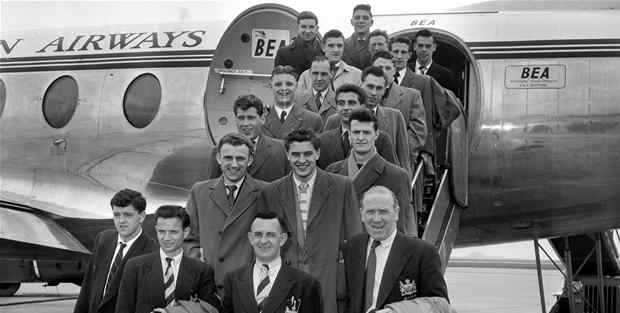
The decision was made to attempt a third takeoff. The passengers reboarded. The plane accelerated down the runway.
It did not get airborne. The aircraft hit slush at the end of the runway, went through the airport fence, crossed a road, and struck a house and a fuel storage hut. The fuselage broke apart on impact.
Twenty three people died. Twenty of them at the scene or in the immediate aftermath. Three more in hospital in the days and weeks that followed. Among the dead were eight Manchester United players. Roger Byrne, Eddie Colman, Mark Jones, David Pegg, Tommy Taylor, Liam Whelan, Geoff Bent and, fifteen days later in hospital, Duncan Edwards.
Edwards fought for his life for over two weeks. The injuries he sustained were catastrophic. Busby, who was himself critically injured and spent weeks in an oxygen tent unaware of the full scale of what had happened, was not told about Edwards’ death immediately because the medical staff feared the news would kill him.
I am going to be honest about how it feels to write this paragraph. It feels inadequate. The facts are the facts and they deserve to be stated plainly. But the human reality behind those facts, the families destroyed, the careers ended, the futures erased, the young men who were alive and brilliant and full of promise on a Tuesday morning and dead by Tuesday afternoon, resists the kind of tidy narrative that journalism normally provides.
Eight footballers. The youngest and most exciting team in England. Gone in the slush at the end of a runway in Munich because a plane could not get airborne on its third attempt in the snow.
The Aftermath
Matt Busby survived. He spent weeks in hospital, twice receiving the last rites. When he was finally told the full truth about what had happened, the guilt settled on him like a weight that he carried for the rest of his life. He had insisted on entering the European Cup. The team was in Belgrade because of his ambition. The connection between his vision and the disaster was not causal in any rational sense but Busby felt it as though it were and that feeling never left him.
Jimmy Murphy was not on the plane. He had been managing Wales in a World Cup qualifier. He received the news in Cardiff and travelled immediately to Manchester where he found a football club in ruins. The ground was functioning but the team was gone. The players who had survived, including Bobby Charlton, Dennis Viollet and Harry Gregg, were in varying states of physical and psychological recovery. There was no squad. There was no structure. There was barely a club.
Murphy held it together. He assembled a makeshift team from reserves, youth players and emergency signings. He managed the side through the remainder of the season while Busby recovered. The emotional weight of what he carried during those months, managing a football club that was simultaneously mourning its dead and trying to continue existing, is almost impossible to comprehend from the outside.
The makeshift team reached the FA Cup final in May 1958, three months after Munich. They lost to Bolton Wanderers. The run to the final was built on an emotional momentum that transcended football, an entire country willing United forward because what had happened to them demanded some form of redemption even if the redemption was ultimately denied.
Busby returned to management. He rebuilt the club over the following decade, slowly and painfully, carrying the guilt and the grief alongside the determination to complete the project that Munich had interrupted. Bobby Charlton became the cornerstone of the rebuilt side. George Best arrived. Denis Law was signed.
1968
Ten years after Munich, Manchester United won the European Cup.
They beat Benfica 4-1 at Wembley on May 29 1968. Charlton scored twice. Best scored once. The trophy that Busby had taken his young team into Europe to pursue, the competition that had taken them to Belgrade and to the runway at Munich, was finally won.
Busby cried. Charlton cried. The Wembley crowd, many of whom understood exactly what this moment represented and what it had cost, responded with an emotion that went beyond the celebration of a football result.
The 1968 European Cup was not just a trophy. It was the completion of a promise. The fulfilment of the vision that Busby had built the Babes around, the vision that Munich had destroyed, rebuilt over a decade of grief and guilt and determination by a man who could have walked away and chose not to.
The players who died in Munich never got to see it. Edwards, Taylor, Byrne, Colman, Pegg, Jones, Bent, Whelan. They were the ones who were supposed to lift that trophy. They were the generation that Busby had built to win it. And the fact that it took ten years and a completely different set of players to achieve what the Babes should have achieved in 1958 or 1959 or 1960 does not diminish the achievement. It contextualises it in a way that makes it almost unbearably poignant.
What Football Lost
My grandad did not talk about Munich often. When he did, it was with the specific sadness of someone who understood that what was lost went beyond the individual players, however extraordinary they were individually.
What was lost was a version of the future. A version of English football in the late 1950s and 1960s that had Duncan Edwards at its heart, that had a Manchester United side entering its peak years with a squad that had been playing together since they were teenagers, that had a depth of young talent unmatched by anything the English game had previously produced.
That version of the future was replaced by a decade of rebuilding, by grief that never fully healed, by the knowledge that the team Busby created between 1953 and 1958 represented something that could not be recreated because the specific combination of players and youth and timing and trust that produced it was unique and unrepeatable.
Bobby Charlton spent the rest of his life carrying Munich with him. He rarely spoke about it in detail. The trauma of surviving when his friends and teammates did not was a burden that he bore with extraordinary dignity for over sixty years.
Busby carried the guilt until he died in 1994. The vision that had driven him to enter the European Cup, the ambition that had put his young team on a plane in Belgrade, haunted him even as the 1968 triumph provided a form of closure that could never be complete.
The city of Manchester was changed by Munich. The club was changed permanently. The relationship between Manchester United and its supporters, the emotional depth of it, the loyalty that goes beyond results and performances and into something that feels almost sacred, is rooted in what happened on February 6 1958 and in the collective grief and rebuilding that followed.
I did not see the Busby Babes play. My grandad did. He carried what he saw and what he lost with him for the rest of his life. He passed the stories to my dad. My dad passed them to me. Three generations connected by a football team that existed for five years and that has never been forgotten.
Duncan Edwards was twenty one. He was, by every account of every person who saw him, the greatest talent English football had ever produced. He died in a hospital in Munich fifteen days after a plane failed to take off in the snow.
Football has never fully recovered from what it lost that day. It was never supposed to. Some losses are too great to recover from. You carry them instead. And you remember.