Every football fan has had the same instinct. An attack is building, the stadium is getting loud, and you want to be in the picture. You lean in, you wave, you scream at the lens. The people trying to broadcast it have a different problem, and in a game between Santa María and Cabildo, one announcer solved it with his hand.
During a goal play, he physically smacked a fan on the head to get him to duck out of the camera’s view. It is a short clip, and it is very funny. What makes it funnier is the ending. After all that effort, nobody scored.
What the Clip Shows
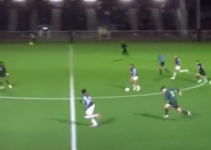
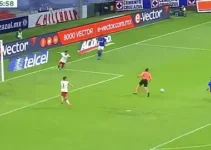
Santa María and Cabildo are playing, and a promising move is developing. The commentary is live, and the announcer is in the middle of it, voice rising, eyes on the pitch. A fan has wandered into the shot, standing between the camera and the action.
There is no time for a polite request. The announcer reaches over, smacks the fan on the head, and the fan ducks out of the way. The camera gets its picture, and the commentary carries on without a pause.
Then the move comes to nothing. There is no goal, and no celebration, just a play that fades away and a slap that turned out to be for nothing.
I do not know who either man is, and I will not guess. What matters is the instinct, which only comes from someone whose entire attention is on one thing.
Watch here:
The Cruel Irony
I want to dwell on that ending, because it is the best part. The announcer made a decision in a split second. He saw a chance, he saw an obstacle, and he cleared it in the only way he could. He did everything right to protect the moment, and then the moment never arrived.
Anyone who has watched football for long enough knows this feeling. You lean forward, you hold your breath, you get ready to roar, and the ball goes wide. The difference here is that he had already committed. The slap was spent, the fan was moved, and the goal he was clearing the way for did not happen.
I think there is something quite touching about that. It is football in miniature. You invest everything in a moment, and the moment lets you down.
The Impossible Job of Calling an Attack
It is worth appreciating how hard commentating a chance actually is. In the space of a few seconds, you have to follow the ball, identify the players, read the danger, find the right words and keep your energy up, all while the crowd noise is climbing. If it goes in, you need the call. If it does not, you need to turn on a sixpence.
At a big broadcaster, that job is surrounded by help. There is a director, a camera operator who can reframe, a producer in your ear, and security to keep people out of the shot. At a small club, you might have none of that. You have a microphone, one camera and whatever stands between you and the pitch.
That is why I find the slap so revealing. It is not an act of aggression, it is a piece of improvised broadcast management. The announcer has seen the problem, there is no one else to fix it, so he does it himself.
Why Fans Always End Up in the Shot
Anyone who has watched football for long enough knows this species. Somewhere behind every camera, reporter and touchline microphone, there is a fan who wants to be on television. They wave, they pull faces, and they position themselves exactly where the picture will be best.
I understand it completely. At a small ground, a camera pointing at the pitch is the closest thing to fame the supporters will ever get. When an attack is building, the instinct to react in front of it is almost impossible to resist.
The trouble is that the fan has no idea they are in the way. They are not looking at the camera’s frame, they are looking at the play. That is the funny part of the clip, two people each completely focused on the same moment, in completely different ways.
The Slap Itself
I will say what I think, because I do not want to be a hypocrite. Hitting someone on the head is not something I would recommend, and I would not want a commentator doing it in the press box at Selhurst Park. In most settings, it would be a problem.
But context matters, and everything in the clip suggests a small, informal game where the people involved know each other. The announcer is not trying to hurt anyone. He is nudging a mate out of the shot in the middle of an attack. If the fan took it with a laugh, I think we can leave it there.
The line to watch is intent. A playful smack in the heat of the moment is a gag. The same action in anger would be something else entirely. The clip works because everyone looks like they are on the same side.
The Charm of Small-Club Broadcasts
There is a reason I keep watching clips like this. The most entertaining football broadcasts often come from the smallest places. Local streams, volunteer crews and one-camera operations have a warmth that the big networks cannot manufacture.
You get commentators who care too much, fans who sit too close and moments that nobody planned. When a chance comes, there is no studio gloss, just a person with a microphone losing his mind. It is football as it was before the money arrived, and the slap is part of the charm.
I think that is why these clips spread so quickly. They remind us that behind every broadcast, no matter how small, there is someone who loves the game enough to stand in a cold stand and shout about it for ninety minutes.
What the Big Broadcasters Could Learn
If I had one suggestion for the bigger networks, it would be to loosen up. The best moments in football television are rarely the polished ones. A commentator breaking his voice on a late winner, a camera catching a supporter in tears, a crowd on a terrace losing control. They stick in the memory because they are real.
The announcer’s smack is a very small version of that. It is raw, slightly ridiculous and completely honest. Nobody planned it, and nobody could have scripted it.
My Verdict
I would not make a habit of smacking fans on the head, and I do not think the announcer would either. But as a snapshot of football at its smallest and most passionate, it is perfect. A man trying to protect a moment, a fan trying to be on television, one very quick solution, and a chance that never turned into a goal.
It is a reminder that the soul of the game is not in the glossy stadiums or the huge contracts. It is in places like Santa María, where someone with a microphone cares enough to do whatever it takes to get the shot, even when the ball does not cooperate.