I was not old enough to fully understand Eric Cantona when he was playing. I was a kid in South London more concerned with Crystal Palace’s survival battles than what was happening at Old Trafford, and my awareness of Cantona was filtered through adults talking about him in the way adults talk about someone who makes them feel slightly uncomfortable and completely fascinated at the same time.
He was different. That much was obvious even to a child who could not yet articulate why. There was something about the way he carried himself, the collar up, the chest out, the expression that suggested he was perpetually thinking about something more interesting than whatever was happening around him, that set him apart from every other footballer of his era.
Most footballers looked like footballers. Cantona looked like he had wandered in from somewhere else entirely and decided, almost as an afterthought, to be the best player in the country.
The years have only deepened that impression. Twenty five years after his retirement, Eric Cantona remains the most iconic figure the Premier League has ever produced. Not the best player, that argument has other candidates. But the most iconic. The one whose image, whose attitude, whose moments both brilliant and catastrophic, have embedded themselves in the culture of English football in a way that no amount of time seems to diminish.
This is the story of how a difficult, brilliant, impossible Frenchman became a legend at the club he was never supposed to join, survived a moment that should have ended his career, and walked away from the game at thirty leaving everyone wanting more.
The Chaos Before the Clarity
Before Eric Cantona became King Eric at Old Trafford, he was somebody else’s problem. Several somebody elses, in fact, in fairly rapid succession.
His career in France was a catalogue of brilliance interrupted by incident. He was suspended by the French Football Federation for calling the national team manager an idiot to his face. He retired from international football at twenty four, then unretired. He threw a ball at a referee. He kicked a teammate during a training session. He was released by Nimes after throwing his shirt at a referee during a disciplinary hearing, an act of contempt so perfectly Cantona that it almost deserves its own dedicated historical analysis.
He played for Auxerre, Marseille, Bordeaux, Montpellier, Nimes and the French national team, leaving varying degrees of chaos in his wake at almost every stop. The talent was never in question. Everyone who worked with him acknowledged it immediately and without reservation. The question was always whether the talent was worth the turbulence.
For most of his French clubs the answer was eventually no. Cantona was too much. Too volatile, too unpredictable, too unwilling to subordinate himself to the requirements of clubs that were not yet equipped to manage someone of his particular complexity.
He arrived in England at Sheffield Wednesday initially, then moved to Leeds United under Howard Wilkinson. The Yorkshire club was where Cantona finally found something approaching a stable environment and where English football got its first proper look at what he could do.
The Leeds Betrayal and the £1.2 Million Mistake
Leeds United won the First Division title in 1992, the last title before the Premier League era began. Cantona was not the primary architect of that triumph but his contribution was significant and his impact on the squad went beyond statistics. He gave Leeds something different. A touch of the extraordinary that lifted everyone around him.
And then Leeds sold him to Manchester United for £1.2 million.
The decision to this day represents one of the most catastrophic pieces of transfer business in English football history. Howard Wilkinson has offered various explanations over the years, none of them entirely satisfying. The basic reality is that Leeds had a player who was about to become one of the most transformative figures in Premier League history and they let him go to their direct rivals for a fee that even by 1992 standards was modest.
The move happened almost by accident. Ferguson had been enquiring about Denis Irwin. The conversation drifted to Cantona. Leeds said yes before anyone could change their minds. And just like that, one of the most consequential transfers in the history of English football was completed with the kind of casualness usually associated with picking up a bargain in a January sale.
Leeds fans have never forgiven it. They are entirely right not to.
The Cantona Effect
What Eric Cantona did to Manchester United in his five years at the club goes beyond the goals and the assists and the trophies, though those alone would be sufficient to secure his legacy.
He changed the culture. He changed the mentality. He changed what the players around him believed was possible.
Ferguson has spoken many times about the Cantona effect on his squad, about watching young players like Ryan Giggs and Paul Scholes and David Beckham raise their standards simply by being in proximity to someone who demanded excellence from himself every single day in training. Cantona was the first to arrive and the last to leave. His preparation was meticulous. His dedication was total.
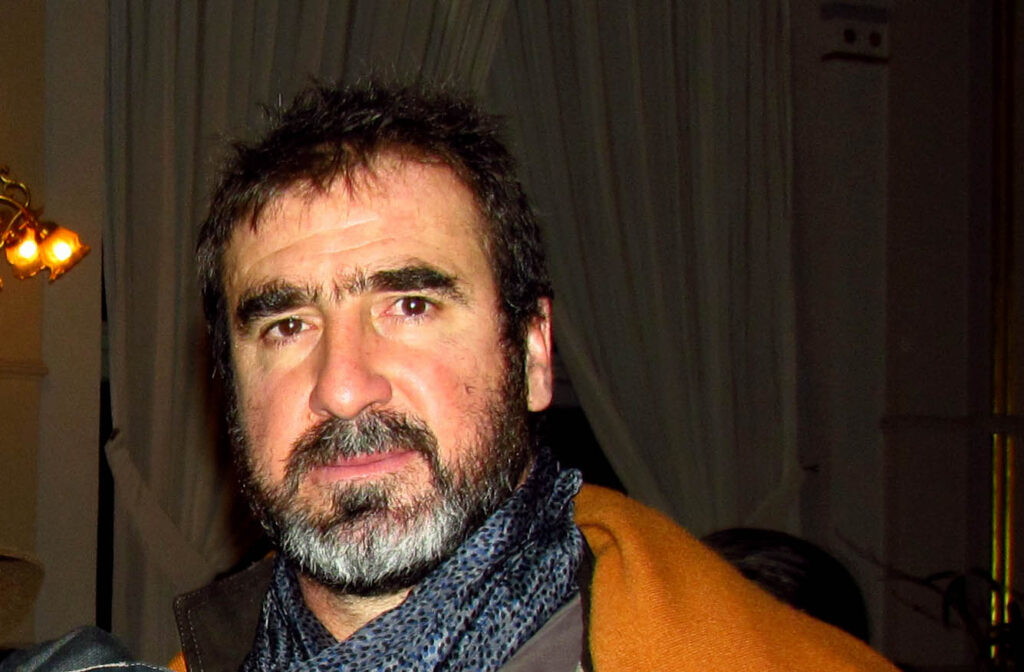
This was the paradox of Cantona that his reputation for chaos sometimes obscured. The man who threw his shirt at referees and called managers idiots was also the most professional trainer at one of the biggest clubs in the world. The fire that caused the problems was the same fire that drove the excellence.
United won four Premier League titles in five seasons with Cantona. The first, in 1993, ended a twenty six year wait for the club and was delivered with a conviction and a quality that announced Ferguson’s side as the dominant force in English football. Cantona was central to all of it, his vision, his link play, his capacity for the decisive moment in the biggest games, running through the titles like a thread.
He was named PFA Players’ Player of the Year in 1994. He scored in an FA Cup final. He produced moments of such individual brilliance that they are still being replayed and discussed as examples of what the game can look like when someone is operating at a level beyond their contemporaries.
And then came Selhurst Park.
The Kick That Should Have Ended Everything
January 25th 1995. Crystal Palace versus Manchester United. A match that should have been entirely unremarkable and which instead produced the most notorious moment in Premier League history.
Cantona was sent off for a foul on Richard Shaw. Walking toward the tunnel at Selhurst Park, he was subjected to abuse from a Palace supporter named Matthew Simmons who had run down the steps to confront him. What happened next has been replayed so many times that it has acquired the quality of a film clip rather than a real event.
Cantona launched himself into the crowd feet first, connecting with Simmons in what the entire watching world immediately understood was going to have consequences unlike anything English football had previously dealt with.
I want to be honest about something here. Selhurst Park is my ground. The away end where this happened is the end I have stood in for away fixtures. There is something genuinely surreal about the fact that the most iconic moment in Premier League history happened at a ground I have been going to since I was a child.
The aftermath was immediate and severe. Cantona was banned for nine months by the Football Association and fined. United suspended him and docked his wages. There were calls for a lifetime ban. The media coverage was extraordinary in its volume and its ferocity, the kind of wall to wall condemnation that in the modern era would have destroyed a player’s reputation permanently.
And then came the press conference.
When journalists gathered expecting contrition or explanation, Cantona sat down, waited for silence, and delivered one of the most celebrated and completely baffling statements in sporting history.
“When the seagulls follow the trawler, it is because they think sardines will be thrown into the sea.”
He stood up and left.
Nobody fully understood it then. Nobody fully understands it now. But it was so perfectly, so completely Cantona that it somehow transformed the entire narrative. The man who had committed an act of genuine violence in front of a live television audience had walked into a press conference and made himself more fascinating than ever.
That takes either extraordinary intelligence or extraordinary instinct. With Cantona it was probably both.
The Comeback and the Retirement That Stunned Everyone
The nine month ban should have broken him. For most players it would have. The loss of momentum, the enforced absence from the game, the psychological weight of having become the most controversial figure in English football would have been insurmountable for someone with a less formidable internal architecture.
Cantona came back in October 1995 and within weeks it was as though he had never been away. If anything he was better. More composed, more authoritative, more completely in command of himself and the players around him. The ban had not diminished him. It appeared to have clarified something.
He captained United to the Double in 1996, the Premier League title and the FA Cup, scoring the winning goal at Wembley against Liverpool with a volley of such technique and composure that it stands as one of the defining images of the entire Premier League era. Chest high ball, slight adjustment, struck first time into the corner with the goalkeeper rooted. A goal that only a handful of players in the history of the game could have scored in an FA Cup final.
And then, in the summer of 1997, aged thirty, at the absolute peak of his powers and the height of his influence, Eric Cantona retired.
No drawn out farewell. No tearful press conference. No final season milking the applause. He simply decided he was done and left, moving into acting and philosophy and beach football with the same decisive authority with which he had always done everything.
The football world was stunned. Ferguson was stunned. The United supporters who had made him their king were stunned.
In retrospect it was the most Cantona ending possible. He left on his own terms, before anyone could tell him it was time to go, taking the decision away from the game before the game could take it away from him.
Why the Kung Fu Kick Made Him More of a Legend
Here is the thing about the Selhurst Park incident that nobody quite anticipated at the time and that history has confirmed completely.
It did not damage his legacy. It enhanced it.
The kung fu kick should have been the moment that defined Cantona negatively. The act that overshadowed the goals and the titles and the influence. The thing people remembered instead of the football.
What actually happened is that the kick became part of the mythology in a way that added to rather than subtracted from the Cantona legend. Because it was so perfectly in character. Because it was so completely the act of a man who operated by his own rules and answered to his own internal code regardless of the consequences. Because even in the moment of his greatest controversy he was more interesting than anyone else in the room.
Cantona did not try to be iconic. He simply was. The collar was not an affectation. The philosophy was not a performance. The retirement at thirty was not a calculated career move. All of it was genuine, the expression of someone who experienced the world differently to the people around him and never saw any particular reason to pretend otherwise.
That authenticity is what English football fell in love with in the 1990s and what it has been chasing, largely unsuccessfully, ever since. There have been better players in the Premier League era. There has not been anyone quite like Eric Cantona.
King Eric. The collar up, the chest out, the sardines and the seagulls. The kick that should have ended everything and instead became the moment that made the legend permanent.