There are football stories where the right approach is to find the emotion, to connect the reader to the human experience of being a supporter, to write with the warmth and the passion that the game generates at its best.
This is not one of those stories. This is a story that demands something different. Precision. Respect. And the honest acknowledgement that nothing I write here, no arrangement of words on a page, can do adequate justice to the ninety seven people who died at Hillsborough on April 15 1989 or to the families who have spent thirty seven years fighting for the truth about how and why they died.
I am going to tell this story as carefully and as accurately as I can. Not because it needs dramatising. Because it does not. The facts are devastating enough without embellishment. The truth, when it was finally established after decades of obstruction, cover up and institutional dishonesty, is more damning than anything a journalist could invent.
Ninety seven Liverpool supporters went to a football match and did not come home. They were killed by a combination of failures in crowd management, policing and stadium infrastructure that were preventable, predictable and, in the years that followed, systematically concealed by the institutions responsible for them.
My dad does not talk about Hillsborough often. When he does, it is with the quiet anger of someone who watched the aftermath unfold over decades and who understood, long before the official investigations confirmed it, that the people responsible for the deaths had been allowed to rewrite the story to protect themselves.
This is the truth. It took thirty seven years to establish. It should have taken hours.
April 15 1989
The FA Cup semi final between Liverpool and Nottingham Forest was played at Hillsborough, Sheffield Wednesday’s ground, on a warm spring afternoon. The match was a neutral venue fixture, as FA Cup semi finals were at that time, with Liverpool supporters allocated the Leppings Lane end of the ground and Forest supporters allocated the larger Kop end.
The Leppings Lane end was a standing terrace divided into pens by metal fencing. The pens were designed to segregate supporters within the terrace and to prevent crowd movement between sections. The fencing at the front of the pens, between the supporters and the pitch, was topped with overhanging barriers designed to prevent fans from climbing onto the playing surface.
The design of the Leppings Lane end was known to be problematic. The access points were inadequate for the number of supporters entering through them. The tunnel leading to the central pens was narrow and funnelled supporters directly into the sections that were most likely to be already full. The capacity of the individual pens was not monitored or controlled once supporters had entered the terrace.
On the afternoon of April 15, a large number of Liverpool supporters arrived at the Leppings Lane end in the period immediately before kickoff. The turnstile area became dangerously congested. Supporters at the back of the crowd were being crushed against the turnstile gates. The situation was developing into a life threatening crowd emergency outside the ground.
The match commander, Chief Superintendent David Duckenfield of South Yorkshire Police, made the decision to open Gate C, a large exit gate, to relieve the pressure outside the ground. The gate was opened. Approximately two thousand supporters entered through it.
The failure that followed was catastrophic and entirely preventable. The supporters who entered through Gate C were not directed away from the central pens, which were already at or beyond capacity. They were funnelled, by the layout of the ground and the absence of any police direction, down the tunnel and directly into pens three and four, the two central sections of the Leppings Lane terrace.
The pens were already full. The additional supporters created a crush that compressed the people at the front of the pens against the perimeter fencing and against each other with a force that made breathing impossible. The metal fencing that was supposed to prevent fans from reaching the pitch prevented them from escaping the crush that was killing them.
People died standing up. People died pressed against fencing that they could not climb over and that nobody on the other side was moving quickly enough to open. People died within sight of a football pitch on a spring afternoon while a match was being played that was stopped after six minutes because the scale of the disaster had become undeniable.
Ninety four people died on the day or in the immediate aftermath. A ninety fifth victim died in 1993 after spending nearly four years in a persistent vegetative state. A ninety sixth victim was confirmed in 2021. The ninety seventh and final victim, Andrew Devine, died in July 2021, more than thirty two years after the disaster, from injuries sustained that afternoon. He was fifty five years old.
What Actually Caused It
The Taylor Report, the official inquiry conducted by Lord Justice Taylor in the months following the disaster, was clear in its findings. The main reason for the disaster was the failure of police control.
Chief Superintendent Duckenfield’s decision to open Gate C without closing the tunnel to the central pens was the immediate cause of the fatal crush. The absence of effective crowd management by South Yorkshire Police, the failure to monitor the capacity of individual pens, the failure to recognise and respond to the developing emergency in time to prevent deaths, were all identified as critical failures of policing.
The stadium itself was inadequate. The Leppings Lane end had been the subject of safety concerns before the disaster. The access arrangements were insufficient. The pen system created enclosed spaces from which escape was effectively impossible once overcrowding occurred. The perimeter fencing prevented supporters from reaching the pitch even as they were being crushed to death against it.
The Taylor Report led directly to the requirement for all top division grounds in England to become all-seater stadiums. The terraces that had been a feature of English football for over a century were removed. The fencing that had been installed to combat hooliganism and that had trapped supporters at Hillsborough was taken down. The physical transformation of English football grounds that followed the Taylor Report was the most significant structural change in the history of the domestic game.
But the Taylor Report was only the beginning of the story. What followed over the next three decades was a systematic attempt by South Yorkshire Police and other institutions to conceal the truth about what happened and to redirect blame onto the supporters who had died.
The Cover Up
Within hours of the disaster, before the dead had been identified and before the families had been formally notified, a narrative was being constructed by South Yorkshire Police that would define the public understanding of Hillsborough for over two decades.
The narrative was simple and it was a lie. The supporters were to blame. Ticketless fans had forced their way into the ground. Drunken behaviour had caused the crush. The police had done everything they could in impossible circumstances created by the supporters themselves.
Chief Superintendent Duckenfield, the match commander whose decision to open Gate C had directly caused the fatal crush, told the FA’s chief executive Graham Kelly on the day of the disaster that supporters had forced open a gate and entered the ground without authorisation. This was untrue. Duckenfield had ordered the gate to be opened. He lied about it within hours of ninety four people dying as a result of his decision.
The Sun newspaper published a front page on April 19 1989, four days after the disaster, under the headline THE TRUTH. The article, attributed to unnamed police sources, alleged that Liverpool supporters had picked the pockets of the dead, that they had urinated on police officers attempting rescue, and that they had attacked a police constable giving mouth to mouth resuscitation.
The allegations were false. Every single one of them. They were fabricated by police sources and published without adequate verification by a newspaper that chose sensation over accuracy in circumstances where accuracy was a moral obligation.
The impact of that front page on the families of the dead and on the city of Liverpool was devastating and permanent. The Sun has never recovered its reputation on Merseyside. The newspaper is still boycotted by large sections of the Liverpool community thirty seven years later. The damage done by those four words and the lies beneath them is incalculable.
But The Sun was a vehicle for the lie rather than its author. The lie originated with South Yorkshire Police. And the cover up went far beyond a single newspaper front page.
The Alteration of Statements
The scale of the institutional dishonesty that followed Hillsborough was not fully revealed until the Hillsborough Independent Panel published its findings in 2012, twenty three years after the disaster.
The Panel examined over 450,000 documents. What they found was a systematic programme of evidence manipulation by South Yorkshire Police that was designed to shift blame from the police onto the supporters.
One hundred and sixteen police statements were altered. The amendments removed or modified references to the failures of police crowd management and added or emphasised references to alleged supporter behaviour. The alterations were not minor editorial corrections. They were deliberate changes to evidence that was intended to be used in legal and coronial proceedings, made with the specific purpose of protecting the reputation of South Yorkshire Police at the expense of the dead and their families.
The West Midlands Police, who were appointed to investigate the disaster, were aware of the alterations and did not intervene. The coroner who conducted the original inquests made a ruling that no evidence from after 3:15pm on the day of the disaster would be considered, a decision that excluded evidence about the emergency response and the rescue attempts that might have saved lives. The original inquest returned a verdict of accidental death.
The families knew the verdict was wrong. They knew the narrative was wrong. They knew the police were lying. They had been saying so since 1989. Nobody in a position of institutional authority was willing to listen.
The Fight for Justice
What the Hillsborough families did over the following decades is one of the most extraordinary and most important campaigns for justice in British history. Not football history. British history.
They fought. They campaigned. They lobbied. They attended every hearing, every inquiry, every legal proceeding. They refused to accept the official narrative despite being told repeatedly by institutions with the power to enforce that narrative that the matter was closed.
The Hillsborough Justice Campaign maintained pressure for over two decades. The families refused to let the story be forgotten. They refused to let the lies stand. They refused to accept that the deaths of their children, their parents, their siblings, their friends, would be officially attributed to the behaviour of the people who died rather than the failures of the people who were supposed to keep them safe.
The breakthrough came in 2009 when Andy Burnham, then Secretary of State for Culture, Media and Sport, attended the twentieth anniversary memorial service at Anfield. The families in attendance chanted justice for the ninety six. Burnham was visibly moved and subsequently championed the creation of the Hillsborough Independent Panel.
The Panel’s report in 2012 was devastating. The evidence of statement alteration, of institutional cover up, of systematic dishonesty by South Yorkshire Police, was laid out in forensic detail across hundreds of pages. The scale of the injustice was confirmed by official documentation that the institutions responsible had spent twenty three years trying to suppress.
The original inquest verdicts of accidental death were quashed. New inquests were ordered. In 2016, after the longest jury case in English legal history, the new inquests returned verdicts of unlawful killing. The jury found that the behaviour of supporters did not cause or contribute to the dangerous situation. The ninety six, as the number stood at that time, were unlawfully killed.
David Duckenfield, the match commander, was charged with manslaughter by gross negligence. He was tried in 2019. The jury failed to reach a verdict. A retrial produced the same result. He was acquitted. No police officer has ever been successfully prosecuted for the deaths at Hillsborough.
What Hillsborough Changed
The physical transformation of English football that followed the Taylor Report is the most visible legacy of Hillsborough. All-seater stadiums. The removal of perimeter fencing. Improved safety standards. The grounds that Premier League supporters attend today are incomparably safer than the grounds that existed in 1989 and that transformation flows directly from the ninety seven deaths at Hillsborough.
But the legacy extends beyond stadiums and safety regulations. Hillsborough changed the relationship between football supporters and the institutions that are supposed to serve them. It demonstrated, with a clarity that no previous event had achieved, that those institutions were capable of failing catastrophically and then lying about it systematically and then sustaining those lies for decades while the families of the dead fought for a truth that should have been acknowledged immediately.
The campaign for justice at Hillsborough influenced subsequent campaigns for institutional accountability across British public life. The persistence of the families, their refusal to accept official narratives that they knew to be false, their willingness to fight for decades against institutions with vastly greater resources and power, established a model for grassroots campaigning that has been referenced and replicated in numerous other contexts.
The boycott of The Sun on Merseyside, sustained for over three decades and showing no sign of ending, is a permanent reminder of the consequences of institutional dishonesty and irresponsible journalism. The newspaper’s failure to apologise adequately, to take genuine accountability for the damage its coverage caused, is a wound that has never healed and that the passage of time has not diminished.
What Justice Actually Looks Like
I want to be honest about something that the story of Hillsborough forces you to confront.
The truth was established. The unlawful killing verdicts were returned. The cover up was exposed. The institutions responsible were publicly identified and condemned. The families achieved what they set out to achieve across thirty seven years of relentless, exhausting, emotionally devastating campaigning.
And yet no individual has been held criminally accountable for the deaths of ninety seven people.
Duckenfield was acquitted. The criminal cases against other officers collapsed or resulted in acquittals. The institutional accountability that the verdicts implied has not translated into personal accountability for the individuals whose decisions and whose dishonesty caused and then concealed the disaster.
The families have expressed their anger and their frustration about this outcome and they are right to do so. Justice that establishes the truth but does not hold individuals accountable for the consequences of their actions is incomplete justice. The verdicts matter. The truth matters. The exposure of the cover up matters. But the absence of criminal conviction for anyone involved in the deaths of ninety seven people or the subsequent concealment of the circumstances of those deaths leaves a gap in the justice that the families have fought for that the legal system has failed to close.
Remembering
I did not know anyone who died at Hillsborough. I have no personal connection to the disaster beyond being a football supporter who understands that ninety seven people went to a match and did not come home and that the institutions responsible spent decades lying about why.
The youngest person who died at Hillsborough was ten years old. A child who went to a football match with his family on a spring afternoon. The oldest was sixty seven.
They were not hooligans. They were not drunk. They were not responsible for their own deaths. They were football supporters attending an FA Cup semi final who were killed by failures of policing and stadium design that were preventable and predictable and that were subsequently covered up by the people who caused them.
It took thirty seven years for the truth to be officially established. Thirty seven years of campaigning, of legal proceedings, of institutional resistance, of families being told that the deaths of their loved ones were the fault of the people who died.
The families never stopped fighting. They never accepted the lies. They never allowed the truth to be buried permanently beneath the institutional dishonesty that tried to suppress it.
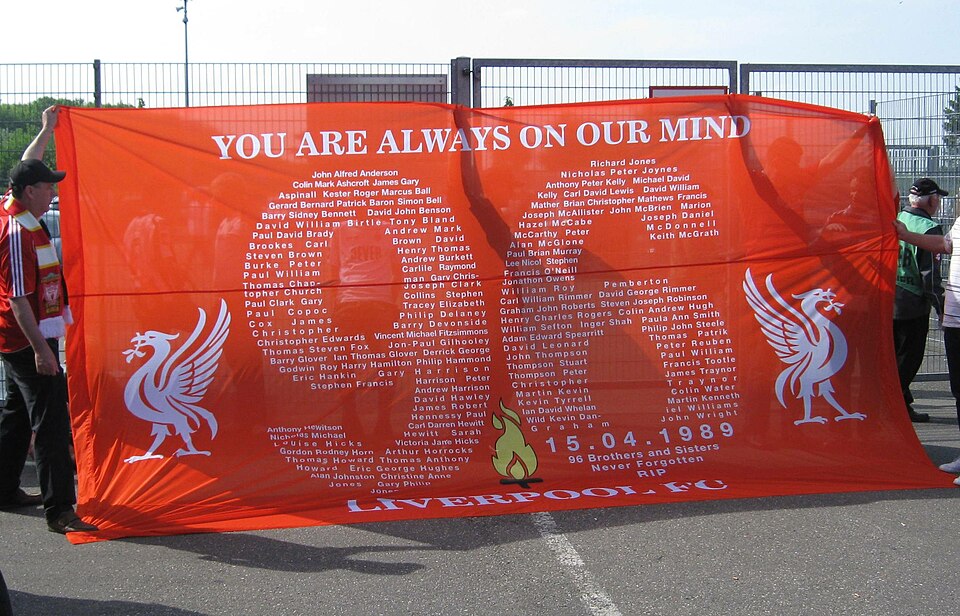
Ninety seven people. Remembered by name. Remembered by the families who loved them. Remembered by a city that has never forgotten and that has never forgiven the people who tried to rewrite the story of how they died.
You’ll Never Walk Alone was sung at Anfield before Hillsborough and it has been sung there after it. But the words carry a weight since April 15 1989 that they did not carry before. The promise of solidarity, of collective support, of standing together in the face of grief and injustice, became real in a way that nobody who sings it at Anfield has ever forgotten.
Ninety seven. Forever in our hearts. Justice for Hillsborough.