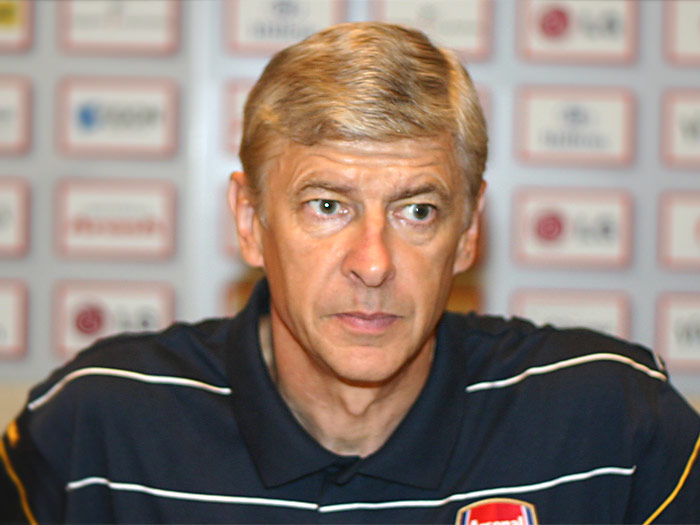
September 1996. A tall, thin, bespectacled Frenchman walked into Highbury to take charge of Arsenal Football Club and the reaction from English football was one of the most spectacularly wrong collective judgements the sport has ever produced.
Arsene who?
The headline that greeted his appointment has become so famous that it has outlived the newspaper that printed it. Two words that captured perfectly the insularity, the arrogance and the complete inability of the English football establishment in the mid-1990s to imagine that someone from outside its borders might have something valuable to teach it.
He had managed Monaco to a Ligue 1 title. He had developed young players of extraordinary quality in the French league. He had spent time in Japan, at Nagoya Grampus Eight, broadening his understanding of coaching and culture in ways that no English manager of his era would have considered necessary or even interesting. His CV was serious, his reputation among people who actually understood European football was significant, and his ideas about how the game should be played and how players should be prepared were years ahead of anything being practised in England.
Nobody in England cared about any of that. He was foreign. He wore glasses. He looked like a geography teacher. And he was replacing Bruce Rioch at a club where the dressing room contained Tony Adams, Lee Dixon, Nigel Winterburn and Steve Bould, men whose idea of post-match recovery involved the pub rather than the physio table.
My dad watched the early press conferences and said something I have never forgotten. He is either going to be sacked by Christmas or he is going to change everything. There was no middle ground with Wenger. You could see it immediately. The intensity of his convictions, the quiet certainty with which he described his philosophy, the absolute refusal to compromise on what he believed was correct regardless of whether English football was ready to hear it.
English football was not ready. But it was about to be changed anyway.
The Man Nobody Knew
Wenger’s path to Arsenal was unconventional by the standards of English football management in the 1990s, which is precisely why it produced someone capable of transforming the game in ways that a conventionally trained English manager never could have.
He studied economics at the University of Strasbourg. He spoke six languages. He had coached in France for over a decade, winning the Ligue 1 title with Monaco in 1988 and reaching the Champions League semi finals. He had developed players like George Weah, Lilian Thuram and Thierry Henry at Monaco, identifying talent before anyone else saw it and creating environments where that talent could flourish.
The Japan period is the part of his career that English football found most baffling and that was actually most instructive about who Wenger was. He went to Nagoya Grampus Eight not because his European options had dried up but because he was genuinely curious about how football was coached and played in a completely different cultural context. He wanted to learn. He wanted to see the game from an angle that European coaches never experienced. He wanted to understand what was universal about football and what was merely convention.
That curiosity, the willingness to look beyond the familiar and to question assumptions that everyone else accepted as permanent, was the quality that made him revolutionary when he arrived in England. English football in 1996 was operating on conventions that had not been seriously challenged for decades. The training methods, the diet, the approach to recovery, the relationship between coaches and players, all of it was built on tradition rather than evidence. Wenger arrived with evidence and the tradition did not survive the encounter.
The Revolution
The changes Wenger made at Arsenal in his first months were so fundamental and so comprehensive that they affected every aspect of how the club operated, from what the players ate for breakfast to how they trained to how they recovered after matches.
The dietary transformation is the change that has been most widely documented and most frequently reduced to anecdote, but it deserves to be understood properly because it represented something more significant than a menu change. English footballers in the mid-1990s ate badly. Not by the standards of the general population but by the standards of elite athletes in almost every other sport. The pre-match meal was steak and chips. The post-match routine involved alcohol. The concept of nutritional science applied to athletic performance was virtually non-existent in English football dressing rooms.
Wenger replaced all of it. Steamed fish. Vegetables. Controlled portions. Vitamin supplements. Hydration protocols. Recovery nutrition timed to specific windows after exercise. Every detail of what went into the players’ bodies was monitored and optimised in ways that the Arsenal squad had never experienced and initially resisted with the kind of bewildered hostility that only a group of British men being told they cannot have chips can produce.
Tony Adams, the Arsenal captain, a man whose authority in the dressing room was absolute and whose lifestyle before Wenger’s arrival had not been calibrated around steamed broccoli, has spoken extensively about the culture shock of the transition. The resistance was real. The players thought Wenger was eccentric at best and insane at worst. The idea that what you ate and drank affected how you performed on a football pitch was treated as a continental affectation rather than a scientific principle.
The results killed the resistance. Adams has credited Wenger with extending his career by several years. Players who had been carrying injuries and managing their bodies through willpower and painkillers found that the new approach to diet, recovery and training produced bodies that functioned better, lasted longer and performed more consistently. The evidence was visible in the performances and the evidence converted the sceptics faster than any argument could have.
The training methods were equally revolutionary. Wenger introduced ball work as the foundation of every session. The long distance running and the physical conditioning that had dominated English training for decades were replaced by exercises designed around technical development, positional play and tactical understanding. The players trained with the ball because Wenger believed that the best preparation for playing football was playing football, a principle so obvious that it is remarkable how long English coaching took to adopt it.
The 1998 Double
The results of the revolution arrived faster than even Wenger’s most optimistic projections.
In his first full season, 1997/98, Arsenal won the Double. The Premier League title and the FA Cup. The title was won with a run of form in the second half of the season that was so emphatic and so stylistically distinctive that it announced Arsenal not just as champions but as a genuinely new force in English football.
Marc Overmars provided the pace and the directness on the wing that Wenger’s system demanded. Nicolas Anelka, a teenage striker that Wenger had identified and developed with the same eye for young talent that had characterised his Monaco years, was devastating. Patrick Vieira, another Wenger discovery, was establishing himself as the most dominant midfielder in the Premier League. Dennis Bergkamp, already at the club before Wenger arrived but transformed by his methods, was producing football of a quality that made everyone around him look better.
The football was different. That was the thing that people noticed beyond the results. Arsenal under Wenger did not just win. They won playing a style that the Premier League had not seen before. Quick, technical, built on passing rather than physical dominance, aesthetically beautiful in a way that English football had not prioritised since the best teams of the 1970s.
Ferguson’s United had been the benchmark. Wenger’s Arsenal offered an alternative that was not just competitive but philosophically distinct. The Premier League suddenly had two great teams playing two different styles of football at the highest level simultaneously. The competition between them would define the next decade.
The Rivalry That Defined an Era
The Wenger-Ferguson rivalry is the greatest managerial rivalry in the history of English football and I do not think any future rivalry will match it because the conditions that produced it, two managers of extraordinary quality and extraordinary stubbornness operating at clubs of comparable stature across a sustained period, are unlikely to be replicated.
They hated each other. Not in the performative way that modern managers occasionally pretend to dislike each other for the cameras. Genuinely. The competition between them was personal in a way that went beyond football and into the territory of two alpha personalities who could not accept the existence of an equal.
Ferguson viewed Wenger as an interloper. A foreigner who had arrived in his league and challenged his authority. The mind games, the press conference provocations, the deliberate attempts to unsettle Arsenal through public comments designed to create pressure and division, were Ferguson’s weapons and he deployed them with a ruthlessness that Wenger never fully learned to counter.
Wenger viewed Ferguson as the establishment. The man who had the referees, the media and the fixture schedule on his side. The paranoia was not always rational but it was not always wrong either. The intensity of his conviction that United received preferential treatment produced some of the most memorable moments of the rivalry, moments that revealed the depth of his competitive fury in ways that contradicted the professorial image he usually projected.
The matches between them were extraordinary. The Battle of Old Trafford. The Pizzagate incident. Keane versus Vieira. The 49 game unbeaten run ended by United at Old Trafford in a match that produced fury and controversy and accusations that persist to this day.
The Premier League was incomparably better for having both of them. The standards they set, the football they produced, the refusal of either to accept second place, drove the quality of the league to heights it had not previously reached. Every other club was competing for third place. The two of them were competing for history.
The Invincibles
The 2003/04 season produced the greatest achievement of Wenger’s Arsenal career and one of the greatest achievements in the history of English football.
Arsenal went through the entire Premier League season unbeaten. Thirty eight games. Twenty six wins. Twelve draws. Zero defeats. The Invincibles.
I will write about this season in full detail elsewhere because it deserves its own dedicated treatment. But in the context of Wenger’s legacy it represents the ultimate validation of everything he believed about how football should be played.
The side that went unbeaten was built on the principles Wenger had established from his first day at the club. Technical quality in every position. Speed of thought and speed of execution. A defensive structure that was organised without being cautious. An attacking philosophy that prioritised movement and passing over physical confrontation.
Henry. Bergkamp. Pires. Vieira. Gilberto. Lauren. Cole. Campbell. Toure. Lehmann. Ljungberg. The squad contained players who were individually world class and collectively irresistible. They played football that was, at its peak, as beautiful as anything the English game has ever produced.
Going unbeaten for an entire league season had not been achieved since Preston North End in 1888/89. It has not been achieved since. The specific combination of quality, consistency, resilience and tactical intelligence required to play thirty eight matches in the most competitive league in the world without losing a single one may never be replicated.
Wenger did it. With players he had largely identified, recruited and developed himself. Using methods that English football had mocked when he arrived eight years earlier.
The Emirates, the Exodus and the Long Decline
What happened to Wenger’s Arsenal after the Invincibles season is one of the most painful stories in modern English football and it needs to be told honestly because the legacy cannot be understood without it.
The decision to build the Emirates Stadium was strategically correct and financially devastating in equal measure. Arsenal needed a bigger ground than Highbury could provide. The revenue gap between Arsenal and the clubs who already had modern, high-capacity stadiums was growing and would eventually become a competitive disadvantage that no amount of coaching genius could overcome.
The cost of the stadium, approximately £390 million, imposed financial constraints on the club that directly and visibly affected Wenger’s ability to compete in the transfer market for over a decade. While Chelsea under Roman Abramovich and later Manchester City under Sheikh Mansour spent hundreds of millions on players, Wenger was operating with a budget that required him to sell his best players almost every summer and replace them with younger, cheaper alternatives.
The exodus was relentless and it was agonising to watch. Vieira left. Henry left. The greatest player in Arsenal’s history, the man whose goals and performances had defined the club for nearly a decade, went to Barcelona because Arsenal could not match the wages or the ambition that he deserved. Fabregas left. Nasri left. Van Persie left, going to Manchester United in a transfer that felt like a personal betrayal to every Arsenal supporter and that delivered Ferguson another title at Wenger’s direct expense.
Each departure weakened the squad. Each replacement was younger, cheaper and less proven. The quality of Arsenal’s football remained remarkably high given the resources available, which was itself a testament to Wenger’s coaching ability, but the results declined steadily. Fourth place finishes became the annual expectation. The trophy drought stretched from 2005 to 2014. The Champions League, which had been a genuine target during the Invincibles era, became a tournament Arsenal entered to qualify for rather than to win.
The fan protests were the cruellest chapter. Supporters who had watched the most beautiful football of their lives under Wenger turned on him during the later years, holding up banners calling for his departure, booing performances that would have been celebrated at most other clubs, treating the man who had transformed their club and their sport as an obstacle rather than an asset.
Wenger Out became a meme. It appeared on signs at cricket matches, at protests in other countries, in locations that had nothing to do with football. The cruelty of it, the reduction of a man’s extraordinary contribution to a joke, was difficult to watch even for people who had no particular affection for Arsenal.
He left in 2018. The final game was at Huddersfield. The reception was warm. The tributes were sincere. But the feeling that surrounded his departure was one of sadness rather than celebration, the sense that the ending had not matched the story that preceded it and that Wenger deserved better than the way his final years had unfolded.
What English Football Owes Him
I am a Crystal Palace fan. I have no emotional attachment to Arsenal Football Club. And yet I feel strongly that Arsene Wenger is owed a debt by English football that has never been properly acknowledged and that extends far beyond what he achieved at a single club.
The Premier League before Wenger and the Premier League after Wenger are two different competitions. The dietary revolution he introduced became the standard across every club in the division within a decade. The training methods he brought from France and Japan are now universal. The approach to young player development that he pioneered at Arsenal, identifying talent globally rather than locally, developing players technically rather than physically, trusting teenagers with genuine first team responsibility, became the model that every progressive club in England adopted.
The foreign manager in English football went from a curiosity to the norm because Wenger proved that someone from outside the English system could not just compete but dominate. The door he opened has been walked through by Mourinho, Guardiola, Klopp, Pochettino, Conte, Ancelotti and every other foreign coach who has managed in the Premier League since.
The standard of football played in the Premier League improved measurably during Wenger’s years. Not just at Arsenal but across the division, because the methods he introduced raised the baseline for preparation, nutrition, recovery and technical development at every club. The competition he created with Ferguson drove standards at the top. The methods he pioneered filtered down to every level of the professional game.
He changed how English footballers ate. He changed how they trained. He changed how they were scouted and developed. He changed how the game was played at the highest level. He changed the expectations of what was possible in the Premier League and he did it with a conviction and a consistency that never wavered even when the results no longer matched the philosophy.
Arsene Wenger walked into English football as a man nobody had heard of. He left it as the most influential figure the Premier League has ever had. Not the most successful. Ferguson holds that distinction and always will. But the most influential. The man who changed the most things about the most fundamental aspects of how the English game operates.
Arsene who? The man who changed everything. That is who.