I am not an Argentina fan. I have no business getting emotional about a South American international team when my own has spent decades finding new and creative ways to disappoint me at Selhurst Park. But Monday’s announcement from Lionel Messi still landed somewhere it should not have, and I suspect I was not the only one who felt it.
Messi has retired from international football. After 21 years, 207 appearances and 125 goals for Argentina, the boy from Rosario who became the most complete footballer most of us will ever see has decided the international stage no longer needs him, or perhaps that he no longer has enough left to give it what it deserves.
The Boots Told Their Own Story
There is a detail from the World Cup final that stuck with me more than any of the football itself. Messi’s boots for that match had been customised with the words “El ultimo tango”. The last tango. He knew before a ball was kicked that whatever happened against Spain, it would be his final act on this particular stage.
I find that almost unbearably sad, in the way only football can be sad. Here is a man who has spent his entire adult life being watched, analysed, celebrated and occasionally torn apart by an entire nation, quietly deciding in private that this was the end, then going out and playing one more World Cup final anyway, boots inscribed with his own goodbye note.
Argentina lost that final to Spain. Messi took his boots off at the end in what reports describe as a gesture that looked deliberately symbolic, holding back tears as the Argentina supporters sang for him one final time. He knew it was over. He had known for weeks.
A Decision Made in Grief
What makes this retirement different from the usual sporting farewell is the timing and the reason behind it. Messi has said he wrote his retirement statement on July 21, just two days after that World Cup final defeat, but held onto it for six further weeks while he processed something far bigger than football. His father, Jorge, passed away on August 8 after a long illness.
Messi has spoken about arriving in the dressing room after each World Cup match this summer and searching for the message his father always sent him, only to find it missing. That is when he apparently realised how serious the situation had become. He has said he thought about pushing further into the tournament simply to buy his father more time to watch him play, that he wanted to win the whole thing to bring the trophy home to him, and that he could not.
Reading his own words back, he described trying to push past his physical limits in that final and not managing it. There is no shame in that. There is barely a footballer alive who could summon peak performance in a World Cup final while grieving a parent in real time. The surprise, if anything, is that he got Argentina to the final at all.
He has apparently said that after everything with his father, he feels even more certain about the decision to step away now. That is not the language of a man walking off in disappointment after a defeat. That is a man recalibrating what actually matters once the football has been stripped back to what it always was underneath, a game, played by human beings who still have fathers and families and grief to carry.
The Player Who Made You Feel Something
I think what separates Messi from almost every other footballer of the modern era is not really about numbers, although the numbers are absurd. It is that he made neutral supporters feel things they had no rational reason to feel. I have sat in pubs with Palace shirts on watching Argentina at World Cups, willing him on, purely because watching him try to drag a team to glory through sheer accumulated genius is one of the purest pleasures football offers.
This summer’s tournament apparently gave us that one more time. Reports from the group stage have him scoring three against Algeria, two against Austria and one more as a substitute against Jordan. But it was the knockout stage where the real magic reportedly happened, turning games from losing positions against both Egypt in the round of 16 and England in the semi final. That is a 39 year old man doing what he did at 24, except now with the added weight of knowing this might be the last time.
The final itself apparently did not go his way. Spain were reportedly the stronger side and Messi’s magic, for once, did not arrive when Argentina needed it most. But I do not think that final defines this chapter of his career in the way people might assume. You do not undo six weeks of a man playing through visible physical and emotional strain just because the very last chapter did not have a fairytale ending.
The Two Halves of an International Career
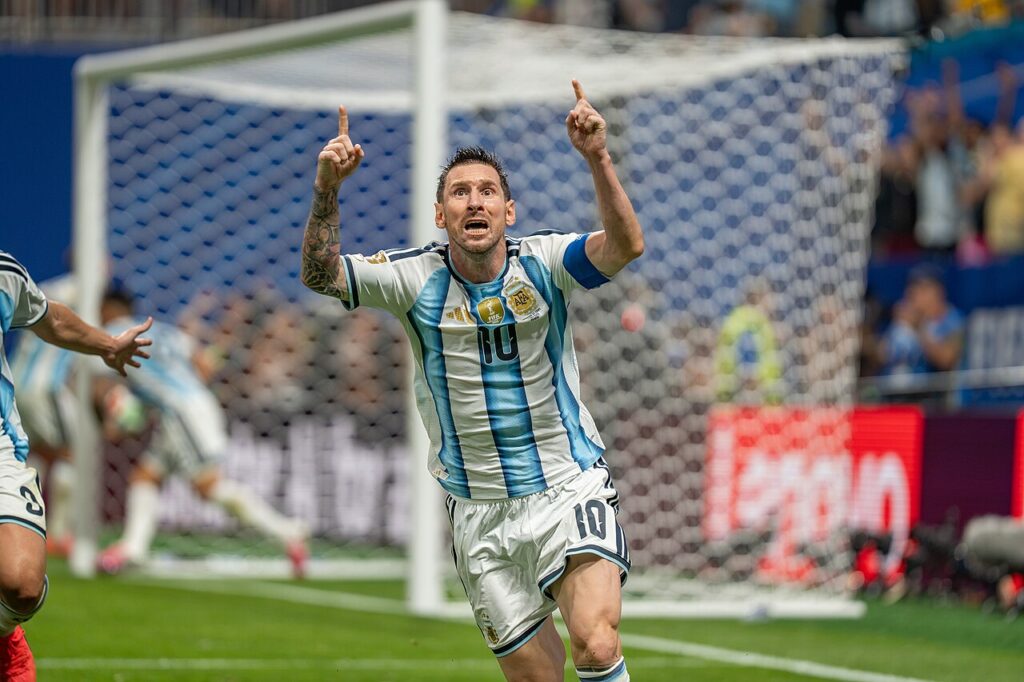
What strikes me most reading back through Messi’s Argentina career is how genuinely split it was into two distinct eras. The first half was reportedly full of frustration. Three consecutive final defeats, two at the Copa America and one at a World Cup, endless comparisons to Diego Maradona that Messi could never quite live up to in the public imagination, and by 2016 apparently enough disillusionment that he briefly announced his international retirement after missing a penalty in a Copa America final shootout defeat to Chile.
He is reported to have told the press at the time that the national team was over for him, that four finals lost was enough, and that there would be no going back. Imagine if that had stuck. Imagine a version of football history where Lionel Messi’s international career ended in 2016 with nothing to show for it but heartbreak and unfavourable Maradona comparisons.
Thankfully for all of us, it did not stick. An outpouring of support from supporters and team mates, along with reported involvement from Argentina’s political establishment at the time, brought him back. The 2018 World Cup still ended in frustration, and Maradona himself was apparently unkind about it, suggesting Messi was a great player but not a leader.
But something shifted after that. Lionel Scaloni built a more cohesive Argentina side around him and Messi appears to have grown into exactly the leadership role people had doubted he possessed. The Copa America title in 2021 unlocked something. Another Copa America followed in 2024. And in between sat the crowning achievement of the entire era, the 2022 World Cup, won at the fifth attempt, aged 35, well past what most would consider a player’s physical peak.
Why the World Cup Win Changed Nothing and Everything
Pep Guardiola, who managed Messi at his absolute peak at Barcelona, apparently made a point after that 2022 win that I think is worth sitting with. He is reported to have said he already considered Messi the greatest before the World Cup, and that winning it changed nothing in that assessment.
I understand that sentiment completely, and I also think it undersells what winning the World Cup actually did. It did not make Messi better than he already was. But it removed the one argument his doubters could still make against him, the idea that he had somehow fallen short of the very biggest stage. After Qatar, that argument simply ceased to exist.
What Comes Next
Messi will keep playing for Inter Miami, at least for now. He apparently scored four goals against CF Montreal just days after this announcement, which tells you the body has not entirely given up even if the international chapter has closed. But there are reportedly question marks over whether he sees out his contract through to the end of 2028, with his own statement referencing not much time being left and chapters coming to a close.
Whatever happens with Miami, this feels like the real ending. Club football will give us a few more years of Messi doing what Messi does, probably at a gentler pace against opposition that will never quite test him the way international tournaments did. But the version of Messi carrying an entire nation’s hopes on his shoulders, the version who turned a Copa America drought into a golden era, who dragged Argentina to a World Cup at 35 and then somehow nearly did it again at 39 while grieving his father, that version is gone now.
I still cannot fully explain why a Palace supporter with zero connection to Argentina should feel anything about this beyond passive appreciation. But football at its best makes you feel connected to moments that have nothing to do with your own club, your own country, your own history. Messi gave the world dozens of those moments across two decades. Losing access to any more of them, even from a neutral distance, is a genuine loss.
He is right that he gave everything he had. Anyone who watched this summer’s World Cup, knowing what we now know he was carrying privately, would struggle to argue otherwise.