
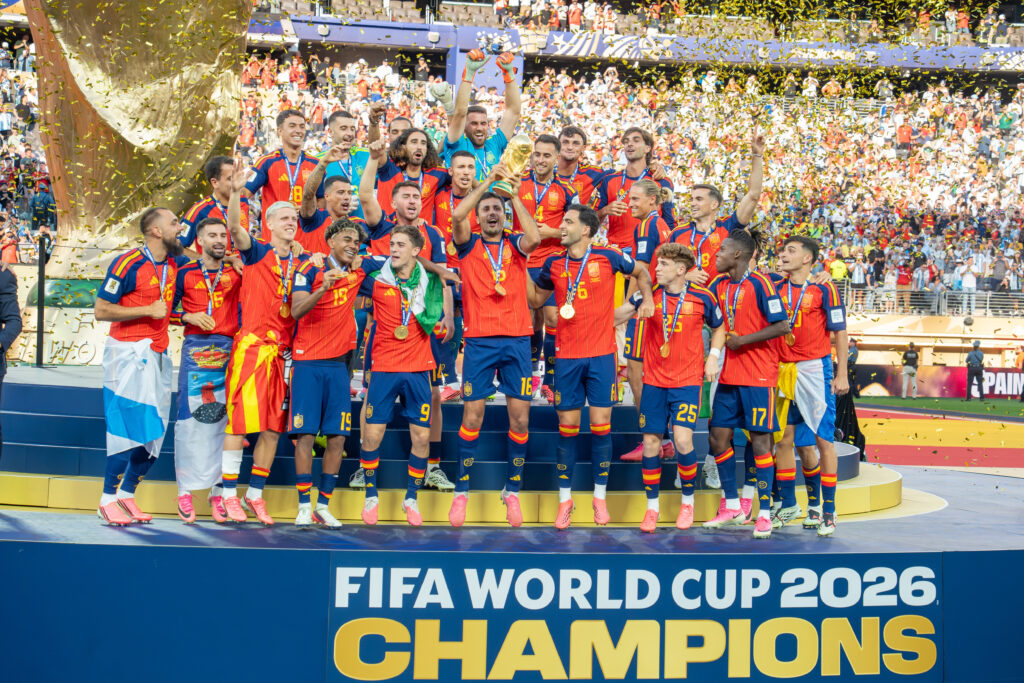
MetLife Stadium. East Rutherford, New Jersey. July 19, 2026. Over eighty thousand people watching inside the ground and billions more watching around the world as Ferran Torres collected the ball in the 106th minute of extra time, turned and drove a thunderous finish past Emiliano Martinez to win the World Cup for Spain.
The celebrations were immediate and enormous. The red shirts flooding toward Torres. The coaching staff on the sideline losing their composure entirely. The Spain supporters behind the goal producing the kind of noise that only a World Cup winning goal in the final minutes of extra time can generate. Rodri lifting the trophy while Gianni Infantino and Donald Trump were booed during the presentation ceremony, an image so perfectly 2026 that it practically wrote its own caption.
All of that was the moment. The drama, the emotion, the culmination of seven weeks of football in three countries. Beautiful to watch, impossible to forget.
But I want to step back from the moment and look at what Spain actually did across this entire tournament. Because when you examine it properly, stripped of the noise and the celebration and the immediate emotional reaction, what emerges is not just a World Cup triumph. It is the most dominant defensive performance by any champion in the history of the competition.
No previous World Cup winner has ever done what Spain just did. And the numbers are so extraordinary that they deserve to be absorbed slowly.
One Goal. Seven Matches. History.
Spain conceded one goal in the entire 2026 World Cup.
One.
Seven matches. Three group stage fixtures. Four knockout rounds including a final against the defending champions that went to extra time. One hundred and twenty minutes against Argentina in the biggest game in world football. One goal conceded across the whole thing.
No World Cup champion has ever achieved that. Not Brazil in their pomp. Not Italy at their most cynically brilliant defensive best. Not Germany with the organisation and the efficiency that made them the benchmark of tournament football for decades. Nobody has ever been through an entire World Cup and conceded only once.
The one goal they did concede came against Belgium in the quarter final, a match Spain still won 2-1. Which means that across every other fixture in the tournament, including the final, Spain kept a clean sheet. Six clean sheets in seven matches. At a World Cup. Against opposition that included Portugal, France and Argentina.
I have followed football closely enough and for long enough to know when a statistic is merely impressive and when it is genuinely unprecedented. This is the second kind. This is the kind of number that will still be referenced in fifty years when people are trying to explain to the next generation what this Spain side was.
What They Did to Argentina in the Final
The defensive dominance was at its most visible and most devastating in the final itself. Argentina, the defending champions, the team containing Lionel Messi, the side that had fought through four knockout rounds of their own including a devastating comeback against England in the semi final, were reduced to something approaching irrelevance for one hundred and twenty minutes at MetLife Stadium.
Argentina had zero shots on target in ninety minutes of normal time. Zero. The best attacker in the history of football was on the pitch and his team could not produce a single shot that tested Unai Simon in the Spain goal across the entirety of regulation time.
Argentina managed just two touches in Spain’s penalty area through the first half of extra time. Two touches. In a World Cup final. Against a team they were supposed to be capable of beating.
Rodri controlled the midfield with a composure and an intelligence that neutralised everything Argentina tried to do through the central areas. Messi, who had been magnificent throughout the tournament and had produced two assists in the semi final against England, was systematically denied the space and the supply lines that his game depends on. Not through brute force or cynical fouling. Through positional discipline and tactical suffocation that made Argentina’s most dangerous player look like a passenger.
Martinez made eleven saves. Eleven. The most ever recorded in a World Cup final by any goalkeeper. That number is extraordinary in its own right but it also tells you something important about the balance of the match. Spain created enough chances to warrant eleven saves from one of the best goalkeepers in world football. They were the dominant team in every phase of the match. They controlled possession, territory and the tempo of the game with a completeness that should not be possible in a World Cup final against a side of Argentina’s quality.
Torres settled it in the 106th minute. A goal that was not so much the product of a single moment of brilliance as the inevitable conclusion of a performance that had been building toward it for nearly two hours. Spain had been the better team for the entire match. It took one hundred and six minutes for that superiority to find the net. When it did, the outcome felt like justice.
The Route That Should Not Have Been Possible
The final was extraordinary in its dominance. The route to the final was arguably even more impressive.
Austria 3-0 in the round of thirty two. Portugal 1-0 in the round of sixteen. Belgium 2-1 in the quarter final. France 2-0 in the semi final.
Read that list of opponents again. Portugal, Belgium and France. Three of the most talented squads in world football, beaten consecutively in knockout matches where the margin for error is zero and the consequences of failure are immediate elimination.
The France semi final was the statement performance of the entire tournament and the match that convinced me Spain were going to win it. Two nil against a France side containing Kylian Mbappe, who finished the World Cup with ten goals and is now the all time leading scorer in the competition’s history. Mikel Oyarzabal converted a first half penalty won by Lamine Yamal. Pedro Porro finished a quick exchange with Dani Olmo in the fifty eighth minute. France, with all their firepower and all their individual brilliance, could not find a way through.
That result against France was not a smash and grab or a defensive masterclass built on good fortune. It was total football. Spain controlled the game in every dimension, created the better chances, scored two goals and did not concede. Against France. In a World Cup semi final.
The Belgium quarter final was the only knockout match where Spain conceded, going behind before recovering to win 2-1. That was the single moment across the entire tournament where they were genuinely tested defensively and they responded by winning the game. Everything else was controlled, composed and decisive in a way that made opponents look like they were competing in a different tournament.
The Generation
This is not the Spain of 2010 revisited. That team, the Xavi and Iniesta and Casillas team, was built on a specific tiki-taka philosophy that defined an era of football. It was beautiful, it was revolutionary, and it won Spain their first World Cup in South Africa.
This team is different. Not better or worse in a way that invites direct comparison, but genuinely different in its construction and its character.
Rodri is the heartbeat. The Manchester City midfielder, operating at the peak of his powers, controlled matches at this World Cup with an authority that made him the obvious choice for the Golden Ball as the tournament’s best player. His range of passing, his positional intelligence, his ability to dictate the pace and the shape of a match through decisions that are invisible to most viewers and utterly decisive to anyone who understands the game at a technical level, were on display consistently across all seven matches.
Lamine Yamal announced himself on the biggest stage in the sport at an age where most players are still learning what it means to compete at the top level. His performance in the semi final against France, winning the penalty that opened the scoring, was the kind of statement that established players spend entire careers trying to produce and that Yamal delivered as though it was the most natural thing in the world.
Pau Cubarsi, recognised with an individual award at the tournament, provided a defensive solidity that belied his youth. The blend of experience and emerging talent that Luis de la Fuente assembled was not just effective. It was balanced in a way that gave Spain the ability to compete physically, technically and tactically against any opposition the tournament could produce.
Both Trophies. One Country. First Time in History.
Spain now hold the men’s World Cup and the women’s World Cup simultaneously. The first nation in history to do so.
That fact deserves more than a passing mention because it speaks to something structural about Spanish football’s development model that goes beyond any individual squad or any individual tournament. Spain are not producing one exceptional generation. They are producing exceptional players across both the men’s and women’s game consistently enough to win the sport’s biggest prizes on both sides at the same time.
The academy systems, the coaching methodologies, the tactical philosophies that have been embedded in Spanish football at every level from youth development through to the senior national team are producing results that no other country in the world is matching. Holding both World Cups is not a coincidence. It is the outcome of decades of investment in a specific approach to developing football players that is now paying dividends in the most visible way possible.
Combined with the European Championship victory in 2024, Spain’s run of success across the past two years represents a period of dominance in international football that has no modern equivalent. Euro 2024 winners. Women’s World Cup holders. Men’s World Cup winners. A thirty eight match unbeaten run that includes all three triumphs.
The sustained excellence required to achieve all of that simultaneously, across both the men’s and women’s game, at the highest level of international competition, is something that the football world has never seen from a single nation within such a compressed timeframe.
More Than Champions
I have watched every World Cup final since I was old enough to understand what I was seeing. Some of them have been dramatic. Some of them have been memorable. Some of them have produced moments that transcend the sport and become part of the broader cultural memory.
What Spain produced across this tournament is something different to any of those categories. It is not just a World Cup triumph. It is a statement of defensive and tactical supremacy that rewrites what we thought was possible over the course of a seven match tournament at the highest level.
One goal conceded. Five clean sheets from seven matches. Argentina shut out in the final for one hundred and twenty minutes. France dismantled in the semi final. Portugal, Belgium and Austria dispatched without ever looking like they had a genuine answer to what Spain were doing.
Ferran Torres said destiny was written. Rodri lifted the trophy. The supporters in red celebrated in New Jersey in the way that only a World Cup win produces. All of it deserved. All of it the product of a tournament performance that has no historical parallel.
Spain did not just win the 2026 World Cup. They produced the most complete, most defensively dominant, most tactically assured tournament performance in the history of the competition.
Every future World Cup winner will be measured against what they did this summer. None of them will match it.