
There is a specific kind of player that football used to produce with reliable regularity and that has almost entirely disappeared from the modern game.
You know the type. The one who made your blood boil when he played against your team and who you would have absolutely loved if he had played for you. The pantomime villain. The wind-up merchant. The player whose very presence on the pitch changed the atmosphere of a match because everyone in the ground, his own supporters included, knew that something was going to happen when he was involved.
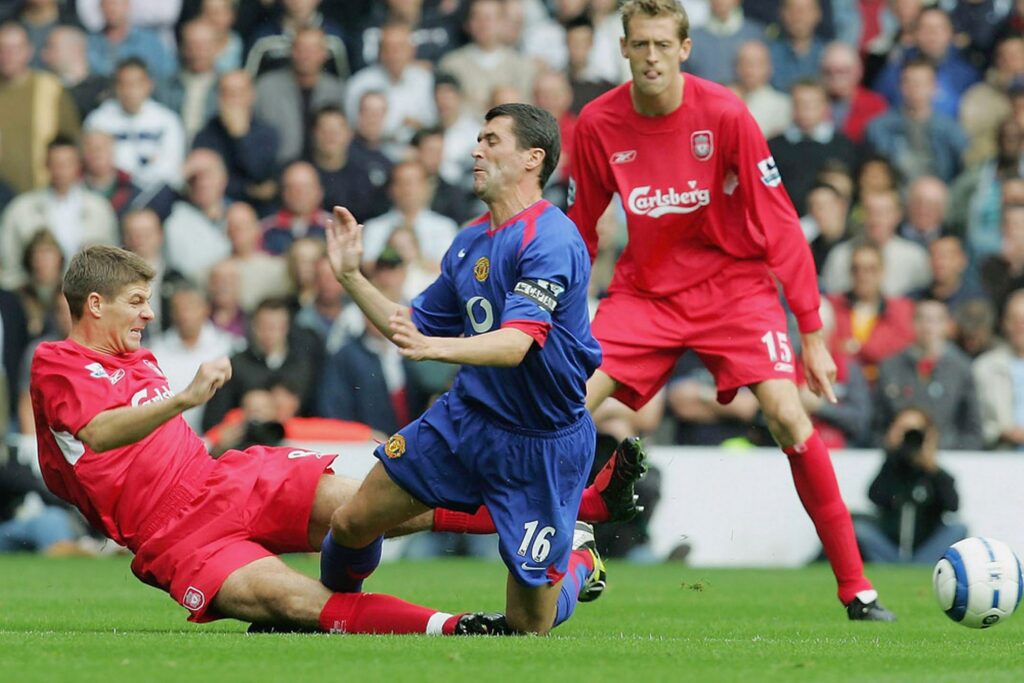
Roy Keane walking onto a pitch at Old Trafford. Vinnie Jones arriving at a ground with that expression that suggested he had already decided the afternoon was going to be deeply unpleasant for whoever was standing nearest to him. Diego Simeone in his playing days, the master of the dark arts, capable of turning a match with a foul, a word in a referee’s ear or a theatrical fall that left opponents furious and officials convinced. Neil Ruddock. Dennis Wise. Patrick Vieira squaring up to Keane in the tunnel at Highbury in a confrontation so charged that you could feel the tension through a television screen.
These players were not nice. They were not supposed to be nice. They were the human embodiment of competitive edge, of the willingness to do whatever was necessary within and occasionally slightly beyond the boundaries of the laws of the game to win. And their presence made football more dramatic, more unpredictable and more compelling than the sanitised, brand-managed version of the sport we are increasingly watching today.
Football has lost its villains. And I genuinely believe the game is worse for it.
What a Villain Actually Was
Before I make the argument I want to be precise about what I mean by a football villain because the term covers a range of behaviours and not all of them deserve equal defence.
I am not talking about racism. I am not talking about genuine violence that goes beyond the physical confrontation inherent in a contact sport. I am not talking about the kind of behaviour that causes real harm to real people in ways that have nothing to do with competitive football.
I am talking about the player who was hard, who was clever about it, who knew exactly where the line was and spent ninety minutes operating as close to it as possible without crossing it. The player who got under opponents’ skin through sheer force of personality and competitive intensity. The player who made opposing fans furious not because he had done anything genuinely wrong but because he was so completely, infuriatingly effective at disrupting the rhythm and the comfort of the team he was playing against.
That player existed in abundance through the 1980s, 1990s and early 2000s. He has become vanishingly rare in 2026. And the reasons for his disappearance tell you a great deal about what has changed in football and whether all of those changes have been improvements.
The Villains Who Made Football Better
Roy Keane is the obvious starting point for any conversation about football villains because he was the most complete version of the archetype the game has ever produced.
He was not dirty in the traditional sense. He did not go around deliberately injuring people as a strategic approach to the game, with one famous and much discussed exception that he has been honest about in his autobiography. What he did was impose himself on matches through a combination of physical presence, technical ability and psychological intensity that made playing against him one of the most uncomfortable experiences in football.
Opponents knew that Keane was watching them. That he was assessing them. That any hesitation, any lack of commitment, any moment of weakness would be identified and exploited. The mental pressure of that knowledge affected performances in ways that never showed up in statistics but were visible to anyone watching closely.
Vieira was his equal and his opposite in almost every respect. Where Keane was controlled fury, Vieira was physical authority. Where Keane operated through intensity, Vieira operated through dominance. Their rivalry, stretching across the late 1990s and early 2000s, was the defining midfield contest of the Premier League era and it was compelling precisely because both men brought something to it that made comfortable neutrality impossible.
Vinnie Jones was a different kind of villain. Less sophisticated tactically, more direct in his methods, absolutely committed to the idea that his job was to make the afternoon as difficult as possible for whoever he was marking. The photograph of him grabbing Paul Gascoigne by a particularly sensitive area of his anatomy is one of the most iconic images in English football history and it captures something essential about what Jones brought to a match. He was not there to play beautiful football. He was there to ensure that whoever was supposed to be playing beautiful football found the experience significantly less beautiful than they had anticipated.
Neil Ruddock, Dennis Wise, Julian Dicks, Mark Hughes in his physical prime, Simeone in the Argentina shirt and at Atletico Madrid. The list of genuine football villains from that era is long and varied and populated by players whose presence made matches feel dangerous in the best possible sense. Dangerous because anything could happen. Dangerous because the edge was always present. Dangerous because football was being played by people for whom winning was not just desirable but essential and who communicated that urgency in ways that were visible and visceral and sometimes slightly frightening.
Where Have They All Gone
The disappearance of the football villain is not a single event with a single cause. It is the product of several overlapping developments that have collectively produced a version of the game that is technically superior to what came before and emotionally flatter in ways that are rarely acknowledged.
The camera revolution is the most significant factor. In the 1980s and early 1990s matches were covered by a handful of cameras that captured the broad shape of the game without the forensic detail that modern multi-camera broadcasts provide. What happened between players away from the ball, the confrontations, the dark arts, the psychological warfare, was largely invisible to the television audience and entirely invisible to the referee unless it happened directly in his line of sight.
Modern broadcast technology means that every square metre of the pitch is covered by multiple camera angles at all times. VAR has access to footage that can be reviewed frame by frame. The dark arts that thrived in the shadows of lower resolution coverage are now conducted under lighting so comprehensive that shadows no longer exist.
The consequence is not that players stopped wanting to bend the rules. It is that bending the rules became significantly riskier because getting caught became significantly more likely. The calculated foul, the tactical shirt pull, the subtle elbow in a defensive set piece, all still happen but they happen with a calculation of exposure that changes their character. They are risk assessments rather than expressions of competitive personality.
Social media has accelerated the process. A moment of confrontation that would have been forgotten within days in the pre-internet era now exists permanently, is shared millions of times, generates sponsorship reviews and disciplinary hearings and think pieces about what it says about the sport. The reputational consequences of being perceived as a villain have increased dramatically at exactly the moment when the commercial value of a clean image has become central to how top players monetise their careers.
A modern player with a major boot deal, a lifestyle brand and several million social media followers has a financial incentive to manage his public image that did not exist for Roy Keane or Vinnie Jones. The villain archetype is commercially inconvenient in a way that makes it increasingly unlikely to be cultivated deliberately by players who understand the economics of modern football celebrity.
The Brand Management Problem
There is a version of this argument that says football is simply better behaved than it used to be and that this is straightforwardly a good thing. Less violence, less intimidation, less of the behaviour that made watching football in certain eras an experience that required a higher tolerance for genuine nastiness than the game should ask of its audience.
I have some sympathy with that version. There were aspects of the villain era that deserve no nostalgia whatsoever. Genuine racism on pitches. Violence that caused lasting physical damage. Behaviour that had no justification even within the most expansive definition of competitive edge.
But the sanitisation of football has gone so far beyond addressing those genuine problems that it has consumed something valuable along with the things that deserved to be removed.
The modern top level footballer is a brand. His public persona is managed by agents and PR teams and social media managers who understand that controversy is commercially dangerous and blandness is commercially safe. Press conferences produce nothing of genuine interest because nothing of genuine interest is permitted to emerge from them. Post match interviews follow scripts so predictable that you could write them before the match has been played. The authentic personality that made figures like Keane and Jones and Simeone so compelling has been replaced by the carefully calibrated public face of someone who has been trained to say nothing worth remembering.
Keane on television as a pundit is the most vivid illustration of this. He is compelling, controversial, worth watching, and almost entirely alone among his generation of pundits in being willing to say what he actually thinks rather than what is expected. The response to his honesty is a mixture of admiration from fans who miss that quality and institutional discomfort from broadcasters who are not entirely sure what to do with someone who refuses to follow the script.
He is compelling precisely because he is the last of a type that the game has spent twenty years trying to eliminate.
What We Lost When the Villain Disappeared
The football villain served a function that the modern game has not found a replacement for. He was the human embodiment of competitive tension. His presence on the pitch created a specific kind of atmosphere, an electricity, a sense that the match was being contested at a level of intensity that went beyond the tactical and the technical and into something more primal and more honest about what competitive sport actually is.
Watching Keane and Vieira go after each other in an Arsenal versus United match was watching two people compete with everything they had in a way that made the result feel genuinely important. Not important because of the title implications or the statistical significance but important because the people on the pitch clearly found it important, viscerally and personally and without any performance of that importance for an audience.
That quality is harder to find in modern football. The game is more sophisticated tactically. The players are more technically complete. The athleticism is extraordinary. But the sense that something genuinely dangerous is happening, that the competitive edge is real rather than managed, that the players on the pitch care about winning in a way that occasionally overrides their better judgment, is rarer than it used to be.
Football has become safer and more predictable and more comfortable in ways that serve some interests very well. The broadcasters who need a product they can sell to family audiences. The sponsors who need players they can attach their brands to without reputational risk. The governing bodies who need a game that generates minimum controversy and maximum commercial appeal.
The supporters sitting in the grounds and watching at home, the ones who fell in love with football because it was raw and unpredictable and occasionally frightening in its intensity, are the people who have lost something in the transaction.
The Last of the Villains
There are players in the modern game who carry traces of the villain archetype. Atletico Madrid under Simeone as a manager rather than a player still play with an edge that sets them apart from most European football. Certain players, a Pepe in his prime, a Sergio Ramos in his Manchester City era, a Granit Xhaka before he smoothed his edges, have shown glimpses of what the villain used to represent.
But they are exceptions operating in an environment that is fundamentally hostile to what they represent. The cameras catch everything. The disciplinary systems respond quickly. The brand management apparatus closes in as soon as a moment of genuine personality threatens to become a commercial problem.
The golden age of the football villain is over. The Roy Keanes and the Vinnie Joneses and the Diego Simeones in their playing pomp are not coming back because the conditions that produced them no longer exist.
Football is cleaner now. More professional. More commercially attractive to a broader audience.
It is also, in ways that nobody who runs the game will ever publicly acknowledge, slightly less alive.