
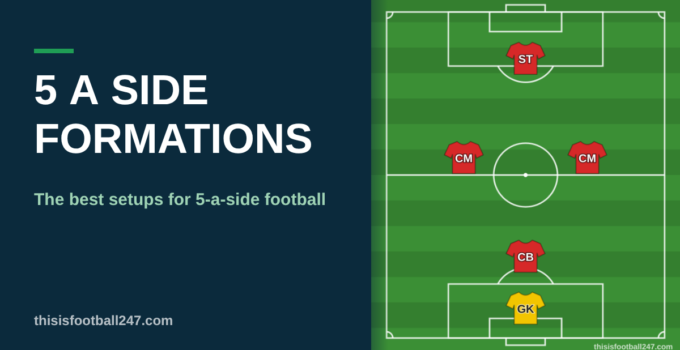
Five-a-side is the purest version of the game. Four outfield players, one goalkeeper, a tiny pitch and a ball that never stops moving. There is no hiding place and no time to switch off, and the team that gets the shape right usually wins, even if the other side has better individuals.
Most weekly games are decided by structure as much as skill. If you want to try out ideas before you play, you can plan your five on our football formation creator. Below is everything you need to know about positions, formations and tactics, with my honest view on what works.
5-a-side Football Positions
A team has five players, which means one goalkeeper and four outfield players. Positions are looser than in 11-a-side, but each role still has its own job.
Check Your Venue’s Rules First
Before you pick a formation, find out what your venue allows, because the rules change the tactics more than people realise. The big ones to check are:
- Whether the keeper has to stay in his area. If he does, you can’t use a rush goalie, and your defender has to cover more ground.
- Whether there’s a head-height rule. If there is, long balls are out, and a diamond that passes on the floor becomes even more valuable.
- Whether the ball is in play off the boards. If it is, a wide player who uses the wall is worth an extra man.
- Whether there are kick-ins or throw-ins. Kick-ins reward a team that’s set up to play quickly from the side.
I’d always ask before the first game. I’ve lost count of the number of teams who turn up planning a rush goalie and find out on the night it gives away a penalty.
Goalkeeper
In most UK leagues, the goalkeeper must stay inside his area, and outfield players cannot enter it. That makes him a specialist. He needs quick reactions, a good throw and the ability to start attacks. Many leagues also use a pass-back rule, so once he has distributed the ball, a team-mate cannot pass it straight back to him. A keeper who can roll the ball accurately to a team-mate’s feet is worth a lot.
Defender
The defender is the player who holds the shape. His job is to stay goal-side, delay the attack and keep the back door closed. He does not have to be the best player, but he has to be the most disciplined. A good defender in 5-a-side talks constantly and never gets pulled out of position.
Midfielders and wingers
The players in the middle are the engine of the team. They link defence and attack, cover the width of the pitch and run the furthest. In some formations they are central midfielders, and in others they act as wingers, hugging the sidelines. Either way, they must be fit and comfortable on the ball.
Pivot (striker)
The pivot is the player at the top of the shape. He holds the ball up, brings others into play and finishes chances. On a small pitch, a good pivot with his back to goal can turn the whole team’s attack. If he is also willing to press the opposition’s defenders, even better.
Best 5 A Side Formations
With four outfield players, formations are described by two or three numbers, with the goalkeeper left out. Here are the shapes that work.
2-2 (the box)
Two defenders and two attackers. It is the simplest setup, and the easiest to explain. The pairs support each other naturally, and it is hard to get outnumbered. The weakness is that the shape can be rigid, and a team that moves the ball quickly can pull the pairs apart. It is a solid choice for a team that has not played together before.
1-2-1 (the diamond)
One at the back, two in the middle, one at the top. It gives you passing angles all over the pitch, and it suits a technical team that wants to keep the ball. The player at the back has to be disciplined, and the player at the front has to work hard. The diamond is demanding, but when it works, it is beautiful to watch.
2-1-1 (the pyramid)
Two defenders, a midfielder and a striker. It is a balanced shape with a strong base. The midfielder links the back and front, and the striker stays high as an outlet. I like it for teams that want to be compact but still carry a threat.
1-1-2 (two up top)
One defender, one midfielder and two strikers. It is an attacking shape that creates problems for defenders. The cost is that you have only one player behind the ball, so you are exposed if you lose it. It works best against weaker teams, or when you need a goal.
3-1 (park the bus)
Three at the back and one up front. It is the most defensive formation you can play. It makes it hard to score against you, but it also gives you little attacking threat. Use it to protect a lead, or if you are up against a far better team and hope to nick a goal on the break.
What is the best formation for 5-a-side football?
There is no perfect answer, but there is a sensible one for most teams. If you are unsure, choose the 2-2. It is balanced, easy to understand and gives you a solid structure to adjust from. The best 5-a-side teams usually keep it simple and change shape only when the game demands it.
Best formation for beginners
The 2-2. It has clear roles, and it is difficult to leave gaps. Everyone knows whether they are a defender or an attacker, and it takes the guesswork out of positioning.
Best formation for an attacking team
The 1-2-1 diamond or the 1-1-2. The diamond gives you more control, with passing angles everywhere, while the 1-1-2 puts more bodies in the final third. My view is that the diamond is the smarter choice, because it lets you attack without losing your structure.
Best formation for a defensive team
The 3-1, or a 2-1-1 with a deep midfielder. Both put more bodies behind the ball and make you hard to break down. If you are protecting a lead, switch to the 3-1 for the last few minutes, and rely on your striker to hold the ball.
Which Formation I’d Actually Pick
Here’s what I’d play depending on the team in front of me:
- A group of mates who’ve never played together: the 2-2. Nobody has to think, and nobody gets lost.
- A team that’s been together a season: the 1-2-1. Once people know each other’s runs, the diamond is the best shape in the game.
- A team that’s better than everyone else in the league: the 1-1-2. You can afford the risk.
- A team that’s getting battered every week: the 2-1-1, not the 3-1. Sitting deep for 40 minutes on a small pitch just invites pressure, and the 2-1-1 at least gives you an outlet.
If I could only ever play one, it’d be the diamond. It’s harder to learn, but it’s the only shape that makes a five feel like a proper team.
Rush Goalie in 5-a-side: Does It Work?
A rush goalie is when the goalkeeper leaves his area and joins the attack, usually in the last few minutes when you are losing. It is a famous tactic in futsal, where it is called a flying goalkeeper, and it can work because you have an extra attacker.
In most UK 5-a-side leagues, you cannot do it. At the big venues, a goalkeeper who leaves his area concedes a penalty, and goalkeepers are not allowed to score. That rules out the rush goalie almost completely.
If your league does allow it, treat it as a last resort. The risk is simple. If you lose the ball, the opposition can shoot into an empty net from anywhere. Only do it in the final two or three minutes, when you have nothing to lose, and make sure your keeper can get back. In every other situation, I would leave him where he is.
5-a-side Tactics and Tips
Never leave the back empty
The quickest way to lose is to have all four outfield players in attack and no one covering. Always keep one player goal-side, so that if you lose the ball, you are not facing a two-on-one with nobody behind you. It is the first rule of 5-a-side, and the one that is broken most often.
Use the walls and the width
Many 5-a-side venues have boards around the pitch, and in most leagues the ball is still in play when it rebounds off them. Use them. A pass off the boards can take out a defender, and a simple one-two with the wall can create space from nothing. Width also stretches the opposition, because a small pitch seems crowded until someone runs to the touchline.
Rotate and swap positions
Five-a-side is exhausting, and the player at the front runs more than anyone. Swap roles every few minutes, so nobody is stuck doing the hardest job. It also confuses the opposition, because players who keep changing position are harder to mark.
Keep the ball on the floor
Many leagues have a head-height rule, which means the ball cannot go above head height, and slide tackles are usually banned. Even where it is allowed, the best advice is to play on the ground. Short, sharp passes keep possession, and a ball in the air is a gift to the other team.
5 A Side vs 7 A Side Formations
The two games feel very different. With seven players and a larger pitch, you can build a full shape with defenders, midfielders and forwards, and use width and depth in a way that is hard on a small court. Five-a-side is more compressed, and shape matters less than movement and quick passing.
In 7-a-side, you have six outfield players to organise, and formations like the 2-3-1 and 3-2-1 give you a proper structure. 6-a-side sits in between, with five outfield players to split. In 5-a-side, you have four, which means every player covers more space and has to be comfortable in attack and defence. If you play both, our guide to 7-a-side football formations covers the bigger game in detail.
I think 5-a-side is the harder game tactically, because you have fewer players to hide mistakes. But it is also more forgiving, because the pitch is small and a bad moment can be forgotten in thirty seconds.
My Verdict
Five-a-side is won by the team that keeps its shape, not the team with the best player. I’ve seen far more games thrown away by four outfield players all chasing the ball than by a team that picked the wrong formation.
My prediction for anyone starting a new team: stick with the 2-2 for the first month, then switch to the diamond. By the end of the season, you’ll be beating sides with better players, because you’ll be the only team on the pitch that knows where everyone’s meant to be.
5 A Side Formation Creator
Want to plan your next game? Use our 5-a-side formation creator to drag your four outfield players and your goalkeeper onto the pitch, try each of the formations above and see how the shape looks. When you are happy with it, build and download your lineup, then send it to the team group chat before you play.