
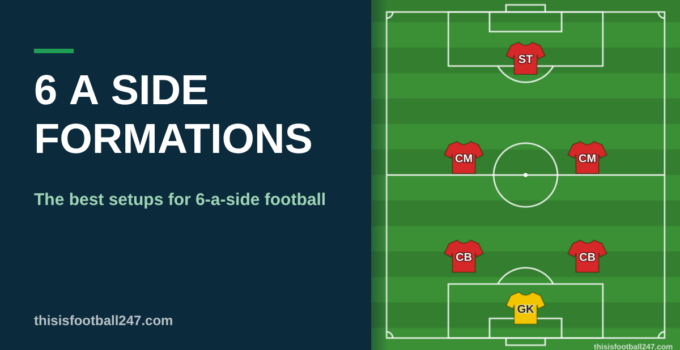
Six-a-side sits in a sweet spot. It is big enough for a proper shape, with defenders, midfielders and a striker, but small enough that every player is involved in every move. There is no time to switch off and no room to hide, and the team with the best structure usually wins.
A lot of weekly games are decided before kick-off, by who goes where. If you want to plan your six, you can try ideas on our football formation creator. Below is everything you need to know about positions, formations and tactics, with my honest view on what works.
6-a-side Football Positions
A team has six players, which means one goalkeeper and five outfield players. That extra outfield player, compared with 5-a-side, makes a big difference. You can build a real structure, and each position has a clear job.
Goalkeeper
The keeper’s job changes more than you’d think when you add one player. With five outfield players, there’s usually a free team-mate somewhere, so a keeper who can spot the spare man and find him quickly is a big asset. In most UK leagues he still has to stay inside his area, and many venues use a pass-back rule, so his first pass matters even more.
Defender
This is where 6-a-side differs most from 5s. With five outfield players, you can afford two defenders without leaving the attack short, so the back line can work as a pair: one presses the ball, the other covers. That partnership is the foundation of most good 6-a-side teams. If your two defenders talk, you’ll concede far less.
Midfielders and wingers
The extra player usually goes into midfield, and it changes the game. In 5-a-side, your midfielders have to do everything. In 6-a-side, one can sit and screen the defence while the other gets forward, or both can hold the width and stretch the pitch. Deciding which before kick-off saves a lot of arguments at half-time.
Pivot (striker)
The pivot gets more support in 6-a-side than in 5s, which changes his role. Instead of having to beat players on his own, he can hold the ball and lay it off to a midfielder arriving late. The best 6-a-side strikers are the ones who make others look good.
Best 6 A Side Formations
With five outfield players, formations are described by the way you split them. Here are the shapes that work.
2-2-1 (the all-rounder)
Two defenders, two midfielders and one striker. It is the default for good reason. It is balanced, easy to explain and gives you a solid base to build from. The midfielders can push up in attack and drop back in defence, and the lone striker has support. If you are unsure, start here.
1-2-1-1 (the diamond)
One defender, two midfielders, an attacking midfielder and a striker. It gives you passing angles all over the pitch, and it suits a technical team that wants to keep the ball. The player at the back must be disciplined, and the attacking midfielder has to work hard. The diamond is demanding, but when it clicks, it is a joy to watch.
2-1-2 (two up top)
Two defenders, one midfielder and two strikers. It gives you two goal threats and a sound base behind them. It works well against teams that sit deep, because the two forwards can pin the defenders. The weakness is the lone midfielder, who can get overrun, so you need a real engine in that role.
1-3-1 (the midfield overload)
One defender, three midfielders and one striker. It floods the middle of the pitch, which makes it excellent for teams that want to dominate possession. The risk is at the back, where one defender has a lot to do, so the midfielders must track back every time the ball is lost.
3-1-1 (park the bus)
Three defenders, one midfielder and one striker. It is the most defensive formation you can play. It makes it hard to score against you, but it gives you little attacking threat. Use it to protect a lead, or if you are up against a much better team and hope to nick a goal on the break.
What is the best formation for 6-a-side football?
There is no perfect answer, but there is a sensible one for most teams. If you are unsure, choose the 2-2-1. It is balanced, flexible and forgiving, and you can adjust it as the game develops. The best 6-a-side teams usually keep it simple and change shape only when the match demands it.
Best formation for beginners
The 2-2-1. Everyone knows whether they are a defender, a midfielder or a striker, and it is difficult to leave gaps. It takes the guesswork out of positioning, which is exactly what a new team needs.
Best formation for an attacking team
The 1-2-1-1 diamond or the 2-1-2. The diamond gives you more control, with passing angles everywhere, while the 2-1-2 puts two strikers in the final third. My view is that the diamond is the smarter choice, because it lets you attack without losing your structure.
Best formation for a defensive team
The 3-1-1, or a 2-2-1 with deep midfielders. Both put more bodies behind the ball and make you hard to break down. If you are protecting a lead, switch to the 3-1-1 for the last few minutes, and rely on your striker to hold the ball.
Rush Goalie in 6-a-side: Does It Work?
In most UK 6-a-side leagues, no. At the big venues, a keeper who leaves his area gives away a penalty, which rules the tactic out. Where it is allowed, it’s even riskier in 6s than in 5s, because the pitch is bigger and the empty net is further away for him to get back to. We cover the tactic in more detail in our guide to 5-a-side football formations.
6-a-side Tactics and Tips
Find the spare player
With five outfield players against five, there’s almost always one free player somewhere. The team that finds him first usually wins. Before every pass, look for the team-mate nobody is marking.
Create two-on-ones out wide
A bigger pitch means more room on the flanks. Get a midfielder and a defender working together on one side, and you’ll keep creating two-on-ones against a single opponent. It’s the easiest way to break down a team that defends narrow.
Let one midfielder hold
The most common mistake in 6s is both midfielders bombing forward. Agree before kick-off which one stays, and the defence will thank you. It’s a small change that stops most counter-attacks before they start.
Switch play quickly
In 5-a-side, the ball rarely travels more than a few yards. In 6-a-side, a quick switch from one side to the other can pull the whole opposition across. Keep it on the floor, especially if there’s a head-height rule, but don’t be afraid to move it fast.
The Mistake I See Most in 6-a-side
If I had to name one thing that loses more 6-a-side games than anything else, it’s teams playing it like 5s. They bunch together, ignore the width and leave the extra player wasted in a crowd. You’ve got a bigger pitch and one more body, so use them.
My favourite formation for 6s is the 2-1-2, as long as you’ve got one midfielder with a big engine. Two strikers give defenders a constant problem, and on a 6-a-side pitch there’s just enough space for them to work. It’s riskier than the 2-2-1, but it’s the most fun to play.
6 A Side vs 5 A Side and 7 A Side Formations
The three formats feel very different. Five-a-side is the most compressed, with four outfield players, so movement and quick passing matter more than shape. If you play it as well, our guide to 5-a-side football formations covers it in detail.
Seven-a-side is the opposite. With six outfield players and a bigger pitch, you can build a full structure with width and depth, and formations like the 2-3-1 and 3-2-1 work properly. Our guide to 7-a-side football formations goes through them.
Six-a-side sits in between. You have enough players to hold a shape, but not so many that it’s easy to hide. I think it’s the most underrated format, because it keeps the intensity of 5-a-side and adds a layer of tactics. Squads are usually small too, so rotation matters.
My Verdict
My prediction is that 6-a-side keeps growing. More venues are adding bigger small-sided pitches, and once a group of mates has tried it, most don’t want to go back to the cramped feel of 5s. If you’re starting a new team, start with the 2-2-1, then move to the 2-1-2 once everyone knows their job.
6 A Side Formation Creator
Want to plan your next game? Use our 6-a-side formation creator to drag your five outfield players and your goalkeeper onto the pitch, try each of the formations above and see how the shape looks. When you are happy with it, build and download your lineup, then send it to the team group chat before you play.