Anyone who has played 7-a-side knows the feeling. The pitch is small, the ball never leaves your feet and every mistake ends up in the back of the net. There is nowhere to hide, no time to think and nobody to bail you out. That is what makes it brilliant, and it is also why picking the right formation matters so much.
Get the shape right and a group of mates can look like a proper team. Get it wrong and you will be chasing shadows by half-time. If you want to try out ideas before the game, you can drag players around a pitch and plan your lineup with our football formation creator. Below is everything you need, from positions to formations to the awkward question of where to put the player who is not very good.
7-a-side football positions
A 7-a-side team has seven players: one goalkeeper and six outfield players. With so few of you, every position carries more responsibility than it does in 11-a-side.
Goalkeeper
In 7-a-side, the goalkeeper is involved all the time. The pitch is small, so the ball comes back to him constantly, and he is often the first attacker as well as the last defender. A good 7-a-side keeper is comfortable with the ball at his feet, quick off his line and loud. If your keeper cannot pass, your team will struggle to get out of its own half.
Defenders
You will usually have two or three defenders. Their job is to protect the goal and win the ball, but also to start attacks. On a small pitch there is little room behind you, so defenders must stay compact and communicate. The best defenders in 7-a-side are not the biggest. They are the ones who read the game early and do not get dragged out of position.
Midfielders
The midfielders are the engine. They link defence and attack, cover the width of the pitch and are usually the players running the furthest. In most formations you have two or three of them, and they need to be fit, tidy on the ball and willing to work both ways.
Striker
Many setups use a lone striker, and it is a demanding role. He has to hold the ball up, run the channels, pressure defenders and finish chances. The best 7-a-side strikers are not just goalscorers. They are the first line of defence too.
How 7-a-side positions differ from 11-a-side
The big difference is space. In 11-a-side, a full-back can spend ten minutes without touching the ball. In 7-a-side, everyone touches it constantly. That means every player needs to be comfortable attacking and defending, because the game switches so quickly.
Specialist roles also matter less. A centre-half who cannot pass is a liability, and a striker who will not track back leaves you short. Think of positions as areas of the pitch, not fixed jobs.
It changes again as the numbers drop. With seven players, you have six outfield players to organise, which is why proper shapes like the 2-3-1 work so well. In 6-a-side you have five, so every position carries even more responsibility, and our guide to 6-a-side football formations shows how to split them. In 5-a-side, with only four outfield players, it’s all movement, quick passing and rotation, which we cover in our guide to 5-a-side football formations.
Best 7 aside football formations
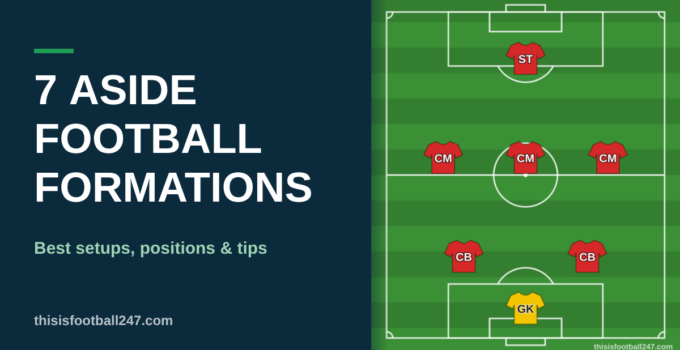
Formations in 7-a-side are described by the six outfield players, with the goalkeeper left out. A 2-3-1, for example, means two defenders, three midfielders and one striker.
2-3-1 (the all-rounder)
This is the default for good reason. Two defenders give you cover at the back, three midfielders control the middle and a lone striker stays up top. It is flexible, easy to understand and works at almost every level. The wide midfielders can push up in attack and drop in defence, which makes it a very natural shape for a mixed group. If you only learn one formation, learn this one.
3-2-1 (solid at the back)
Three at the back, two in midfield and one up front. It is the safest shape, and it is good for a team that wants to stay compact and counter-attack. The trade-off is that your midfield is thin, so the two in the middle need to cover a lot of ground. I would pick this if you are up against a stronger side and want to keep it tight.
2-1-2-1 (the diamond)
Two defenders, one holding midfielder, two wide players and a striker. It looks like a diamond and gives you plenty of passing angles. It is excellent for a technical team that likes to keep the ball. The downside is that it demands fitness and discipline, because the wide players and the holding midfielder have to do a lot of running.
3-1-2 (two up top)
Three defenders, a single midfielder and two strikers. It gives you two goal threats and a solid base, and it works well against teams that sit deep. The weakness is the lone midfielder, who can get overrun. You need a real engine in that role.
2-2-2 (balanced pairs)
Two defenders, two midfielders and two forwards. It is simple, balanced and easy to explain to anyone, which is why it works well for casual teams. The pairs support each other naturally, and it is hard to be outnumbered anywhere. The risk is that there is little width, so teams that spread play can stretch you.
1-2-1-2 (all-out attack)
One defender, two midfielders, an attacking midfielder and two strikers. This is the shape for a team that wants to win at all costs, or needs a goal. It will create chances, but you will leave yourself open at the back. I would only use it for the last ten minutes, or against a team much weaker than yours.
How I’d rank them
If you’re putting together a team of mates for a weekly game, here’s my order, best to worst:
- 2-3-1. It’s the one I’d always start with, because it’s the hardest to get badly wrong.
- 2-2-2. The easiest to explain in a car park five minutes before kick-off.
- 3-2-1. Brilliant when you’re the weaker side, dull when you’re not.
- 2-1-2-1. The best on paper, but it falls apart the moment someone stops running.
- 3-1-2. Only works if you’ve got one midfielder who never gets tired, and most teams don’t.
- 1-2-1-2. Fun for ten minutes, a disaster for fifty.
What is the best formation for 7 aside?
There is no single answer. The best formation depends on who you have, who you are playing and what you need. If you want a safe starting point, go with 2-3-1. It is balanced, flexible and forgiving, and you can adjust it as the game develops.
Best formation for a defensive team
3-2-1. The extra defender gives you cover, and the compact shape makes it hard to play through you. Use the two midfielders to shield the back three, and rely on quick counters through the striker. It is a good choice if you are the underdog or protecting a lead.
Best formation for an attacking team
2-1-2-1 or 1-2-1-2. The diamond gives you plenty of attacking options without losing all your structure. If you want to go further, 1-2-1-2 pushes numbers forward, but be prepared to concede. I think the diamond is the better bet, since it gives you more control.
Best formation if you have no subs
If you are playing with no substitutes, think about legs. A tired team makes mistakes, and 7-a-side is exhausting. A 2-3-1 or 3-2-1 will be the most sustainable, because the shape stays compact and does not require as much running as a diamond or an attacking shape. Rotate roles during the game if you can, so nobody runs out of energy in the same position for 50 minutes.
Attacking vs Defensive 7-a-side Formations
Here is how the shapes compare:
| Formation | Style | Best for | Main risk |
|---|---|---|---|
| 3-2-1 | Defensive | Protecting a lead, counter-attacking | Thin midfield |
| 2-3-1 | Balanced | Most teams, most games | Lone striker can be isolated |
| 2-2-2 | Balanced | Casual teams, simple structure | Lack of width |
| 3-1-2 | Defensive-attacking | Teams with a strong holding midfielder | Midfield overrun |
| 2-1-2-1 | Attacking | Technical, fit teams | Gaps behind the wide players |
| 1-2-1-2 | Very attacking | Chasing a goal | Exposed at the back |
My rule of thumb is that the more attacking the formation, the more fitness and discipline it demands. A defensive shape forgives mistakes. An attacking shape does not.
Tips for Playing 7-a-side Football
Keep your shape when you lose the ball
The fastest way to lose a 7-a-side game is to lose the ball and have six players in the wrong place. As soon as you lose possession, get back into your shape. It does not have to be perfect, but you need to be compact enough that the opposition cannot play through you.
Use the goalkeeper to build from the back
On a small pitch, the goalkeeper is a free extra player. If he can pass accurately, he gives you an extra option when under pressure, and it lets you play out through the defence. A keeper who just kicks it long is wasting a weapon.
Rotate positions to save legs
If you are playing with few subs, rotate who does the hardest jobs. The wide midfielders and the striker run the most, so swap them every ten minutes or so. Fresh legs in the right places can win you a game in the last quarter.
Communicate (the one thing every Sunday team forgets)
Talk to each other. Shout who is picking up who, call for the ball and tell your team-mates when someone is on their shoulder. It costs nothing, it makes the team feel connected, and most Sunday teams barely do it. The loudest team on the pitch is often the best organised.
Where do you put weak players in 7v7 soccer?
Every team has one, and it is an awkward question. The honest answer is that there is nowhere to hide in 7-a-side, but there are ways to give a less experienced player a role where he can contribute.
Why hiding a player rarely works
On a pitch this small, the ball finds everyone. If you stick a weaker player in a corner and hope the game passes him by, he will touch the ball constantly, and the opposition will target him. It is also demoralising for the player, who knows what you are doing.
Best positions for less experienced players
The safest options are usually in the back two of a 2-3-1, paired with a stronger partner, or in a wide midfield role with clear, simple jobs. Give him something concrete to do, such as holding his width, tracking one runner or passing simply to a team-mate. Avoid putting him in goal or as a lone striker, because both positions demand a lot.
How to cover for a weaker player as a team
Make sure the players around him are strong communicators. A good partner will talk him through the game and cover his space when he steps out. Make the rest of the shape compact, so the gap between players is small. And keep the instructions simple. A player with one clear job will usually do better than one with five.
7-a-side Formations for Kids and Youth Football
7v7 is now the standard format for under-10s and under-11s in England. It’s part of the FA’s Future Fit changes, which came in this season and mean young players stay on smaller formats for longer. Under-9s have dropped from 7v7 to 5v5, and under-11s, who used to play 9v9, now play 7v7 instead.
The recommended pitch is 55 metres by 37 metres, with goals of 12 feet by 6 feet and a size 3 ball. Matches last up to 50 minutes, with rolling substitutions so everyone gets plenty of game time. Deliberate heading has also been phased out at this level, and from this season that includes under-11s.
At this age, the formation matters far less than the experience. The best advice from the governing body is to let children try different positions, so they learn the game and develop a broad range of skills. I would use a simple 2-3-1 or 3-2-1, rotate positions between matches and focus on encouraging players to have the ball and try things.
The result is the least important part of youth football. If the children are smiling at the final whistle, you have got it right.
My Take
If you take one thing from this guide, make it this: the formation matters less than everyone sticking to it. I’ve seen far more 7-a-side games lost by a team that forgot its shape than by one that picked the wrong one.
My prediction is that 7-a-side is about to get a lot more popular. With every under-10 and under-11 in England now playing 7v7, a whole generation is growing up on the format, and plenty of them will keep playing it as adults. I’d bet the 2-3-1 is still the default in every Wednesday night league ten years from now.
7 a side formation creator
Want to plan your next game? Use our 7-a-side formation creator to drag your players onto the pitch, try different formations and see how the shape looks. When you are happy with it, build and download your lineup, then send it to the team group chat before kick-off.