I wrote about this months ago when Gianni Infantino first announced that the World Cup final would feature a halftime show for the first time in the tournament’s history. I said it was unnecessary. I said the World Cup final did not need a support act. I said the beautiful game does not require an interval concert to make it more watchable.
What I did not anticipate was that the halftime show would be only one part of a broader entertainment operation that turned the World Cup final into a three act variety performance with a football match attached.
Before the halftime show even happened, the supporters who had paid thousands to attend the biggest football match in the world were subjected to a closing ceremony that lasted long enough to make several of them question whether they had accidentally bought tickets to the wrong event.
Before Kickoff: The Closing Ceremony Nobody Asked For
The pre-match entertainment at MetLife Stadium featured Robbie Williams performing the official FIFA anthem Desire alongside Nicole Scherzinger and Laura Pausini, IShowSpeed doing whatever it is IShowSpeed does, Jennifer Hudson singing the American national anthem, and Tom Cruise standing alone in the centre circle in a black polo shirt delivering a speech about the unifying power of football.
Tom Cruise. Standing on the pitch. At a World Cup final between Spain and Argentina. Telling eighty thousand people, the vast majority of whom had travelled from Europe and South America to watch football, that football is a language spoken without words that unites people and turns strangers into friends.
Roy Keane’s response, captured on camera and shared millions of times within minutes, said everything that needed saying. The look on his face communicated what every football supporter in the ground and watching at home was thinking more effectively than any words could have managed.
I do not have a problem with Tom Cruise. He is an excellent actor. He has made some brilliant films. His commitment to performing his own stunts is genuinely impressive. But watching him stand in the centre of a football pitch before a World Cup final and deliver a motivational speech about a sport he has no connection to, in a country that calls it soccer, was one of the most painfully unnecessary things I have witnessed at a football match.
Robbie Williams in a bedazzled Adidas tracksuit singing a FIFA anthem nobody had heard before the tournament started. Nicole Scherzinger in a blue gown. Laura Pausini, an Italian pop star, at a final featuring neither Italy nor any Italian speaking nation. IShowSpeed, a YouTube streamer, performing to a crowd of football supporters whose average age suggested the majority of them had no idea who he was or why he was there.
The fans in the stadium had not paid to hear Tom Cruise talk about unity. They had not saved for months and flown across oceans to watch Robbie Williams in a sparkly tracksuit. They had come to watch Spain versus Argentina. They had come for Messi and Rodri and Yamal. They had come for football.
The closing ceremony was the appetiser that nobody ordered before a meal they were already desperate to eat. By the time kickoff actually arrived, the event had been running for over an hour and not a single ball had been kicked.
And then came halftime.
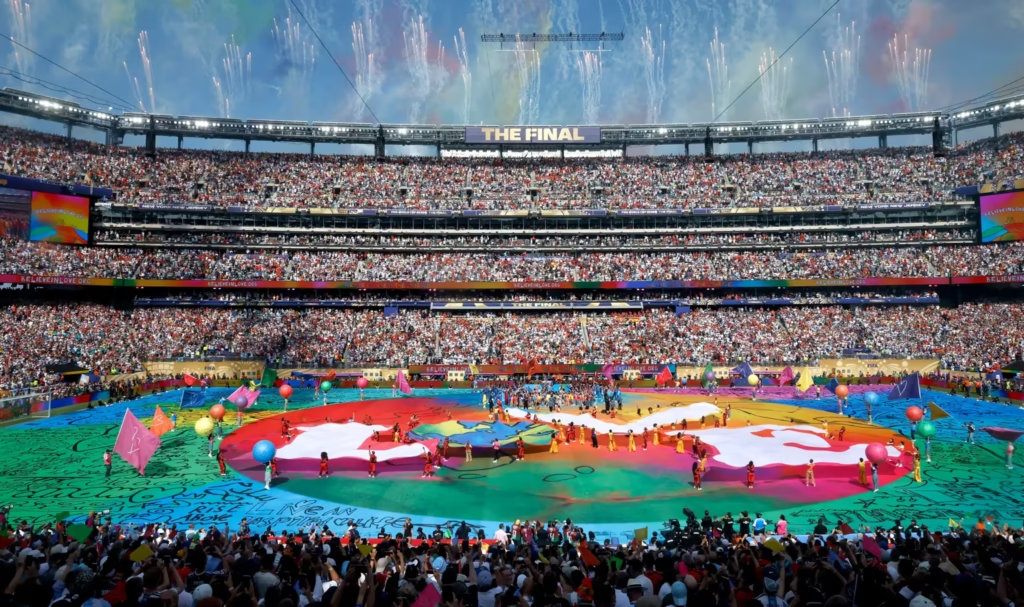
What Actually Happened at Halftime
The normal halftime break at a World Cup final is fifteen minutes. This one lasted twenty seven.
Twenty seven minutes. In the middle of a World Cup final between Spain and Argentina. With Lionel Messi sitting in a dressing room at thirty nine years old, possibly playing the last competitive match of his career, waiting for Madonna to finish riding around on a dune buggy with two retired Brazilian footballers before he could go back out and try to win the biggest game of his life.
The show ran for eleven minutes of performance within the twenty seven minute total break that included stage construction, breakdown and time for substitution warmups. Each headliner performed for approximately two minutes.
Madonna opened the show. She arrived through the stadium tunnel on a dune buggy driven by Ronaldo, the Brazilian one, with Ronaldinho riding alongside. She performed her 2000 hit Music, the one about music making the people come together, which is a perfectly fine song that has absolutely nothing to do with football or the World Cup or the two teams that had just played forty five minutes of a scoreless final that had every supporter in the ground and every viewer at home completely engrossed.
Gustavo Dudamel, the Venezuelan conductor, then appeared to conduct The Muppets in a rendition of Seven Nation Army. The Muppets. At a World Cup final. Miss Piggy and Kermit the Frog staring into each other’s eyes while eighty thousand people who had paid to watch Spain versus Argentina sat in their seats processing the fact that puppet characters from a children’s television show were now part of the most important football match of the year.
BTS followed with Dynamite, performing with the kind of choreographed precision that has made them one of the biggest acts in the world. Their two minutes were, by most accounts, the strongest musical performance of the show. The choreography was sharp, the energy was genuine, and the crowd responded.
Then Jason Sudeikis appeared as Ted Lasso. The fictional American football coach from a television show. At a real World Cup final. He introduced Justin Bieber, who performed Everything Hallelujah on guitar, changing the final line to World Cup Hallelujah. It was a quieter moment that some reviewers described as touching and others described as bewildering in the context of a World Cup final where neither team was American and the connection between the performer and the occasion was unclear.
Shakira and Burna Boy closed the performances with Dai Dai, the official tournament song, before Chris Martin led a children’s choir in a song called Believe in Love, with elementary school students from Staten Island joining the remaining performers on the pitch.
Eleven minutes of music. Twenty seven minutes of total disruption to a World Cup final that did not need disrupting. And that is before you factor in the hour of pre-match entertainment that had already taken place.
What the Players Were Doing
This is the part that I keep coming back to because it is the part that matters most and the part that the people who designed the show appear to have considered least.
Lionel Messi was in the Argentina dressing room. He was thirty nine years old. He was potentially playing the last match of his international career. He had just completed forty five minutes of a World Cup final in which Argentina and Spain had been locked at nil nil in a tactical battle of genuine intensity and sophistication.
The normal halftime interval in football exists for a reason. Fifteen minutes for players to recover physically, for managers to deliver team talks, for tactical adjustments to be communicated and absorbed, for the second half strategy to be set. That fifteen minute window is one of the most important periods in any football match and in a World Cup final its significance is amplified beyond measure.
The players got twenty seven minutes instead. Nearly double the normal interval. The stage had to be built, the performances had to happen, the stage had to be removed and the pitch had to be cleared before the second half could begin.
Any sports scientist will tell you that extending a halftime break significantly changes the physical dynamics of the second half. Muscles cool down differently over twenty seven minutes than they do over fifteen. The warm up protocols that players use to prepare for the restart are calibrated for a specific interval length. Extending that interval introduces variables that the players and the coaching staff have not prepared for and cannot control.
In a World Cup final. Between two teams who had prepared for this match for weeks. Whose entire tactical approach for the second half was predicated on a fifteen minute break that was extended by twelve minutes because FIFA needed time for The Muppets.
The Entertainment Was Not the Problem
I want to be clear about something because I think it is important to separate the quality of the entertainment from the principle of the decision.
The performances were fine. Madonna is a global icon whose presence at any event is significant. BTS delivered a polished, professional two minutes. Bieber’s acoustic moment had a simplicity that worked in its own right. Shakira belongs at a World Cup more than almost any other artist alive given her history with the tournament. Burna Boy’s energy was genuine. Robbie Williams can perform in his sleep and did so capably before kickoff.
None of these artists did anything wrong. They were invited to perform at the biggest sporting event in the world and they performed with the professionalism that their careers have been built on.
The problem was never the quality of the entertainment. The problem was the principle that entertainment was needed at all.
The World Cup final is not the Super Bowl. The comparison that FIFA used to justify the halftime show falls apart the moment you examine it with any seriousness. The Super Bowl has a built in thirty minute halftime break that exists regardless of whether there is a show or not. The sport is structured around that interval. The players expect it. The coaches plan for it. The entertainment fills time that would otherwise be empty.
Football does not work that way. The fifteen minute interval is functional, not ceremonial. Extending it to accommodate a concert changes the conditions of the match itself. The entertainment does not fill dead time. It creates dead time that would not otherwise exist.
The Full Picture of What Happened Yesterday
Let me lay out the complete timeline of what supporters at MetLife Stadium experienced yesterday because seeing it all together is more powerful than examining each piece individually.
They arrived at the stadium and were encouraged to be in their seats early for the closing ceremony. They watched Robbie Williams, Nicole Scherzinger and Laura Pausini perform the FIFA anthem. They watched IShowSpeed. They watched Jennifer Hudson sing the American national anthem. They watched Tom Cruise deliver a speech about the unifying power of football from the centre circle. They waited for the stage to be cleared and the pitch to be prepared.
Kickoff happened. Forty five minutes of brilliant, tense, scoreless football.
The halftime whistle blew. They watched a stage being constructed on the pitch. They watched Madonna arrive on a dune buggy. They watched The Muppets. They watched BTS. They watched Ted Lasso introduce Justin Bieber. They watched Shakira and Burna Boy. They watched Chris Martin and a children’s choir. They watched the stage being dismantled. They waited for the pitch to be cleared again.
The second half started. Seventy five more minutes of football, including extra time, culminating in Ferran Torres scoring the winning goal in the 106th minute.
Then the trophy ceremony. Then Trump and Infantino being booed. Then the celebrations.
The football was extraordinary. Spain’s defensive performance was historically dominant. The goal was worth waiting for. The result will be remembered for decades.
But the football existed within a wrapper of entertainment and ceremony and corporate spectacle that took a World Cup final and turned it into something that felt, at times, more like a product launch than a sporting event.
What It Was Really About
The halftime show was sponsored by Topps, the trading card company. The official name was the Topps Final Halftime Show. That branding tells you everything about why it existed.
This was not a gift to football supporters. It was not an enhancement of the matchday experience. It was not a celebration of the beautiful game or a tribute to the two nations competing for the biggest prize in football.
It was a commercial product. A sellable, sponsorable, broadcastable eleven minutes of content designed to attract viewers who might not otherwise watch a World Cup final and to create advertising inventory that did not previously exist in football’s most watched fixture.
The pre-match closing ceremony served the same purpose. More broadcast time. More sponsor exposure. More opportunities to insert commercial content into the spaces around the football.
FIFA looked at the entire match day experience and saw unused commercial real estate everywhere. Before the match. During the interval. Around the trophy ceremony. Every gap between football was an opportunity to generate revenue and every opportunity was taken.
The players, the supporters in the ground and the football itself were the tenants who had to accommodate the construction.
Where This Goes Next
The question now is whether the halftime show and the extended pre-match entertainment become permanent fixtures of the World Cup final or whether they were one off experiments that FIFA assesses honestly and decides not to repeat.
I am not optimistic about the second option. The commercial logic that justified the show in the first place has not changed and the revenue it generated will strengthen the argument for its continuation. Infantino described the broader World Cup entertainment programme as a success. The language of permanence is already present in how FIFA discusses it.
The 2030 World Cup final will be staged in either Spain, Portugal or Morocco. If a halftime show accompanies it, the format will have been established and the precedent set. Every subsequent World Cup final will feature a concert in the middle of it, the interval will be extended to accommodate it, and the match itself will be shaped around the entertainment rather than the entertainment being shaped around the match.
Football supporters who care about the purity of the occasion, about the idea that a World Cup final is ninety minutes of football and nothing more, will have lost a battle they were never really given a chance to fight. The decision was made without consultation, implemented without consent, and will be continued without regard for the views of the people whose passion for the sport is the only reason the event has commercial value in the first place.
Leave the Beautiful Game Alone
I said it months ago and I will say it again now that the show has happened.
The World Cup final does not need a halftime show. It does not need a closing ceremony. It does not need Tom Cruise. It does not need The Muppets performing Seven Nation Army. It does not need a bedazzled Robbie Williams or a fictional American television character introducing Justin Bieber.
It needs two teams, a pitch, a ball and ninety minutes.
Twenty seven minutes of halftime entertainment yesterday. Over an hour of pre-match ceremony. Madonna on a dune buggy. Kermit the Frog at a World Cup final. Ted Lasso subbing in Justin Bieber. Tom Cruise explaining football to football fans.
The beautiful game does not need a support act. It proved that for nearly a century before FIFA decided otherwise. And the fact that the show was polished and professional and featured some of the biggest names in entertainment does not change the fundamental point.
Football was enough. It was always enough. The people running the game are the only ones who have never quite believed that.