There is a specific kind of footballer who makes the game look like it was designed for them and them alone. A player whose relationship with the ball is so natural, so completely without visible effort, that watching them play feels less like watching sport and more like watching someone express something fundamental about themselves through movement.
Zinedine Zidane was that kind of footballer. The most elegant player who has ever lived. A man whose touch was so perfect that the ball appeared to obey him out of respect rather than physics. Whose body moved through football matches with a grace that belonged to dance rather than sport. Whose capacity for the extraordinary moment on the biggest stage was matched only by the capacity for the catastrophic one that defined the final act of his career.
My dad watched Zidane throughout his career and described him in terms that he did not use for any other player. Not the warmth he had for Keegan. Not the awe he reserved for Best and Maradona. Something closer to reverence for a craftsman. The appreciation of someone watching a person do something so well that the act itself becomes beautiful regardless of the context.
I watched Zidane in his later years, the Real Madrid years, the World Cup years, and I understood immediately what my dad had been trying to articulate. There are players who are exciting. Players who are brilliant. Players who are effective. And then there is Zidane, who was all of those things while also being the most aesthetically perfect footballer the world has ever seen.
His career ended with a headbutt in a World Cup final. That sentence is so perfectly, so completely Zidane that it could serve as the entire article. The most elegant player in history choosing the most inelegant possible exit. The genius and the madness contained in the same person, expressed on the same night, on the biggest stage the sport provides.
Marseille and La Castellane
Zinedine Zidane was born in 1972 in Marseille to Algerian parents who had emigrated from the Kabyle region. He grew up in La Castellane, a housing estate in the northern suburbs of the city that was characterised by the specific kind of poverty that produces either nothing or everything depending on who emerges from it.
The football started on the concrete pitches of La Castellane, the informal games between buildings that served as the development pathway for generations of French footballers from immigrant backgrounds. The surface was unforgiving. The spaces were tight. The technical demands of playing in those conditions, the close control required to keep the ball on concrete, the body movement needed to create space in areas where space barely existed, shaped the player Zidane became in ways that no formal academy could have replicated.
He was spotted by AS Cannes and joined their youth system at fourteen. The move from La Castellane to the relative comfort of a professional football club’s academy was the first of several transitions in Zidane’s life that took him progressively further from his origins without ever fully disconnecting him from them. He has spoken throughout his career about La Castellane and about his Algerian heritage with a consistency that suggests both remained central to his identity regardless of how far the football took him.
He made his professional debut at seventeen. By twenty he was at Bordeaux, developing into the midfielder that the rest of Europe was beginning to pay attention to. By twenty four he was at Juventus. By twenty nine he was at Real Madrid for a world record fee. The trajectory was steep and the quality that drove it was obvious from the first moment anyone watched him play.
The Touch
Before we talk about the goals and the trophies and the World Cups and the headbutt, I want to talk about Zidane’s touch because it was the quality that separated him from every other midfielder of his generation and that made watching him a fundamentally different experience to watching anyone else.
A footballer’s first touch is the most revealing indicator of their quality. The ability to receive the ball, regardless of the pace or the angle or the pressure from opponents, and control it instantly into the exact position from which the next action can be executed is the foundation on which everything else is built.
Zidane’s first touch was perfect. Not good. Not excellent. Perfect. The ball arrived at him from every conceivable angle, at every conceivable speed, under every conceivable degree of defensive pressure, and it died at his feet as though the laws of physics had been temporarily suspended to accommodate his preferences.
The roulette, his signature move, was the most visible expression of his technical mastery. Receiving the ball under pressure, spinning away from the defender using the sole of his foot to drag the ball through a 360 degree turn, emerging on the other side with the ball under complete control and the defender behind him wondering what had happened. It was not a trick in the conventional sense. It was a functional piece of football executed with the elegance of a pirouette.
But the roulette was simply the most dramatic version of something Zidane did constantly and without apparent effort. Every touch was precise. Every pass was weighted correctly. Every movement with the ball at his feet was smooth and unhurried and completely in control. He played football the way a concert pianist plays a familiar piece, with the relaxation and the confidence that comes from having internalised the mechanics so completely that the conscious mind is free to focus on expression rather than execution.
The elegance was not performative. It was structural. Zidane did not add elegance to his football the way a player might add a step over or a no look pass. The elegance was the football. The two things were the same. He could not have played ugly football if he had tried because the technical quality that produced the elegance was the same technical quality that produced the effectiveness.
Juventus and the Making of a Champion
Zidane joined Juventus in 1996 and spent five years in Turin developing from an exceptional midfielder into one of the greatest players the game had ever seen.
Serie A in the late 1990s was the strongest domestic league in the world. The tactical sophistication, the defensive quality, the concentration of world class talent across multiple clubs made it the most demanding environment any footballer could operate in. Succeeding in Serie A required not just technical ability but tactical intelligence, physical resilience and the mental capacity to perform consistently in matches that were structurally designed to prevent you from performing.
Zidane thrived. He won two Serie A titles with Juventus. He reached two Champions League finals, losing both, a disappointment that became the primary motivation for his subsequent move to Real Madrid. His performances in Italian football established him as the complete midfielder, a player who could create, who could score, who could control the tempo of a match, who could produce the decisive moment in the biggest games, and who did all of it with a grace that the cynical, defensive foundations of Italian football could not suppress.
The Champions League final defeats were painful for Zidane and they shaped his career in ways that became apparent later. He wanted the biggest trophy in club football. Juventus could not give it to him. Real Madrid could.
The Volley
In 2001 Real Madrid signed Zidane from Juventus for approximately £46 million, a world record fee at the time. He joined the Galacticos, the collection of the world’s most famous and most talented players that Florentino Perez was assembling with the commercial ambition of a man building a brand as much as a football team.
Figo. Ronaldo. Beckham. Roberto Carlos. Raul. Zidane arrived into a squad of individual brilliance that needed a central intelligence to organise it and elevate it from a collection of stars into a functioning team.
The Champions League final against Bayer Leverkusen in 2002 at Hampden Park in Glasgow produced the goal that defined Zidane’s career at club level and that stands as one of the greatest goals ever scored in a Champions League final.
Roberto Carlos crossed the ball from the left side. It arrived at Zidane on the edge of the penalty area, dropping over his left shoulder at a height and an angle that invited a header or a chest and volley or, most sensibly, a controlled touch to bring the ball down before shooting.
Zidane volleyed it first time with his left foot. The ball flew into the top corner with a power and a precision that made the goalkeeper irrelevant and that made everyone watching, in the stadium and on television screens around the world, produce a noise that was not quite a cheer and not quite a gasp but something between the two that only genuine shock can generate.
The technique required to strike a dropping ball on the volley with the weaker foot, from that distance, under the pressure of a Champions League final, and direct it into the top corner is so extreme that most professional footballers would not attempt it in training. Zidane did it in the biggest club match of the year with the composure of someone who had been expecting the ball to arrive at exactly that angle and had already decided what he was going to do with it.
The goal won Real Madrid the Champions League. It gave Zidane the trophy that had eluded him at Juventus. And it produced an image, the ball leaving his boot, his body perfectly balanced, the connection between foot and ball so clean that the follow through looked choreographed, that is as close to a perfect sporting photograph as football has ever generated.
France 1998 and 2006
Zidane’s international career produced two World Cup finals, one triumph and one catastrophe, and together they tell you more about who he was than any club career could.
The 1998 World Cup in France was the tournament that established Zidane as the best player in the world. Playing on home soil, with the weight of an entire nation’s expectations on his shoulders, he produced a performance in the final against Brazil that was decisive and emphatic. Two headers. Both from corners. A player not known for his aerial ability scoring twice with his head in a World Cup final to give France their first ever World Cup.
The image of Zidane’s face projected onto the Arc de Triomphe after the final, the entire nation celebrating the son of Algerian immigrants who had given them the biggest trophy in football, is one of the most culturally significant images in French sporting history. Zidane did not just win the World Cup. He became a symbol of a multicultural France that could achieve anything when it worked together. The significance went far beyond sport.
Euro 2000 followed with another triumph, Zidane again central to everything France achieved. The golden generation of French football, Vieira, Henry, Thuram, Desailly, Barthez, with Zidane as its conductor, was the most dominant international side of the late 1990s and early 2000s.
Then came 2006. The final act. The World Cup in Germany that Zidane had come out of international retirement to play in, persuaded back by Raymond Domenech for one last tournament at the age of thirty four.
What he produced across that tournament was extraordinary even by his own standards. Against Brazil in the quarter final he was the best player on the pitch in a match that contained Ronaldo, Ronaldinho, Kaka and Roberto Carlos. Against Spain in the round of sixteen he controlled the game with a maturity and a composure that suggested retirement had refreshed rather than diminished him. Against Portugal in the semi final he scored the penalty that sent France to the final.
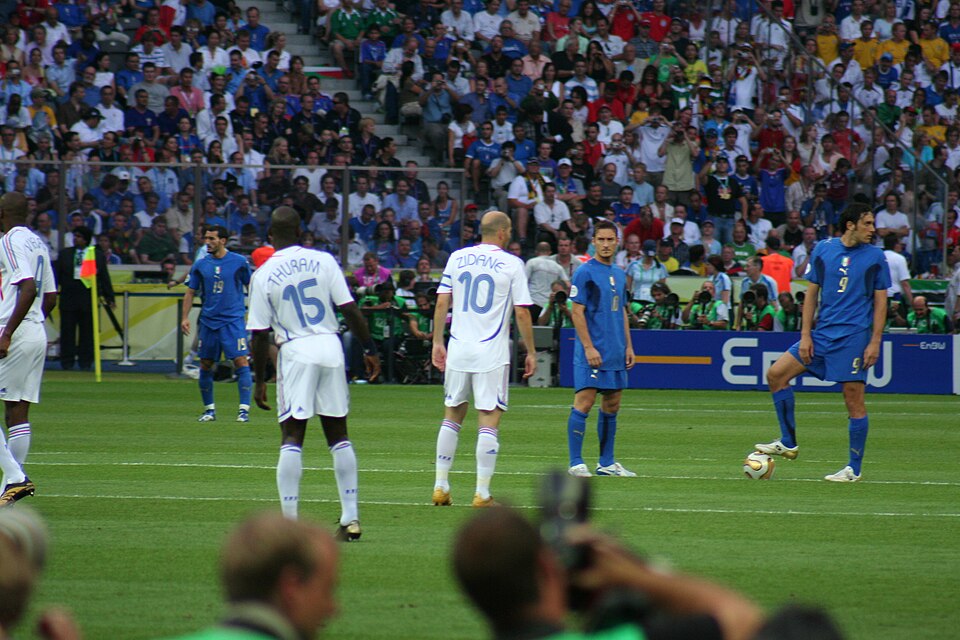
He arrived at the World Cup final against Italy as the best player in the tournament, playing what everyone knew would be the last match of his career, carrying the hopes of a nation that wanted him to end his story with the most perfect possible conclusion.
The Headbutt
The 2006 World Cup final between France and Italy in Berlin is the match that the football world cannot stop thinking about because of how it ended and because of what that ending says about the man at the centre of it.
Zidane scored in the seventh minute. A Panenka penalty, chipped down the middle with an audacity that was either supreme confidence or supreme arrogance depending on your perspective. The ball clipped the underside of the crossbar and bounced down over the line. France were ahead. Zidane was playing beautifully. The fairy tale ending was being written in real time.
Italy equalised through Marco Materazzi. The match went to extra time. Zidane continued to play well. A header that Buffon saved brilliantly in extra time came close to providing the winning goal that would have completed the narrative perfectly.
And then, in the 110th minute, with twenty minutes remaining in the final match of his career, Zinedine Zidane headbutted Marco Materazzi in the chest and was sent off.
The incident happened away from the ball. Materazzi had been talking to Zidane throughout the match. The exact words that provoked the headbutt have been the subject of endless speculation, investigation and eventual partial confirmation. Materazzi said something about Zidane’s sister. The precise nature of the insult has been described in various accounts as involving his family and potentially his Algerian heritage.
Zidane turned. He walked back toward Materazzi. He lowered his head. He drove it into Materazzi’s chest with a force and a deliberateness that left no ambiguity about the intention. Materazzi fell. The referee was alerted by the fourth official who had seen the incident on the monitor. The red card was shown.
Zidane walked off the pitch. He walked past the World Cup trophy that was positioned beside the tunnel. The most elegant footballer who had ever lived walked past the trophy he had won eight years earlier and that he would not win again, dismissed from his final match for an act of violence that was as inelegant as anything the sport has ever produced.
France lost the penalty shootout. Italy were world champions. Zidane’s career ended with a red card in a World Cup final.
The Man Who Contained Everything
I have thought about the headbutt for years and I keep arriving at the same conclusion.
It makes sense. Not morally. Not tactically. Not in any way that a rational analysis of professional behaviour would endorse. But it makes sense as an expression of who Zidane actually was, as opposed to who the elegance on the pitch sometimes suggested he was.
The touch was perfect. The control was absolute. The grace was genuine. But underneath all of it was a man from La Castellane whose relationship with the world was not always graceful, whose temper was real, whose willingness to respond to provocation with physical force was documented across his entire career in a series of red cards and confrontations that the elegance tends to obscure.
Zidane was sent off fourteen times during his career. Fourteen. The most elegant footballer who ever lived was also one of the most frequently dismissed. The contradiction is not a contradiction at all when you understand that the intensity which produced the extraordinary football was the same intensity that produced the headbutt. You could not have one without the other. The passion that made the volley possible was the same passion that made the headbutt inevitable given the right provocation at the right moment.
The 2006 World Cup final provided the right provocation at the right moment. And Zidane, being Zidane, responded with the full force of his personality in a way that was simultaneously the worst possible decision and the most authentically Zidane decision he could have made.
The Legacy of Contradiction
Zinedine Zidane’s career contains the volley and the headbutt. The 1998 World Cup triumph and the 2006 World Cup dismissal. The most beautiful goal in Champions League final history and the most infamous red card in World Cup final history. The elegance and the violence. The control and the loss of it.
He went on to manage Real Madrid and won the Champions League three times in a row, an achievement so extraordinary that it would define the legacy of any other person in football. For Zidane it is almost a footnote, mentioned after the playing career rather than alongside it, because what he did on the pitch was so transcendent that even three consecutive European Cups as a manager cannot match it.
The volley at Hampden Park is the image I return to most often when I think about Zidane. The ball dropping over his shoulder. The body perfectly balanced. The left foot connecting with a cleanness that defied the difficulty of what he was attempting. The ball flying into the top corner. The silence before the noise.
That is Zidane at his purest. The moment where technique and instinct and courage and the specific genius that only he possessed combined to produce something that nobody else could have produced and that nobody has produced since.
The headbutt is the other image. The one that ended everything. The one that introduced chaos into the final act of a career that had been defined by control.
Both are Zidane. Both are true. Both are necessary to understand who he was.
The most elegant footballer who ever lived. The man who contained perfection and destruction in equal measure and who expressed both on the biggest stage the sport provides.
There has never been anyone like him. There never will be again.