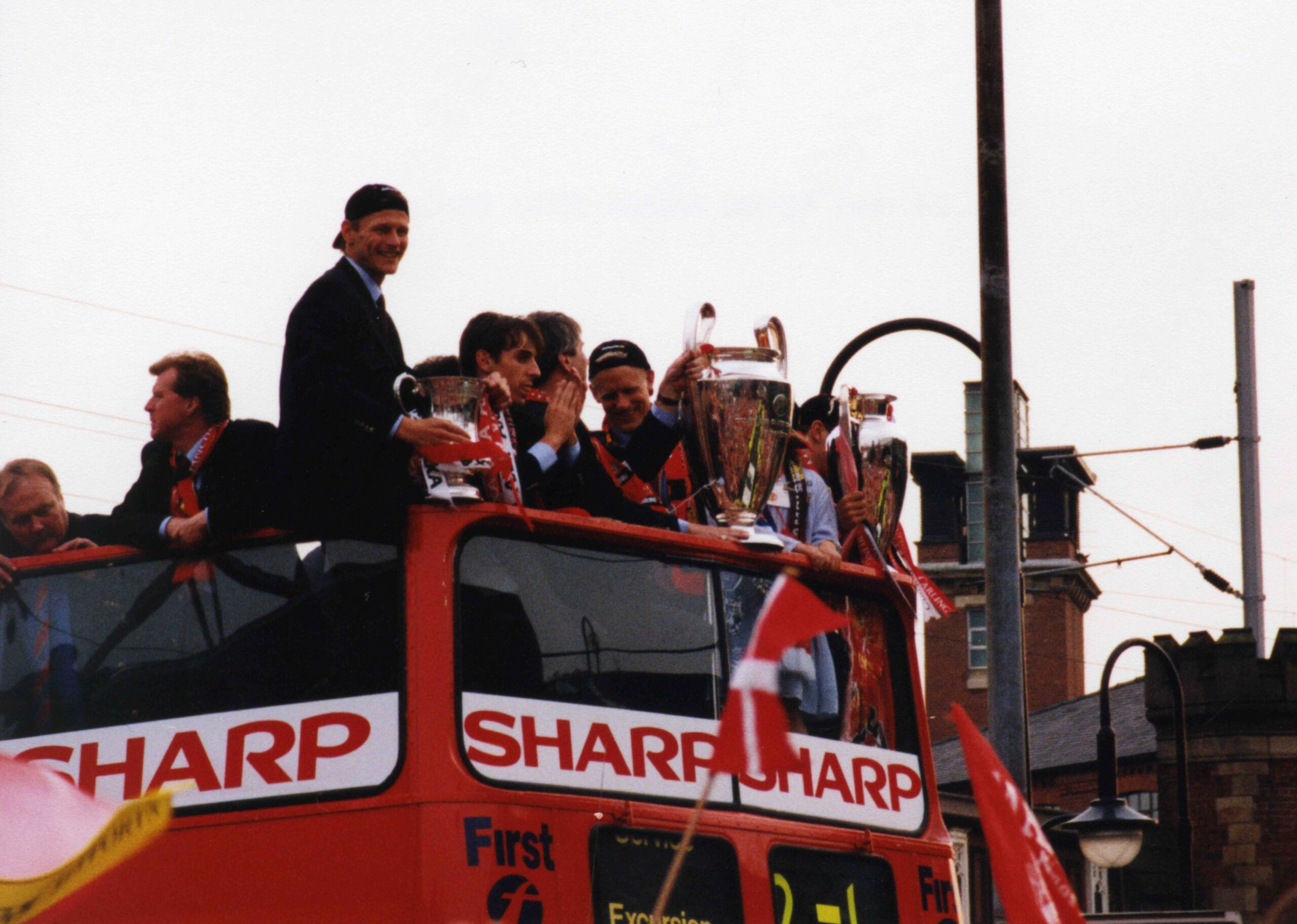
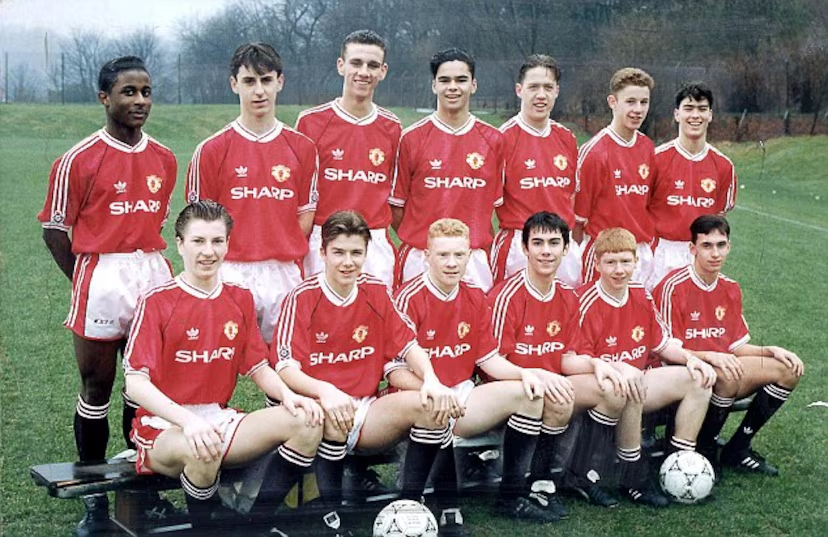
There is a photograph that tells you everything about the Class of 92 before you know a single fact about any of them.
Six young men in Manchester United tracksuits, barely out of their teens, standing together with the expressions of people who have not yet fully processed that the thing they dreamed about as children is actually happening. David Beckham, Ryan Giggs, Paul Scholes, Gary Neville, Phil Neville and Nicky Butt. None of them famous yet. None of them wealthy yet. None of them aware that they are standing at the beginning of something that will define not just their careers but the identity of the biggest football club in England for the next two decades.
The Class of 92 is not just a story about six talented footballers who came through the same academy at the same time. It is a story about what happens when a club trusts its own development, when a manager backs young players against every instinct that tells him to buy experience instead, and when a group of teenagers have the talent and the mentality to repay that trust with the most successful period in the history of English club football.
My dad watched the Class of 92 emerge and he talks about it with a specific kind of appreciation that is different from how he talks about individual great players. Not awe at individual genius but respect for something collective. The sense that what happened at Manchester United in the mid-1990s was not just good management or good recruitment but something rarer. A perfect alignment of people, place and timing that produced results that could not have been engineered deliberately and that will almost certainly never be replicated.
I grew up watching the later years of their careers, the Beckham celebrity era, the Scholes retirement and return, the Neville transition into punditry. By the time I was old enough to properly understand football they were already legends. But the story of how they became legends, the years before the fame, before the trophies, before the world knew their names, is the part that matters most.
The Academy That Produced Them
Manchester United’s youth development system in the late 1980s and early 1990s was run by people who understood something fundamental about producing footballers that many modern academies have forgotten in the pursuit of technical perfection and positional versatility.
Character matters as much as talent.
Eric Harrison, the youth team coach who oversaw the development of the Class of 92, was not a gentle man. He was demanding, confrontational, occasionally brutal in his assessments, and completely committed to the principle that young players needed to be tested psychologically as well as developed technically. His training sessions were intense. His standards were absolute. His willingness to tell a talented teenager that their attitude was not good enough, regardless of how gifted they were, was the quality that separated United’s academy from the systems at other clubs that produced technically accomplished players who could not cope with the pressure of first team football.
Brian Kidd worked alongside Harrison and later alongside Ferguson as assistant manager. The continuity of the coaching staff, the consistency of the values being applied from the youth team through to the first team, created a pathway that felt coherent rather than fragmented. The young players who graduated from Harrison’s youth team into Ferguson’s first team did not experience a dramatic shift in culture or expectations. The standards were the same. The demands were the same. The ethos was the same.
Ferguson’s role in the development of the Class of 92 was less hands-on than Harrison’s during their formative years but more consequential in the decision that ultimately mattered most. He chose to play them. At a moment when buying experienced replacements would have been the safer, more conventional, more defensible decision, Ferguson looked at what his academy had produced and decided that the young players were ready.
That decision was not popular. It was not universally supported within the club or within the media. And it produced one of the most famous quotes in Premier League history, delivered by a pundit whose judgement on this specific matter has been remembered considerably less fondly than his playing career.
You Can’t Win Anything With Kids
Alan Hansen’s assertion on Match of the Day in August 1995 that you cannot win anything with kids has become the most frequently cited example of punditry getting it wrong in the history of English football. It is referenced every time a young player succeeds, every time an academy graduate wins a trophy, every time the Class of 92 story is retold.
The context of Hansen’s comment is worth examining because it was not as absurd at the time as it appears in retrospect. United had lost their opening match of the 1995/96 season 3-1 to Aston Villa. Ferguson had fielded a young side that included Beckham, Scholes, Butt, and the Neville brothers. The performance was poor. The experienced players who had left the club, Paul Ince, Mark Hughes and Andrei Kanchelskis, had not been adequately replaced with senior signings. The squad looked thin and the young players looked raw.
Hansen’s assessment was the conventional wisdom expressed with conventional confidence. Young players need time. They need to be integrated gradually alongside experienced professionals. You cannot build a title challenging side around teenagers and expect them to cope with the pressure of competing at the highest level.
United won the Double that season. The Premier League and the FA Cup. The kids that Hansen said could not win anything won everything.
The quote has haunted Hansen ever since and he has been gracious about acknowledging the error. But the real significance of the moment is not Hansen’s misjudgement. It is what United’s season revealed about the assumptions that English football had operated on for decades. Young players could handle the pressure. Young players could deliver in the biggest matches. Young players, given the right environment and the right manager and the right collective mentality, could be the foundation of the most successful club side in the country.
Ferguson knew it. Harrison knew it. The players themselves knew it. Hansen and the rest of the football world took a season to catch up.
David Beckham
Beckham’s trajectory from academy graduate to global celebrity is one of the most extraordinary personal stories in the history of sport and it began on the pitch at Old Trafford with a talent that the celebrity sometimes obscured but never diminished.
His ability to deliver a football from wide positions with accuracy and consistency that no other English player of his generation could match was the foundation of everything. The crossing, the free kicks, the set piece delivery, the capacity to put the ball on a specific blade of grass from thirty or forty yards with either foot but predominantly the right, was a technical skill so refined that it became its own category.
The goal from the halfway line against Wimbledon on the opening day of the 1996/97 season announced Beckham to the country in the most dramatic way possible. A young man spotting the goalkeeper off his line from inside his own half and striking the ball with enough accuracy and enough elevation to send it over the goalkeeper and into the net from a distance that made the ambition of the attempt almost as remarkable as the execution.
What followed over the next seven years at United was a career of sustained excellence that the noise of the celebrity era sometimes made difficult to appreciate properly. Two more Premier League titles. The Champions League. The treble season in which his corners provided the assists for both goals in the final at the Nou Camp. His contribution to the most dramatic three minutes in English club football history, swinging in the deliveries that Sheringham and Solskjaer converted, should be mentioned every time the treble is discussed and frequently is not.
The celebrity took him to Real Madrid and then around the world. The brand became bigger than the football in the public consciousness. But the football was always there, always serious, always executed at a level that justified the attention even when the attention itself had moved beyond the pitch.
Ryan Giggs
Giggs was the first of the Class of 92 to establish himself in the first team and the one whose career at United spanned the longest period. Twenty four years. Over nine hundred appearances. Thirteen Premier League titles. Two Champions League trophies. The numbers are so enormous that they almost lose their meaning through repetition.
He made his debut at seventeen in 1991, before the Premier League era began. He was still playing first team football in 2014, at the age of forty, having reinvented himself from the explosive winger of his youth into the intelligent, positionally disciplined midfielder of his later years. The longevity is itself an achievement of extraordinary self-management and physical discipline.
The young Giggs was devastating. The pace, the dribbling, the directness, the willingness to take on defenders at full speed and beat them through a combination of acceleration and close control that the Premier League had not previously encountered. The goal against Arsenal in the 1999 FA Cup semi final replay, the sixty yard run through the entire Arsenal defence, remains one of the greatest individual goals in the history of English football and the defining image of Giggs as a player.
The older Giggs was different but equally effective. The pace diminished but the intelligence deepened. The ability to control the tempo of a match from central midfield, to find the right pass at the right moment, to manage games rather than dominate them, extended his career far beyond the point where a player reliant on physical attributes alone would have been forced to retire.
He played under Ferguson for the entirety of his managerial career. From the early years of building to the final years of sustained dominance. No other player has been as continuously present across as long a period of success at a single club. The consistency of his contribution across twenty four years is without parallel in English football.
Paul Scholes
Scholes is the one that other footballers talk about with the most reverence and the one that the general public probably underestimated the most. The gap between his reputation among professionals and his reputation among casual observers is wider than for any other player of his generation.
Xavi said Scholes was the best midfielder of his generation. Zidane said he was the most complete. Guardiola tried to sign him for Barcelona. These are not casual compliments from people trying to be polite. These are assessments from the finest football minds in the world confirming what anyone who watched Scholes closely already knew. He was operating at a level that most players around him could not reach.
His passing range was extraordinary. The ability to switch play from one side of the pitch to the other with a single pass, struck with an accuracy and a weight that allowed the receiver to control the ball and move forward in a single touch, was a skill that looked simple and was anything but. The long diagonal pass that Scholes executed dozens of times per match required not just technique but vision, the ability to see the full width of the pitch and to identify the correct pass before the ball had arrived at his feet.
He scored goals from midfield with a regularity that would have defined the career of a less modest player. Arriving late in the penalty area, timing his run to coincide with the delivery, striking the ball with a technique that was as clean and as consistent as any midfielder in the Premier League. His scoring record from central midfield across a twenty year career is remarkable and underappreciated.
Scholes did not do interviews. He did not cultivate a public persona. He did not engage with the celebrity culture that surrounded Beckham and that increasingly permeated the Premier League during his career. He played football at the highest level for two decades, was recognised by his peers as the best in the world at what he did, and maintained a privacy that the modern game almost never allows.
The tackling was a problem. He would be the first to acknowledge it and the highlight reels of his worst challenges are as entertaining in their own way as the highlight reels of his best passes. The red cards, the two footed lunges, the challenges that arrived late and hard and with an enthusiasm that the referee could not overlook. The same competitive intensity that drove the passing and the goals also drove the tackling and the tackling was, to put it charitably, agricultural.
Gary Neville
Neville was not the most talented of the Class of 92. He has said so himself, repeatedly and without false modesty. He was not blessed with the natural ability of Beckham or Giggs or Scholes. What he had was an intensity of commitment and a willingness to work that turned a player with good but not exceptional physical gifts into one of the most reliable right backs of his generation.
He made 602 appearances for Manchester United. He captained the club. He won eight Premier League titles and two Champions League trophies. He was England’s first choice right back for a decade. The career was built entirely on determination, tactical intelligence and the absolute refusal to accept that his natural limitations defined his ceiling.
His relationship with Beckham on the right side of United’s midfield and defence was one of the most effective partnerships in Premier League history. They understood each other instinctively. The overlapping runs, the defensive cover, the communication between two players who had been training together since they were teenagers, produced a right flank that was simultaneously dangerous in attack and disciplined in defence.
Neville’s transition into punditry after retirement has been so successful that it has almost overshadowed his playing career, which is itself a reflection of the intelligence that made him a top level footballer in the first place. The analytical ability, the willingness to express strong opinions, the capacity for work and preparation that he brings to broadcasting are the same qualities that sustained a twenty year career at the highest level despite natural talent that he honestly acknowledges was inferior to his closest friends.
Nicky Butt and Phil Neville
Butt and Phil Neville are the two members of the Class of 92 whose contributions are most frequently overlooked and most deserving of proper recognition.
Butt was a midfielder of genuine quality whose career at United was compressed by the presence of Keane, Scholes and Beckham in the same squad. On the nights when he played, he was consistently effective. His performance in the 1999 Champions League final, replacing the suspended Keane and Scholes, was one of the most underrated individual displays in the history of the competition. He played out of his skin in the biggest match of the season and his contribution to the treble deserves to be mentioned alongside the goals that decided it.
Phil Neville was the utility player, capable of operating at left back, in midfield, at right back, wherever the team needed him. The versatility that defined his career was also the quality that prevented him from being identified with a single position and receiving the recognition that a decade of consistent service at the highest level warranted. He made over 300 appearances for United and won six Premier League titles. The numbers speak for themselves even if the narrative has always centred on his more celebrated teammates.
What They Achieved Together
The collective achievement of the Class of 92 at Manchester United is without parallel in English football and is unlikely to be replicated in the modern game because the conditions that produced it no longer exist.
Six players from the same academy, developed by the same coaches, promoted by the same manager, winning trophies together across a period spanning more than a decade. The Premier League titles, the Champions League trophies, the FA Cups, the treble, all of it achieved with a core of homegrown players who had known each other since they were teenagers and who shared a collective identity that no amount of transfer market spending can manufacture.
The 1999 treble is the pinnacle. The greatest achievement in English club football history, accomplished with academy graduates in the spine of the team. Beckham’s corners. Scholes’ goals. Giggs’ FA Cup semi final winner. Neville’s defensive discipline. Butt’s Champions League final performance. The Class of 92 was not decoration around a team of expensive signings. They were the foundation on which everything else was built.
Ferguson understood that the bond between players who had grown up together, who had shared the experience of Harrison’s youth team and the transition to first team football, who trusted each other with the instinctive understanding that only years of proximity can produce, was more valuable than any individual signing he could make. The Class of 92 gave United something that money could not buy. A collective mentality rooted in shared experience that sustained the club’s dominance across an entire era.
The Lesson That Football Forgot
The Class of 92 should be the blueprint for every football club with a functioning academy. The proof that investing in youth development and trusting the results of that investment with genuine first team opportunities can produce outcomes that exceed anything the transfer market offers.
Instead it has become a nostalgia piece. A story that clubs reference in their marketing materials while spending hundreds of millions on players from other clubs and other countries and sending their own academy graduates out on loan to the Championship.
I wrote months ago about the Premier League’s failure to give young English players a genuine pathway to the first team. The Class of 92 is the most powerful counter-argument to that failure. Six players from the same academy, given the chance, repaid that chance with the most successful period in the history of the club. The evidence is there. The lesson is clear. And the game has collectively decided to ignore it in favour of the transfer market.
Five kids from Manchester. Given a chance by a manager who believed in them. Repaying that belief with thirteen Premier League titles, two Champions Leagues, and the greatest treble in English football history.
The game has never produced anything quite like it. And until it starts trusting its own young players again, it almost certainly never will.