I was eleven years old. I was sitting on the sofa in our living room in South London with my dad, way past the time I should have been in bed on a school night, watching a football match I had absolutely no personal stake in.
I am not a Liverpool fan. I was not a Liverpool fan then. I had no particular reason to care which way the result went beyond the general interest of a football obsessed kid who would watch any game put in front of him regardless of the hour or the occasion.
But I remember that night with a clarity that I cannot say about most things that happened when I was eleven. I remember the room. I remember my dad’s face when the third goal went in before half time. I remember the quiet that settled over the house in a way that felt like something had ended rather than something was still being played.
And I remember the second half. Every single minute of it.
Twenty years on, the Champions League final of 2005 remains the single greatest thing I have ever seen in football. I have watched a lot of football since that night. I have been to grounds across the country, followed the game through seasons that have produced moments of genuine brilliance, watched World Cups and European Championships and Champions League finals that have delivered drama and spectacle and everything the sport promises at its best.
None of it has touched Istanbul. Nothing has come close. And I genuinely do not believe anything ever will.
The Context Going In
To understand why what happened in the Ataturk Olympic Stadium on the night of May 25th 2005 was so extraordinary, you have to understand what AC Milan represented at that moment in football history.
This was not a good team. This was not even a very good team. This was one of the finest club sides ever assembled, operating at or near the peak of its powers, managed by Carlo Ancelotti and populated with players whose names read like a roll call of the greatest footballers of their generation.
Paolo Maldini. Alessandro Nesta. Cafu. Clarence Seedorf. Andrea Pirlo, not yet the global superstar he would become but already an exceptional controlling midfielder. Hernan Crespo, one of the most clinical finishers in the world. Andriy Shevchenko, the reigning Ballon d’Or winner, the most feared centre forward in Europe.
And Kaka. Twenty three years old, already playing football of a quality that made you feel you were watching something that would not be repeated. Kaka in 2005 was as good as anyone in the world and he was about to spend forty five minutes dismantling Liverpool in a way that felt almost cruel in its completeness.
Liverpool, managed by Rafael Benitez in his first season at the club, were a good side. Gerrard was captain, Carragher marshalled the defence, Xabi Alonso provided the creative intelligence in midfield. They had beaten Chelsea in the semi-finals in circumstances that were themselves dramatic and had arrived in Istanbul as worthy finalists.
But nobody, and I mean nobody outside the Liverpool dressing room and the red half of Merseyside, genuinely believed they could beat this Milan side over ninety minutes. The gap in quality on paper was simply too large.
The paper, as it turned out, was irrelevant.
The First Half and the Lowest Point
Maldini scored after fifty two seconds. Fifty two seconds. The Champions League final had barely begun and Liverpool were already behind to a volleyed finish from the greatest defender the game has ever produced, a man in his final years as a player still doing things that made you understand why his name belonged alongside the all time greats.
It was the fastest goal ever scored in a Champions League final. It set the tone for everything that followed in those first forty five minutes.
Crespo made it two before half time and then, with a composure and a quality that was almost insulting in its ease, added a third. A chip, delicate and precise, finishing a move that Kaka had orchestrated with the kind of vision that makes you want to simply stop watching everyone else and track the man in possession for the entire ninety minutes.
Three nil at half time. Liverpool eviscerated. The greatest club side in Europe doing exactly what the greatest club side in Europe was supposed to do.
I remember my dad looking at me at half time with an expression that said there is no point watching the second half. We both knew it was over. The mathematics were not impossible but the footballing reality was. You do not come back from three nil against this Milan side. It simply does not happen.
And then something remarkable occurred in the Liverpool dressing room during those fifteen minutes. Something that Gerrard has described in interviews since, something that Benitez has discussed, something that the players themselves have tried and largely failed to fully explain. A decision was made, collectively and without drama, to go back out and play. Not to survive. Not to make the scoreline more respectable. To actually play.
I stayed on the sofa. My dad stayed on the sofa. Somewhere across the country and across Europe, millions of people who had made the rational decision to switch off or go to bed made the slightly irrational decision to keep watching.
Nobody can fully explain why. Football does that to you sometimes. You stay because you cannot quite bring yourself to leave.
The Six Minutes That Changed Everything
Fifty four minutes. Steven Gerrard rises at the back post and plants a header into the Milan net. Three one.
In isolation it means almost nothing. A consolation goal. A scoreline improvement. The kind of thing that happens at the end of games that have already been decided and that everyone forgets by the following morning.
Except something about the way Gerrard celebrated told you it was not a consolation. Something about the noise from the Liverpool end of the stadium told you the players on the pitch had not accepted it was over. Something shifted in the atmosphere of a game that had felt completely settled and suddenly felt, impossibly, like it might not be.
Fifty six minutes. Vladimir Smicer, a substitute who had spent the majority of his Liverpool career on the periphery, struck a shot from outside the box that flew past Dida and into the net. Three two.
I remember standing up. I remember my dad standing up. Neither of us said anything. There was nothing to say because what was happening did not yet have language to describe it.
Fifty nine minutes. Gerrard was brought down in the penalty area. Xabi Alonso stepped up. Dida saved it. Alonso followed up and scored the rebound.
Three three.
Six minutes. Three goals. The impossible made real on a football pitch in Istanbul in front of the entire watching world.
I was eleven years old and I was shaking. Not from cold, not from tiredness, but from the pure physical impact of watching something that my brain was struggling to process as something that was actually happening rather than something I was imagining.
My dad, a man not given to outward displays of emotion, had his hands on his head. He kept saying I do not believe it. I do not believe it. Over and over. Like a mantra that might help him make sense of what he was seeing.
I have never forgotten the sound of his voice in that moment. I do not think I ever will.
Dudek and the Shootout
Extra time produced chances at both ends without a goal. Milan hit the post. Liverpool survived. The game went to penalties and what followed in the shootout entered the realm of the legendary before it was even finished.
Jerzy Dudek, Liverpool’s goalkeeper, had been briefed by assistant manager Pako Ayesteban to replicate the trick Bruce Grobbelaar had used in the 1984 European Cup final. The wobbly legs on the line. The deliberate distraction of movement designed to unsettle the penalty taker at the crucial moment.
Dudek took the instruction and executed it with a commitment that was both technically brilliant and slightly unhinged in the best possible way. He danced on his line. He waved his arms. He made himself as distracting and as unpredictable as he possibly could and in doing so he got inside the heads of Milan’s penalty takers in a way that changed the outcome of the shootout.
He saved from Pirlo. He saved from Tomasson. And then, with the shootout poised and Liverpool needing him one more time, Andriy Shevchenko stepped up.
Shevchenko. The Ballon d’Or winner. The most feared penalty taker at the most feared club side in Europe. A man who had spent the entire season putting the ball in the net with a regularity that made goalkeepers look helpless.
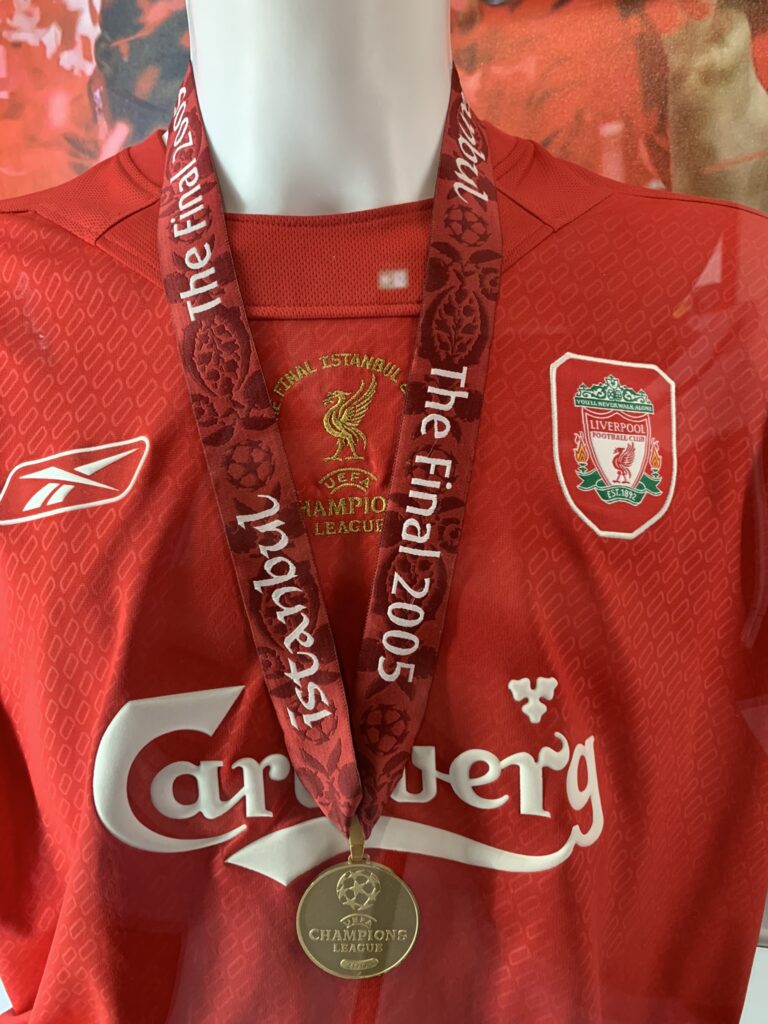
Dudek saved it. Low to his left, instinctive, decisive, absolutely correct. And Liverpool had won the European Cup.
I was on my feet. My dad was on his feet. The living room in South London was, for a moment, the loudest room I had ever been in with only two people in it.
Why It Still Matters
The question of why Istanbul still resonates twenty years later is one that I have thought about a great deal and I think the answer is simpler than the philosophical explanations that sometimes get attached to it.
Football at its absolute best is about the suspension of the rational. About the moments when everything you know about how the game works gets overridden by something you cannot explain or predict or prepare for. About the times when the sport reminds you that the reason you fell in love with it is precisely because it is capable of producing things that defy all logic and expectation.
Istanbul is the purest expression of that quality that the game has ever produced. Not just a comeback. Not just a dramatic result. A complete demolition of everything that was supposed to be true about those ninety minutes, executed in six impossible minutes by a group of players who decided, collectively, that the game was not over because they had not decided it was over.
No other sport produces moments like this with the same frequency or the same emotional weight. No other sport has the capacity to take something that looks completely finished and make it completely unfinished in the space of six minutes. That is what football does when it is working at the highest level and Istanbul is the proof.
I was an eleven year old Crystal Palace fan sitting on a sofa in South London with no personal stake in the result. I had school the next morning. I should have been in bed hours before the final whistle.
Twenty years later it remains the greatest thing I have ever seen in football. The night that proved, beyond any argument or any doubt, that in this sport it is never over until it is over.
And sometimes not even then.