
I have watched enough Palace matches over the years to remember when shin pads actually looked like they were protecting something, clumpy plastic slabs running most of the way from ankle to knee. These days some Premier League players are stepping onto the pitch with what amounts to a credit card tucked into their sock, and honestly, watching Luke Shaw walk off recently with a gash on his shin roughly where a proper pad should have been sitting made me wonder how this was ever allowed to happen in the first place.
The Trend Nobody Asked For, Except the Players Themselves
This is not some isolated quirk with one or two eccentric players. There is a genuine shift happening across the modern game towards smaller and smaller shin protection, with younger players in particular leading the charge. Brighton’s Jack Hinshelwood has actually partnered with a manufacturer to promote his own range of miniature guards, measuring just eight by five centimetres, roughly the size of a mobile phone rather than anything resembling meaningful protection for a bone that regularly takes full force studs to it during a ninety minute match.
Wayne Rooney recently weighed in on this exact trend, criticising Manchester United’s Benjamin Sesko for wearing what he called stupid little shin pads, a comment that landed with extra weight given Sesko is currently out injured with a shin problem. Whether the size of his pads had anything to do with that specific injury is impossible to say for certain, but the timing certainly gave Rooney’s criticism some genuine bite.
Jack Grealish has been open about this for years, telling GQ magazine back in 2021 that he wears a kids size shin guard, somewhere around a seven or eight. Hull City striker Oli McBurnie apparently went even further, admitting to The Guardian as far back as 2019 that he wears what he described as toddler sized pads. These are not fringe confessions from unknown squad players either. These are established Premier League professionals openly telling the football press they have essentially opted out of meaningful shin protection.
Why Players Actually Do This
The obvious question is why any professional footballer would willingly reduce their own protection against an injury that could genuinely end a season, or worse. The answer, based on what players themselves say, comes down almost entirely to comfort rather than any deliberate risk taking. Many players train all week without wearing shin pads at all, so by the time matchday arrives, strapping on a traditional full sized guard reportedly feels genuinely restrictive and unfamiliar. The smaller the pad, particularly for players who like to wear their socks rolled down around the ankle, the closer the matchday sensation gets to how they actually train.
Bayern Munich and France forward Michael Olise has apparently admitted he would rather not wear shin pads at all if given the choice. That tells you everything about where player preference genuinely sits on this issue. Protection is clearly not the primary consideration for a growing number of top level professionals, comfort and habit are.
Not everyone in the dressing room agrees though. Newcastle defender Dan Burn has joked about being mocked by teammates for wearing what he describes as comparatively enormous pads, while Liverpool captain Virgil van Dijk has been openly critical of the tiny alternatives, pointing out that a shin pad roughly the size of an AirPods case genuinely worries him if a player takes a direct kick to that area during a match. Van Dijk’s concern feels like the most sensible reaction in this entire debate, frankly. A shin guard that small is barely covering the bone it exists to protect.
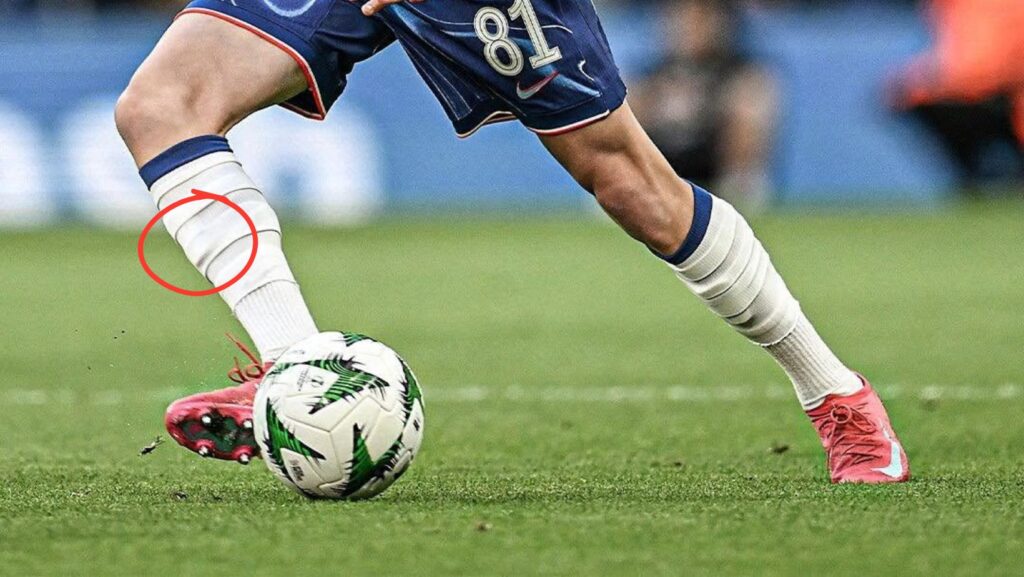
How the Rules Actually Changed
What genuinely surprised me researching this is discovering that football’s lawmakers deliberately softened their own stance on shin pad sizing back in March 2024, at exactly the moment you might have expected them to tighten it instead. The International Football Association Board, meeting at their AGM beside Loch Lomond, updated Law 4 covering player equipment to explicitly state that players themselves are now responsible for the size and suitability of their own shin guards.
David Elleray, the former FIFA referee who now serves as technical director at IFAB, has explained the thinking behind that change. According to Elleray, the previous wording requiring guards of an appropriate size had become genuinely impossible to enforce consistently, and there was a real legal concern that if a referee approved a shin pad as acceptable and a player was then injured, that approval could expose officials to liability. Shifting responsibility firmly onto players, coaches and, for younger players, parents was intended to solve that legal grey area, with lawmakers apparently hoping individuals would take a genuinely responsible attitude towards their own safety.
Reading between the lines of Elleray’s more recent comments, that hope has not entirely panned out. He referenced a recent incident where a player’s shin protection was, in his words, almost like a sticking plaster, and called for renewed pressure on players, coaches and clubs to actually prioritise proper protection given how difficult the situation has become to legislate for directly. Pierluigi Collina, now head of FIFA’s referees committee, echoed that sentiment, framing it explicitly as a matter of player safety rather than personal style preference.
The Reality on the Ground Is Even Looser Than It Sounds
Down in the English Football League, the three divisions sitting below the Premier League, the situation appears to be considerably more relaxed than even the top flight. One EFL club physio, speaking anonymously to protect working relationships, has suggested some players are not wearing meaningful shin protection at all, describing instances of players cutting foam into rough shin pad shapes purely to satisfy a visual check from officials. According to that same source, referees rarely inspect closely enough to notice the difference, as long as something resembling the outline of a shin pad is visible beneath the sock.
That is a genuinely concerning admission if accurate, because it suggests the entire compliance system at lower league level has become largely theatrical, a box ticking exercise rather than any real safeguard against serious injury.
How Officials Actually Police This on Matchday
The enforcement process itself is lighter touch than most fans probably assume. Before every Premier League fixture, an assistant referee is stationed at each dressing room door roughly five minutes before kick off, with players filing past for a brief visual check. In the modern game, that check focuses overwhelmingly on jewellery, players pulling down their shirt collars to confirm no chains are being worn, with shin pads receiving comparatively little scrutiny by comparison. Substitutes go through an equivalent check with the fourth official when they are introduced during a match, and in theory a player could be denied entry to the pitch entirely for wearing no shin protection whatsoever.
Former Premier League official Graham Scott, now working as a refereeing expert, has described the reality of enforcing this rule in practice as almost farcical at times, admitting he has jokingly asked players wearing postage stamp sized pads whether they were actually wearing any shin protection at all. His broader point, though, is a serious one. Once a player insists their guard provides adequate protection, referees genuinely have very little practical authority to challenge that judgement, and picking that particular fight with a club over equipment sizing was, in his words, simply not worth the confrontation in the moment.
Where This Leaves Things
I understand the comfort argument, and I genuinely do not think most players wearing tiny shin pads are being reckless for the sake of it. Nobody wants to feel restricted during a ninety minute match at the highest level of the sport. But there is something slightly absurd about a mandatory piece of safety equipment becoming so small that it has essentially become optional in everything but name, enforced by a genuinely light touch inspection that both officials and players openly acknowledge is not really designed to catch anyone out.
Luke Shaw’s cut shin and Benjamin Sesko’s current injury will not settle this debate on their own, and correlation is obviously not proof of causation when it comes to a single incident. But watching a compulsory law, introduced specifically to protect players, effectively hand full responsibility back to the very players who have the strongest incentive to prioritise comfort over protection feels like exactly the kind of well intentioned rule change that quietly stops working the moment nobody is properly enforcing it anymore.