I was a kid when the Invincibles happened. Old enough to understand what was going on but young enough that the full weight of the achievement only settled on me years later when I started to properly understand how football works and how impossible what Arsenal did in 2003/04 actually was.
I am a Crystal Palace fan. Arsenal are not my club. The beauty of the Invincibles season is that it does not matter whose club they are. What Arsenal achieved across those thirty eight games belongs to everyone who watched it because the standard of football they played was so high and so sustained and so completely without precedent that it transcended club allegiance and became something the entire sport could claim as its own.
Thirty eight games. Twenty six wins. Twelve draws. Zero defeats. An entire Premier League season without losing a single match.
Nobody had done it in the modern era. Nobody has done it since. The specific combination of talent, mentality, tactical intelligence and collective belief required to play thirty eight matches across nine months in the most competitive league in the world without losing once may never be replicated. Not because future teams will lack the ability. Because the psychological demands of sustaining perfection across a full season are so extraordinary that the ability alone is not enough.
My dad watched the Invincibles and said something that I think captures the achievement better than any statistic. He said they did not just avoid losing. They made losing look like something that could not happen to them. There is a difference. A team that avoids losing is cautious, conservative, built to survive. A team that makes losing look impossible is something else entirely. That is what Arsenal were in 2003/04.
The Team That Wenger Built
The Invincibles squad was the culmination of everything Arsene Wenger had been building at Arsenal since his arrival in 1996. Eight years of identifying talent, developing players, embedding a philosophy and creating a culture that valued technical excellence and collective intelligence above everything else.
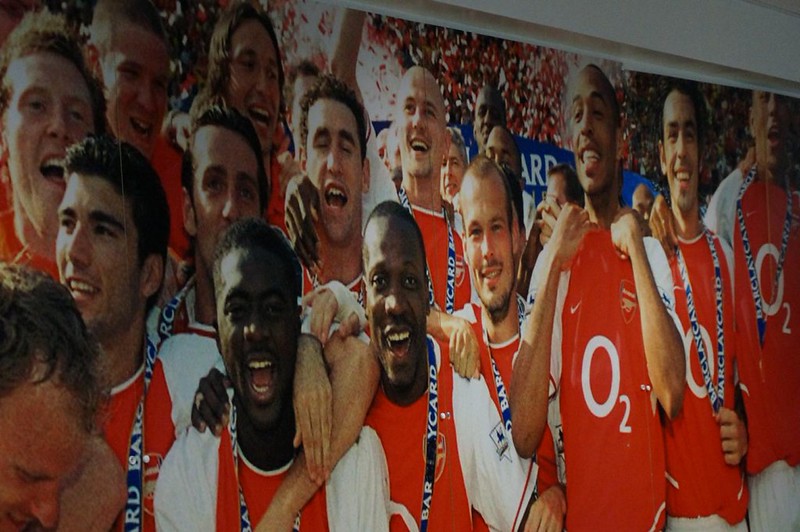
The starting eleven that played the majority of the season contained players who were individually world class and collectively irresistible. Each one deserves to be named because each one contributed something specific that made the whole greater than any collection of individual parts.
Jens Lehmann in goal. A German goalkeeper whose intensity bordered on the unhinged and whose shot stopping ability was matched by a competitive fury that set the tone for the entire team. Lehmann was not a calming presence. He was an agitating one. He demanded excellence from the players in front of him with a volume and a conviction that left no room for complacency.
Lauren at right back. Kolo Toure and Sol Campbell in central defence. Ashley Cole at left back. A defensive unit that combined physical power with pace and intelligence in proportions that made them exceptionally difficult to breach. Campbell was the immovable object in the centre. Cole was the most complete left back in the world. Toure read the game with a composure that his occasionally excitable public persona belied.
Patrick Vieira in central midfield alongside Gilberto Silva. The combination of those two players in the centre of the pitch is one of the most perfectly balanced midfield partnerships the Premier League has ever produced. Vieira was the dominant force, the physical presence who imposed himself on matches through a combination of power, technique and personality that made him the most complete midfielder in England. Gilberto was the quiet genius alongside him, the player who did the invisible work that allowed Vieira to play with the freedom and the authority that defined his best performances.
Robert Pires on the left wing. Freddie Ljungberg on the right. Two wide players with entirely different profiles who contributed complementary qualities to the attack. Pires was elegant, technically refined, a player whose movement and finishing from wide positions were so consistent that he was effectively a second striker operating from the wing. Ljungberg was direct, energetic, an athlete whose runs from deep and whose timing of arrival in the penalty area produced goals that the opposition never quite worked out how to prevent.
Dennis Bergkamp behind the striker. The Dutchman was thirty four during the Invincibles season and playing some of the most intelligent football of his career. His vision, his touch, his capacity to produce a moment of pure technical brilliance in the tightest spaces, gave Arsenal a creative dimension that no other team in the league could match. Bergkamp did not run past people. He thought past them. By the time the defender understood what he was doing, the ball was already somewhere else.
And Thierry Henry. The striker. The focal point. The most devastating goalscoring forward the Premier League has ever seen, operating at the absolute peak of his extraordinary ability during the season that defined his career.
Henry scored thirty goals in the league during the Invincibles season. The number alone is impressive but it fails to capture what he actually did and how he did it. Henry did not just score goals. He scored goals that no other player in the world could have scored. The acceleration from a standing start to full speed in three strides. The ability to receive the ball with his back to goal, turn and be past the defender before the defender had processed what was happening. The finishing with both feet, precise and powerful and delivered with a composure that suggested he found the entire process slightly less challenging than everyone around him.
Watching Henry during the 2003/04 season was watching a player who existed on a different level to his contemporaries. Not slightly different. Fundamentally different. The gap between Henry and the next best striker in the Premier League that season was wider than the gap between that striker and an average top flight forward. He was operating in a category of one.
How They Actually Did It
The tactical structure that Wenger built for the Invincibles season was deceptively simple in its principles and extraordinarily difficult to execute at the level they maintained across thirty eight matches.
Arsenal played 4-4-2 for most of the season. A formation that was conventional at the time and that most Premier League teams employed in some variation. What made Arsenal’s version different was the quality of execution and the speed at which they transitioned from defence to attack.
The defensive shape was organised without being cautious. Wenger did not set his team up to avoid defeat. He set them up to win. The defensive discipline came from the intelligence of the players rather than from a conservative tactical instruction. Campbell and Toure defended the space in front of them with authority. Vieira and Gilberto controlled the midfield. Cole and Lauren protected the flanks. The defensive record that season was excellent but it was a byproduct of overall team function rather than the result of a deliberately defensive approach.
The attacking play was where the magic lived. Arsenal’s ability to transition from defensive positions to goalscoring opportunities in three or four passes was so fast and so precise that opposing teams frequently found themselves exposed before they had completed their own attacking move. A clearance would become a counter attack would become a goal in a sequence so fluid and so quick that the replays looked accelerated.
Henry and Bergkamp were the primary beneficiaries of the speed of transition but they were not the only contributors to it. Pires, Ljungberg, Vieira, even the full backs, all participated in attacking moves with a directness and a confidence that reflected the collective understanding of a team that had been playing together for years and that knew, instinctively and precisely, where everyone else would be at any given moment.
The quality of the football at its peak was breathtaking. There were matches during the Invincibles season where Arsenal produced passages of play that were as aesthetically beautiful as anything the Premier League has ever seen. Short, sharp, one-touch combinations at speed, played with a confidence and a fluency that made the game look simple in the way that only the very best teams can make the game look simple.
The Matches That Defined the Season
An unbeaten season is not built on a series of comfortable victories. It is built on the matches where defeat looked probable and the team found something within itself to prevent it.
The 2-2 draw at Tottenham in November was one such match. Arsenal were behind twice. Twice they came back. The refusal to lose, the mentality that treated the concession of a goal as a temporary inconvenience rather than a crisis, was visible in how the team responded to adversity. They did not panic. They did not change their approach. They kept playing the same way, at the same tempo, with the same conviction, until the scoreline reflected their performance.
The 1-1 draw at Manchester United in September was another defining moment. Old Trafford was the most hostile away ground in the country for Arsenal given the rivalry between the two clubs. United were the defending champions. The atmosphere was intense and the match was physical in a way that tested Arsenal’s discipline as much as their ability. Vieira was sent off. Arsenal went down to ten men. Henry equalised. The point was secured through sheer competitive resilience.
The 5-0 demolition of Leeds United was the performance that most completely represented what the Invincibles were capable of when everything aligned. Henry scored four. The football was so far beyond anything Leeds could cope with that the match stopped being a contest within twenty minutes and became an exhibition. It was not cruel. It was simply the natural consequence of a team operating at a level that the opposition could not approach.
The 2-1 victory over Liverpool at Highbury in April was the match that confirmed the title. Henry scored both goals, the second a penalty, and the celebrations that followed reflected the understanding that what Arsenal had achieved was historically significant regardless of whether the unbeaten record survived to the end of the season.
The Record That Preceded It and the One That Followed
The Invincibles season did not exist in isolation. The unbeaten run actually began on May 7 2003, the penultimate match of the previous season, a 6-1 victory over Southampton. From that date to October 24 2004, when the run was finally ended at Old Trafford, Arsenal went forty nine consecutive league matches without defeat.
Forty nine games. Spanning two seasons. Nearly eighteen months. The longest unbeaten run in English top flight history and a record that may never be broken.
The ending, when it came, was controversial and bitter and produced one of the most famous incidents in the history of the Arsenal-United rivalry.
Manchester United won 2-0 at Old Trafford on October 24 2004. Ruud van Nistelrooy won a penalty that Arsenal believed was a dive. Wayne Rooney scored the second. The Arsenal players were furious. The confrontation in the tunnel after the match, the Pizzagate incident in which a slice of pizza was allegedly thrown at Ferguson by an Arsenal player, became part of the folklore of the rivalry.
Wenger called the penalty disgraceful. He felt the unbeaten run had been ended by a decision rather than by a performance. The anger was genuine and it revealed how much the record meant to him personally and how deeply its ending affected him.
The controversy does not diminish the achievement. Forty nine games unbeaten. Thirty eight of them in a single season without a single defeat. No amount of post-match pizza throwing or tunnel confrontations changes what Arsenal accomplished across those months.
The Comparison That Cannot Be Made
Every great team invites comparison. The Invincibles are compared to the great Liverpool sides of the 1970s and 1980s. To Ferguson’s treble-winning United. To Guardiola’s centurions. To every dominant side the English game has produced across its history.
The comparisons are interesting but ultimately meaningless because the Invincibles achieved something that none of those sides achieved. They went an entire league season without losing. The centurions accumulated more points. The treble winners won more trophies. The great Liverpool sides sustained their dominance across a longer period.
None of them went unbeaten.
The distinction matters because it is the one thing that elevates the Invincibles above comparison. Points totals can be exceeded. Trophies can be matched. Dominance can be replicated. Going through an entire season without defeat in the most competitive league in the world cannot be diminished by anything that came before or since because nobody else has done it.
It is a binary achievement. You either lost zero games or you did not. Arsenal lost zero games. Every other great team in Premier League history lost at least one. That is the gap that no amount of context or qualification can bridge.
Why It Matters Beyond Arsenal
I said at the beginning that the Invincibles season transcends club allegiance and I want to explain why I believe that as a Palace fan who has no reason to celebrate anything Arsenal achieve.
Football is a sport built on the acceptance of imperfection. You will lose. Your team will have bad days. The best teams in the world lose matches they should win, drop points in games they dominate, make mistakes that cost them results they deserved. That imperfection is part of what makes the sport compelling. The uncertainty of outcome is the product that every league sells to every viewer.
The Invincibles defied that fundamental characteristic of the sport. They played thirty eight matches across nine months and did not have a single bad day significant enough to produce a defeat. The imperfection that defines football was, for one team across one season, absent. The uncertainty of outcome was, when Arsenal were playing, suspended.
That is remarkable regardless of which team achieved it. It would be remarkable if it were Manchester United or Liverpool or any club you could name. The fact that it was Arsenal is relevant to Arsenal supporters. The fact that it happened at all is relevant to everyone who watches football and who understands how extraordinary it is to sustain excellence across thirty eight matches without a single lapse severe enough to cost you.
Perfection in a sport designed to prevent perfection. That is what the Invincibles represent. And that is why the achievement belongs not just to Arsenal but to football itself.
The Golden Plaque
The Premier League presented Arsenal with a unique golden version of the Premier League trophy to commemorate the unbeaten season. It sits in the trophy cabinet at the Emirates alongside the standard silver trophy that every champion receives.
The golden trophy is the only one of its kind. It was created specifically for this achievement because the achievement was without precedent and required specific recognition. No other club has one. No other club has earned one.
Every Arsenal supporter who walks past that trophy cabinet sees the golden plaque and knows what it represents. Every opposition supporter who sees it knows what their club has never achieved and, in all probability, never will.
Twenty six wins. Twelve draws. Zero defeats. Thirty eight games. One season. One golden trophy. The greatest single season achievement in the history of English league football.
The Invincibles. 2003/04. Wenger’s masterpiece. Football’s closest approximation to perfection.
Nobody has done it before. Nobody has done it since.
I do not think anybody ever will.