Diego Maradona is the only footballer in history who cheated and scored the greatest goal ever played within four minutes of each other and somehow both moments made you love him more.
That sentence should not make sense. In any other sport, in any other context, a player who deliberately handled the ball into the net and then lied about it to the referee’s face would be condemned. The cheating would define the story. The controversy would overshadow everything else. The player would spend the rest of his career answering for the moment he chose dishonesty over sportsmanship.
Maradona scored the Hand of God and the Goal of the Century in the same match. On the same afternoon. Against the same opponent. Four minutes apart. One was the most brazen act of deception the World Cup has ever seen. The other was the single greatest individual moment the sport has ever produced. And the fact that they coexist in the same person, in the same game, in the same four minute window, tells you everything about who Diego Armando Maradona was.
He was not simple. He was not comfortable. He was not the kind of sporting hero whose story fits neatly into a narrative of greatness achieved through hard work and clean living and the right decisions made at the right moments. He was a genius who was also a cheat. A magician who was also an addict. The most gifted footballer who ever lived who was also the most self-destructive. The contradictions were not incidental to who he was. They were the entire point.
My dad spoke about Maradona differently to how he spoke about any other footballer. Not with the uncomplicated warmth he had for Keegan or the reverent sadness he carried about Best. With something more complicated. A mixture of awe and unease, the recognition that what he was watching was the greatest talent the game had ever produced wrapped in a person whose relationship with the world was so turbulent and so chaotic that watching him was never entirely comfortable.
Naples and the Boy From Villa Fiorito
Diego Maradona was born in Lanus, Buenos Aires Province, in 1960, and grew up in Villa Fiorito, one of the poorest neighbourhoods in the city. The poverty of his childhood was not the kind that gets softened in retrospect by the success that followed. It was genuine, grinding, material poverty. The family lived in a small house with a corrugated iron roof. There was not always enough food. The world that Maradona was born into gave him nothing except a football and the talent to do things with it that nobody had done before.
He was juggling the ball on television at the age of ten. A small, stocky boy from the slums performing tricks that professional players could not replicate, broadcast to the nation as a curiosity that was also clearly something more than a curiosity. The talent was so obvious so early that it bypassed the normal development pathway entirely. He was not a promising youngster who might become good. He was already extraordinary at an age when most children are still learning which foot to kick with.
He made his professional debut for Argentinos Juniors at fifteen. He was playing for the Argentina national team at sixteen. By the time he was twenty he was at Boca Juniors, the club he loved most and that loved him back with a ferocity that matched his own. Then Barcelona for a fee that made him the most expensive player in the world. Then Naples, where the real story began.
Napoli and the Kingdom
Maradona arrived at Napoli in 1984 and what followed over the next seven years was the most extraordinary relationship between a player and a city that football has ever produced.
Naples was the poorest major city in Italy. The south of the country was looked down upon by the wealthy north with a contempt that was cultural, economic and deeply ingrained. Milan and Turin and the northern industrial cities regarded Naples as inferior. The football clubs of the north, Juventus and AC Milan and Inter, dominated Serie A with the resources that southern clubs could not match. Napoli were a mid-table side in a league that was structured, financially and culturally, to ensure they stayed there.
Maradona changed everything. He took a mid-table club in a league dominated by the richest teams in the world and made them champions. Not through spending or infrastructure or institutional advantage. Through the sheer, overwhelming, completely unprecedented force of his individual talent.
Napoli won two Serie A titles under Maradona. They won the UEFA Cup. They won the Coppa Italia. A club from the poorest city in Italy, competing against clubs with vastly superior resources, became the best team in the country because one man made them so.
The city worshipped him. Not in the casual way that football supporters admire their best players. In a way that was closer to religious devotion. Murals appeared on the walls of the city. Babies were named after him. The relationship between Maradona and Naples transcended sport and became something cultural and political and deeply emotional, the symbol of a proud, marginalised city proving that it could compete with and defeat the wealthy establishment that had looked down on it.
Maradona gave Naples something that money could not buy and that no other player could have provided. He gave them dignity. He gave them proof that they were not inferior. He gave them two league titles that the entire northern Italian football establishment believed were impossible.
The price he paid for that gift was enormous. The fame, the pressure, the adulation, the constant surveillance of a city that treated him simultaneously as a deity and as a possession, contributed to the personal destruction that was already underway and that would accelerate dramatically in the years that followed.
Mexico 1986 and the Four Minutes That Defined a Career
The 1986 World Cup in Mexico was the tournament where Maradona produced the two moments that have been replayed more than any other moments in football history and that together form the most complete portrait of a single player that a single match has ever provided.
Argentina versus England in the quarter final. The context was not purely sporting. The Falklands War had been fought four years earlier. The political tension between the two countries was real and present and it coloured the match in ways that went beyond football. For Maradona, for the Argentine public, this was not just a World Cup quarter final. It was something more.
The fifty first minute. A high ball into the England penalty area. Maradona and Peter Shilton, the England goalkeeper, both went for it. Maradona was significantly shorter than Shilton. He could not have won the header legitimately. He did not try to. He punched the ball into the net with his left fist, disguising the contact just enough that the referee, who was poorly positioned, did not see it.
The goal stood. England protested furiously. The replays showed the handball clearly. Maradona celebrated as though nothing irregular had happened.
After the match he was asked about the goal. His answer has become one of the most famous quotes in sporting history. He said it was scored a little with the head of Maradona and a little with the hand of God.
The audacity of that response is breathtaking even now. He did not deny the handball. He did not apologise. He attributed the goal to divine intervention with a completely straight face and dared the world to prove otherwise. It was cheating described as theology. Dishonesty reframed as destiny. And it worked, not because anyone believed him but because the sheer brazenness of the claim was so perfectly Maradona that it became its own kind of truth.
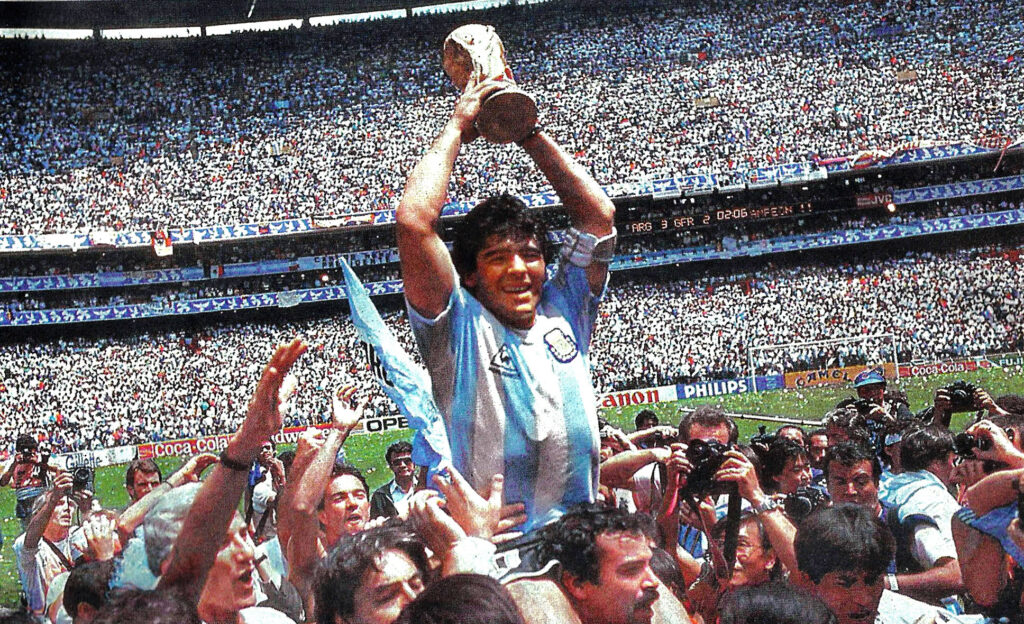
Four minutes later he scored the Goal of the Century. And the hand of God was immediately recontextualised as the warm-up act for the most extraordinary piece of individual football the world had ever seen.
He received the ball in his own half. He turned. He ran. Sixty yards, past five England players, each one beaten with a combination of pace, balance, close control and body movement that defied analysis then and defies it now. He reached the penalty area. He went past the goalkeeper. He scored.
I have watched the goal hundreds of times. On grainy VHS recordings, on restored HD footage, on YouTube compilations set to dramatic music, on tactical analysis videos that try to explain what happened in terms of angles and body positioning and spatial awareness. None of it adequately captures what Maradona did in those ten seconds. The analysis explains the mechanics. It does not explain the magic.
The goal was not just brilliant. It was impossible. The things he did with the ball at the speed he was travelling, on a pitch in Mexico City at altitude, against professional defenders who knew what he was capable of and were specifically positioned to prevent it, should not have been achievable by a human being. And yet he did it with a casualness that suggested he was not operating at the limit of his ability but somewhere comfortably within it.
Two goals. Four minutes apart. One a cheat. One a masterpiece. Both completely and irreducibly Maradona.
The 1990 World Cup and the Tears
Italia 90 brought Maradona back to the World Cup stage in the country where he had become a god.
Argentina were defending champions. Maradona was carrying injuries that limited his physical capacity. The team was not as good as the 1986 side. What followed was a tournament performance built almost entirely on Maradona’s will, his leadership and his capacity to produce decisive moments in matches that his team had no business winning.
The semi final was played in Naples. Maradona’s city. The city he had given two league titles. The city that worshipped him. The opponents were Italy.
Maradona asked the Neapolitan supporters to back Argentina rather than Italy. The request was audacious and it split the city in ways that revealed the complexity of the relationship between the player and the place. Some supported him. Some could not bring themselves to support Argentina against their own country regardless of what Maradona meant to them.
Argentina won on penalties. Maradona scored his. The Italian crowd, including the Neapolitans who had sided with their country, booed him. The relationship that had been the defining feature of his career was damaged in a way that never fully healed.
The final against West Germany was lost 1-0 to a late penalty. Maradona cried on the pitch at the final whistle. The image of him in tears, defeated, the defending champion’s crown taken away in circumstances he felt were unjust, is the counterpart to Gazza’s tears at the same tournament. Two men crying at Italia 90 for different reasons and with different consequences, both images burned permanently into the collective memory of everyone who watched.
The Darkness
What happened to Maradona after his playing career peaked is a story that football has told and retold without ever fully confronting the central question it raises. How does a sport allow its greatest ever player to destroy himself in public while the world watches and does nothing?
The cocaine use began during his time in Barcelona and intensified in Naples. The nightlife, the connections to the Camorra, the lifestyle that the city both enabled and demanded, created an environment where addiction could flourish unchecked. He tested positive for drugs at the 1994 World Cup and was sent home in disgrace, the image of him being led away from the tournament for a failed drug test one of the most jarring falls from grace the sport has ever witnessed.
The years that followed were chaotic and frequently desperate. Weight gain, health scares, hospitalisations, public episodes that were covered by the media with the same combination of fascination and exploitation that had characterised the coverage of George Best’s decline. The parallels between the two are striking and depressing. Two of the most gifted footballers who ever lived, both consumed by addictions that the sport they graced was unable or unwilling to help them manage.
Maradona became a manager, a television personality, a political figure, a cultural icon whose relevance never diminished regardless of how far he fell from the person he had been on the pitch. He managed Argentina. He managed clubs in the Middle East and Mexico and Argentina’s lower divisions. He appeared at World Cups as a supporter, his reactions in the stands during Argentina’s matches at Russia 2018 producing images that circled the world and that revealed a man whose emotional relationship with football had not diminished despite everything the game had taken from him.
November 25 2020
Maradona died on November 25 2020 at the age of sixty. A cardiac arrest at his home in Buenos Aires. The immediate cause of death was heart failure. The underlying causes were decades of addiction, poor health, medical negligence and the accumulated damage of a life lived at an intensity that the human body is not designed to sustain.
Argentina declared three days of national mourning. The streets of Buenos Aires filled with people. The streets of Naples filled with people. Two cities on different continents, separated by an ocean, united by a footballer who had given both of them something that transcended the sport and that neither of them had experienced before or has experienced since.
The funeral was at the Casa Rosada, the presidential palace. The queue to pay respects stretched for blocks. The grief was national and it was genuine and it was complicated in the way that grief for complicated people is always complicated.
The investigation into his death, the allegations of medical negligence, the legal proceedings against the medical professionals who were responsible for his care in his final days, revealed a picture of a man who was not adequately protected by the people around him. A man whose fame and whose wealth and whose status as the greatest footballer in Argentine history did not translate into the kind of care that might have kept him alive longer.
The Most Complicated Genius
Pele was simpler. Messi is cleaner. Ronaldo is more disciplined. Every other contender for the title of greatest footballer ever lived has a story that is easier to tell and easier to celebrate without reservation.
Maradona defies easy celebration. The genius was real and it was the most extraordinary genius the sport has ever produced. But the cheating was also real. The addiction was real. The associations with organised crime were real. The treatment of people in his personal life was, by many accounts, real and deeply harmful.
The temptation is to separate the player from the person. To celebrate the Goal of the Century and ignore the Hand of God. To remember Naples and forget the cocaine. To watch the 1986 World Cup highlights and pretend that the man who produced them was not also the man who failed drug tests and whose personal life was a catalogue of damage inflicted on himself and others.
I cannot do that. I do not think it is honest to try. Maradona was all of it simultaneously. The genius and the cheat. The magician and the addict. The man who gave Naples its dignity and the man who could not maintain his own. The contradictions were not a flaw in the story. They were the story.
My dad watched the Goal of the Century live on television. He has described the experience of seeing it happen in real time as one of the most extraordinary things he has ever witnessed. He has also described the discomfort of loving a player whose life off the pitch was so frequently and so visibly in crisis.
That discomfort is, I think, the honest response to Maradona. Not uncritical worship. Not moral condemnation. The recognition that the greatest talent the game has ever produced was housed in a person whose relationship with the world was so complicated and so destructive that the talent alone cannot tell you who he was.
Diego Armando Maradona. Born in Villa Fiorito. Died in Buenos Aires. The Hand of God and the Goal of the Century, four minutes apart, in the same match, from the same man.
The most complicated genius football has ever produced. And the game has never fully worked out how to remember him. Both things. All of it. At the same time.
That is the only honest way.