I want to start with a moment from the semi final against England that I do not think I will ever forget.
The eighty fifth minute. England leading 1-0. Anthony Gordon’s goal still echoing around the stadium and every English supporter in the ground daring to believe that this was finally going to be the moment. The semi final. The World Cup. After sixty years of waiting, after all the heartbreak and the near misses and the penalty shootouts that had become part of the national identity, this was it. We were going to a final.
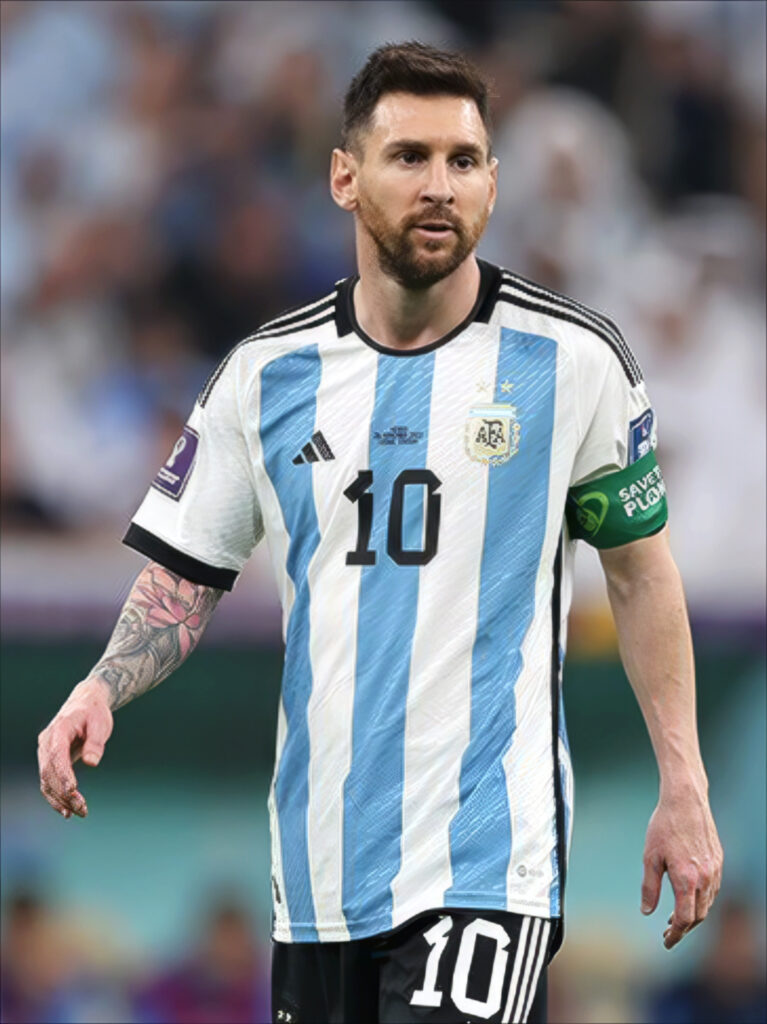
Lionel Messi received the ball thirty yards from goal. He was thirty nine years old. He had been playing in North American summer heat for five weeks. He was, by his own post-match admission, really very tired. He looked it. For long stretches of the match he had been peripheral, conserving energy, walking between moments in the way that only he has ever been able to walk between moments without looking like he has given up.
He played a pass to Enzo Fernandez. Fernandez struck it from distance. The ball flew past Pickford and into the net. Eighty fifth minute. One all.
Six minutes later. Stoppage time. Messi again. A ball delivered with the precision and the timing of a man who has been doing this for twenty years and whose brain processes the geometry of a football pitch faster than any human being who has ever lived. Lautaro Martinez headed it in. Two one Argentina.
England’s World Cup was over. Messi had ended it. At thirty nine, visibly exhausted, operating at maybe sixty percent of the physical capacity he had possessed at his peak, he had produced two assists in the final minutes of a World Cup semi final that ripped the heart out of a nation.
I sat in my living room in South London with my hands on my head and I was not even angry. I was just watching the greatest footballer who has ever lived doing what the greatest footballer who has ever lived does. One more time. The last time.
The Sixth World Cup
No male footballer had ever played in six World Cups before Lionel Messi did it this summer. The number alone tells you something about the longevity and the determination required to still be competing at this level at thirty nine in a sport that chews through careers with a relentlessness that spares almost nobody.
His first World Cup was Germany 2006. He was eighteen. A teenager from Rosario who had already established himself at Barcelona but who was still several years away from becoming the force that would redefine what was possible on a football pitch. He scored his first World Cup goal that summer and the world caught its first glimpse of something that would take two decades to fully appreciate.
South Africa 2010. Brazil 2014, where he dragged Argentina to the final through sheer individual brilliance before losing to Germany in extra time. Russia 2018, where Argentina stumbled and Messi looked, for the first time, like the weight of expectation was becoming heavier than his ability to carry it. Qatar 2022, where he won it. The greatest World Cup final ever played. The penalty shootout. The trophy lifted in the golden light of a Lusail evening. The image that will define him for as long as football is remembered.
And then this. The United States, Canada and Mexico. The sixth. The one that nobody was sure he would play and that he entered at thirty nine with nothing left to prove to anyone except himself.
Twelve goal contributions across the tournament. Seven goals in the group stage and early knockout rounds that confirmed what every football supporter already knew. Age had taken his pace and his ability to sustain effort across ninety minutes. It had not touched his brain, his feet or his capacity to produce the decisive moment when the stakes were at their highest.
What He Did and What He Could Not Do
The semi final against England was vintage Messi in the truest sense. Not the Messi of 2012 who would run at four defenders and beat all of them. Not the Messi of the Barcelona years who covered every blade of grass and made the game look like it had been designed specifically for his amusement. The Messi of 2026, the late period Messi, the version who understood that his body could no longer do what his mind could still conceive and who adapted accordingly.
He walked. He waited. He conserved. And then, in the moments that mattered, he was the best player on the pitch. Two assists in the dying minutes of a semi final against a team that had been defending its lead with everything it had. Passes that no other player at the tournament could have produced. Decisions made at a speed that no other brain in football could have processed.
That is what thirty nine year old Messi looked like. Devastating in bursts. Peripheral for stretches. Utterly decisive when the game needed someone to decide it.
The final was different. Spain did to Messi what very few teams have ever managed to do across twenty years of trying. They took him out of the game completely. Rodri controlled the midfield with such authority that the supply lines Messi depended on were severed before they could reach him. Argentina had zero shots on target in ninety minutes of normal time. The entire team was neutralised but the neutralisation of Messi specifically was the foundation of everything Spain achieved.
He was thirty nine years old, playing in a World Cup final, trying to become the first man to win back to back World Cups since the Brazil side of 1958 and 1962. He could not do it. Not because he failed. Because Spain were better on the night and because the body of a thirty nine year old, however extraordinary the mind controlling it, has limits that cannot be wished away.
Argentina lost 1-0 in extra time. Ferran Torres scored in the 106th minute. Messi’s World Cup career ended not with a triumph but with a defeat, standing on the pitch at MetLife Stadium while Spain celebrated around him.
The Greatest of All Time
I am a Crystal Palace fan. I have no emotional attachment to Lionel Messi beyond the universal attachment that anyone who loves football feels toward the person who played it better than any other human being in history.
And yet writing about the end of his World Cup career feels genuinely significant in a way that goes beyond any individual result or any specific tournament.
We have been watching Lionel Messi play football for twenty years. An entire generation of football supporters, my generation, grew up with him as the constant against which everything else in the sport was measured. Other players came and went. Managers changed. Clubs rose and fell. Leagues evolved. Tactical revolutions swept through the game and changed how it looked and how it was played.
Through all of it, Messi was there. Doing things that nobody else could do. Producing moments that nobody else could produce. Existing at a level of footballing ability so far beyond his contemporaries that the gap between him and the next best player was wider than the gap between the next best player and anyone in the division below.
The debate about whether he is the greatest of all time has been settled by the only jury that matters. The people who watched him. The millions of supporters around the world who saw what he did over two decades and understood, intuitively and irrefutably, that they were watching something that would not come again.
Pele was before my time. Maradona was slightly before my time. Cristiano Ronaldo has been extraordinary in ways that deserve their own category of recognition. None of them were Messi. Nobody has been Messi. Nobody will be Messi.
What Football Looks Like Without Him
The 2030 World Cup will be staged in Spain, Portugal and Morocco. It will be the first World Cup without Lionel Messi since 2002. An entire generation of supporters will watch it without the assumption that the greatest player in the world is somewhere on the pitch and that at any moment he might do something that makes you forget to breathe.
Football will continue. It always does. The sport is bigger than any individual and the next generation of extraordinary players is already emerging. Lamine Yamal, who played a central role in Spain’s World Cup triumph at an age when Messi was still establishing himself at Barcelona, carries the kind of talent that suggests he may eventually approach the level that Messi occupied for so long.
But there is a difference between approaching and reaching. And there is a difference between a great player and the greatest player. Messi existed in a category that had one occupant. The space he leaves is not a gap that the next talented forward fills automatically. It is the absence of something that defined the sport for a generation.
My children, if I have them, will never see Lionel Messi play a competitive football match. They will watch the highlights and the compilations and the YouTube videos that compress twenty years of genius into ten minute packages. They will see the goals and the dribbles and the moments of brilliance that have already been archived and catalogued and ranked by the internet’s relentless documentation of everything.
They will not feel what it felt like to watch it live. To sit in front of a television knowing that at any second, without warning, the greatest footballer who has ever lived might do something that you have never seen before and will never see again. That feeling, that specific electricity, that knowledge that you are watching someone operating at the absolute limit of what a human being can do with a football, is what disappears when Messi stops playing.
The Last Image
The last image of Messi at a World Cup is not the one anyone wanted. It is not the golden trophy in the golden light. It is not the celebration. It is not the triumph.
It is a thirty nine year old man standing on a pitch in New Jersey while the team that beat him celebrates the biggest moment of their lives around him. Tired. Defeated. The greatest player the game has ever produced coming to terms with the fact that this particular story did not end the way the previous one did.
There is something honest about that image that I think, in time, will make it more powerful rather than less. Football is not a fairy tale. It does not always provide the ending that the narrative demands. The greatest of all time does not always win the last game. Sometimes the last game is a defeat and the legacy has to be strong enough to absorb it.
Messi’s legacy can absorb anything. Eight Ballon d’Or awards. Four Champions Leagues. Eleven league titles. Two Copa Americas. A World Cup. Six World Cup appearances. Twelve goal contributions at his final tournament at the age of thirty nine. Two assists in a semi final that ended England’s dreams with the casual precision of a man who has been ending dreams for twenty years.
He said after the semi final that he was really very tired, just like his other friends. The understatement of a career defined by doing extraordinary things and describing them as though they were ordinary.
I am going to miss watching Lionel Messi at a World Cup. I did not fully appreciate what it meant to live in the era of the greatest footballer who has ever played until the moment I realised the era was over.
It is over now. Football will never look like this again.