
Some football arguments have a correct answer buried somewhere inside the stats if you dig hard enough. This one does not, and I have come to genuinely enjoy that about it. Paul Scholes, Steven Gerrard and Frank Lampard spent the best part of fifteen years operating at the very top of the English game simultaneously, and two decades on, supporters, pundits and even the players themselves still cannot agree on which one of them was actually the best.
As a Palace fan I have no tribal stake in this one, which I think makes me a reasonably honest broker. I never had to defend Gerrard because he wore the right shirt or dismiss Lampard because he played for a rival. I just watched three genuinely different footballers dominate English football at the same time, and like most neutrals, I have gone back and forth on this more times than I care to admit.
The Case for Lampard, Built on Sheer Weight of Numbers
If you are the sort of person who trusts spreadsheets over sentiment, Lampard’s case writes itself. He sits among the highest ever Premier League appearance makers, reportedly ranking third all time with over six hundred games, and his goal output from midfield remains genuinely absurd for the position, with figures placing him around fifth on the Premier League’s all time scoring list. He finished as Chelsea’s record goalscorer across all competitions, a remarkable achievement for a central midfielder rather than a forward.
What often gets lost in Lampard’s case is how influential he was tactically, not just statistically. His role for Chelsea, arriving late into the box from deep positions to convert chances that a conventional midfielder would rarely even be positioned to take, reportedly helped popularise the diamond midfield shape that became increasingly common across English football during his peak years. He was, by most respected assessments, the least naturally gifted of the three in terms of pure technique, but arguably the hardest working, squeezing every possible ounce of output from his ability across a remarkably long and consistent career.
The Case for Scholes, Built on Pure Football Intelligence
Then there is Scholes, whose case rests less on numbers and more on a kind of reverence that borders on football folklore. The list of genuine greats who have apparently rated him as the best of the three, or in some cases the best midfielder they ever played against, reads like a who’s who of the sport. Reports suggest Zinedine Zidane once described facing Scholes as his toughest individual battle. Thierry Henry has apparently said Scholes was always a step ahead mentally, someone Arsenal specifically had to plan around every time the two sides met. Toni Kroos once settled the debate publicly with a two word answer that simply named Scholes.
What made Scholes different was reportedly never about pace, strength or the eye catching moments that tend to define how fans remember a career. It was about a level of technical execution and game understanding that made the extraordinarily difficult look almost boringly simple. Gary Neville, who played alongside all three of these midfielders across his England career, has apparently gone on record naming Scholes as the greatest footballer he ever played with, ahead of teammates including Cristiano Ronaldo, which is about as strong an endorsement as this debate produces from anyone.
The Case for Gerrard, Built on Doing Absolutely Everything
Gerrard’s argument is different again, and it is the one I personally find hardest to argue against. Where Scholes was a specialist in pure technical craft and Lampard was a specialist in arriving at the right moment to score, Gerrard’s entire game was built around doing literally everything a midfielder could be asked to do, often within the same ninety minutes. Box to box running, last ditch defending, Hollywood passes, thunderous strikes from distance, and moments of pure captaincy inspiration that dragged entire teams through matches that looked lost.
Gerrard himself has apparently made this exact case when asked directly about the debate, arguing that a complete midfielder needs to be judged across every component of the position, defensively, in attack, and in transitions both ways, and that he would back himself against anyone in the world on that specific measure. It is a fair point, and it is echoed by plenty of people who actually played alongside him. Michael Owen, who came through Liverpool’s academy alongside Gerrard, has apparently said that if he genuinely had to pick one player to build a team around for a must win Champions League final, Gerrard would be his first choice ahead of both Scholes and Lampard, describing him as operating on a different level to almost anyone he ever played with.
What Makes This Debate So Impossible to Settle
I think the reason this argument has survived for two decades without any real resolution is that it is not actually one debate. It is three completely different definitions of greatness being forced to compete against each other as though they were measuring the same thing.
If your definition of the best midfielder in the world is the player with the greatest technical range and footballing intelligence, Scholes wins comfortably, and the sheer number of genuine legends who have publicly said exactly that makes his case difficult to dismiss. If your definition is pure statistical output and longevity at the highest level, Lampard’s numbers are simply better than the other two, full stop. And if your definition of a complete midfielder is someone capable of single handedly deciding a match through any means necessary, defending, attacking, or moments of individual brilliance under the most extreme pressure, Gerrard’s Istanbul final performance alone makes a case that numbers can never fully capture.
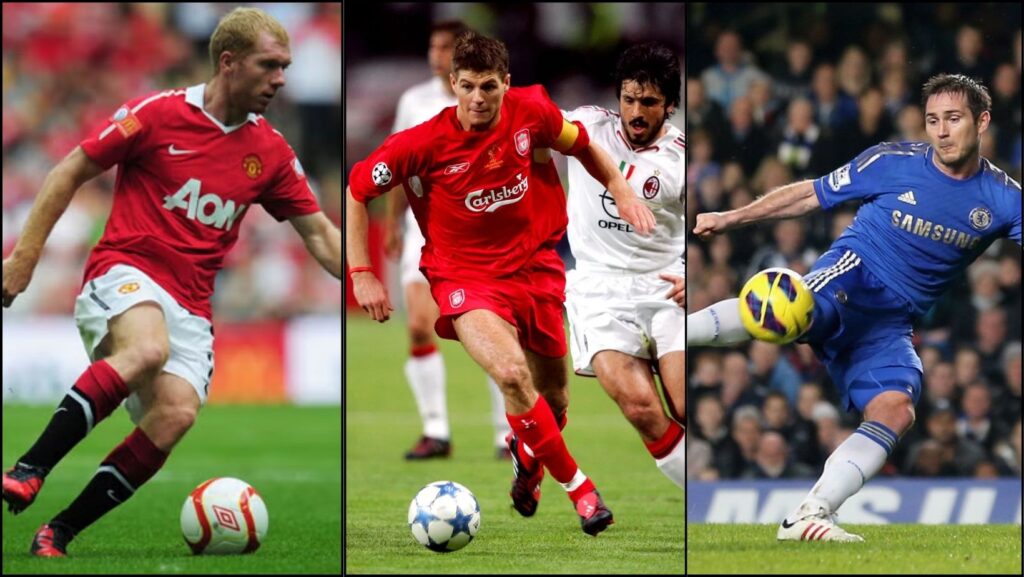
Former goalkeeper Ben Foster reportedly tried to settle this exact argument on his own podcast recently, ranking the trio within a wider list of the greatest Premier League midfielders in history. He apparently placed Lampard above Gerrard, with Scholes rated as the best midfielder the competition has ever seen, a ranking that reportedly sparked immediate disagreement from his own co-host live on the show, and predictably furious debate online afterwards. Even people whose entire job is analysing football professionally cannot agree on where these three actually sit relative to each other.
The England Tragedy Running Underneath All of This
There is a slightly sadder thread running through this entire debate that I think deserves more attention than it usually gets. All three of these players were, at various points, squeezed into the same England midfield as part of what became known as the Golden Generation, a squad absolutely loaded with individual quality that somehow never delivered anything close to what that talent should have produced on the international stage.
Multiple England managers apparently tried and failed to find a system that allowed all three to function together effectively, with Gerrard and Lampard in particular frequently deployed in overlapping central roles that never quite let either player express themselves the way they did for their respective clubs. It remains one of English football’s genuine what ifs, a golden generation of midfield talent that individual club football showcased brilliantly but that international management somehow could never properly harness.
Why I Do Not Actually Want This Settled
Having gone through all three cases properly, I do not think I want this debate to ever have a definitive answer, and I suspect most football fans secretly feel the same way, even the ones shouting loudest about their own preferred pick in pub arguments and comment sections. The entire appeal of this debate is that it forces you to actually define what greatness means to you personally, rather than simply pointing at a stat sheet and calling it settled.
Scholes represents the purest footballing craft. Lampard represents relentless output sustained across an entire career. Gerrard represents the idea that a single player can simply refuse to let their team lose through force of will alone. All three are correct answers depending entirely on which version of greatness you value most, and honestly, needing three completely different types of genius to even have this argument tells you everything about how exceptional English football’s midfield talent genuinely was during that era. We are unlikely to see anything quite like it again.