
There is a specific kind of dread that settles over a stadium when a player gets sent off while their team is winning comfortably. Everyone in the ground knows, on some instinctive level, that the game has just changed shape, even if the scoreline says otherwise. As a Palace fan I have lived through both sides of this particular horror, watching teams we should have put away come roaring back once we went down to ten men, and occasionally, on the rarer good days, being on the receiving end of somebody else’s collapse. Few things in football are as psychologically brutal as watching a comfortable lead evaporate because one man lost his head.
When Being Two Goals Down Somehow Gets Worse
The most infamous of these implosions in recent Premier League memory has to be Newcastle against Arsenal at St James’ Park back in February 2011. Arsenal strolled into a four goal lead by half time, the kind of scoreline that usually means the away fans start planning their journey home early. Then Abou Diaby was sent off in the fiftieth minute for a rough challenge on Joey Barton, and everything unravelled from there.
Barton scored twice himself, Leon Best added another, and in the eighty seventh minute the late Cheick Tioté smashed home a volley that turned four goals of Arsenal comfort into one of the most improbable draws the Premier League has ever produced. Arsenal at least escaped with a point. Not every team facing this kind of collapse is so fortunate.
Manchester United have their own version of this nightmare, and a more recent one at that. In a Champions League group match away at FC Copenhagen, Rasmus Hojlund’s brace had United cruising against his former club, only for Marcus Rashford to be sent off and the entire complexion of the match to change. Copenhagen clawed back not once but twice, eventually winning it courtesy of a dramatic late strike, leaving United bottom of their group and licking their wounds in Denmark. It is a reminder that this phenomenon is not some quirk confined to a single decade. It happens whenever a team with a numerical advantage suddenly loses it, regardless of era or opposition.
Southampton’s Uncomfortable Specialism
If there is one club that has become almost synonymous with capitulating after a red card in the Premier League era, it is Southampton, and their record makes for genuinely painful reading if you happen to support them. In December 2019, already trailing Leicester City by a single goal at home, Ryan Bertrand was dismissed in just the twelfth minute. What followed was not so much a defeat as a public humiliation, Southampton eventually going down nine nil, conceding at a rate that made you wonder whether the ten remaining players had simply stopped trying to defend at all.
Remarkably, Southampton managed to repeat this exact scoreline within the same season. Away at Old Trafford against Manchester United, Alexandre Jankewitz saw red inside the opening two minutes with the match still goalless. Nine goals later, Southampton had somehow contrived to lose by an identical margin to the one suffered against Leicester, a genuinely unique piece of unwanted history. Two nine goal beatings in a single campaign, both triggered by an early dismissal, tells you everything about how quickly a match can spiral once a team is forced to play the majority of it a man short against quality opposition with nothing to lose.
The Continental Collapses That Rival Anything England Has Produced
English football does not have a monopoly on this particular brand of disaster. Over in Italy during the 1991-92 Serie A season, Zdenek Zeman’s wonderfully attacking Foggia side found themselves four goals to one ahead away at Atalanta, seemingly cruising to an away win that would have been a huge statement for a smaller club. Then Dan Petrescu picked up a second yellow card in the seventy second minute, and Atalanta simply refused to accept defeat. Carlo Cornacchia scored a hat-trick inside fourteen frantic minutes, and what should have been a routine Foggia victory finished level at four goals apiece.
Down in Italy again, more recently, Venezia suffered their own version of this collapse during the Derby del Veneto against Verona in December 2021. Three one up at home with the game seemingly under control, Pietro Ceccaroni was dismissed for handling on the goalline in the sixty second minute. Verona converted the resulting penalty and then scored twice more through Giovanni Simeone to complete a genuinely famous away victory that Venezia’s supporters would rather forget entirely.
Sometimes the Damage Is Instant Rather Than Gradual
Not every costly red card produces a slow motion collapse over the closing stages. Some inflict maximum damage almost immediately. Liverpool’s visit to the Etihad during the 2017-18 season is a good example. Already trailing Manchester City by a single goal, Sadio Mane was shown red in the thirty seventh minute for a high, reckless challenge on Ederson. Liverpool never recovered any kind of foothold in the game after that, eventually losing five nil in what remains one of the more one sided beatings City have handed out to a genuine title rival in the Guardiola era.
Emmanuel Adebayor’s return to the Emirates in November 2012 provides a different flavour of chaos entirely, given he was actually playing for the away side that day. The Togolese striker gave Tottenham an early lead against his former club, only to be shown a straight red card in the seventeenth minute for a dangerous challenge on Santi Cazorla. Arsenal, who had already beaten Spurs five two earlier that same season at the Emirates, produced an almost identical scoreline again, turning Adebayor’s homecoming into a thoroughly miserable afternoon.
When Ten Men Nearly Get Away With It Anyway
Not every story involving a costly dismissal ends in complete disaster, and it is worth remembering that going down to ten men does not automatically guarantee collapse. The 2006 Champions League final between Arsenal and Barcelona at the Stade de France offers a fascinating counterpoint. Jens Lehmann was dismissed for bringing down Samuel Eto’o, becoming the first player ever sent off in a European Cup final in the process, and yet Arsenal somehow still took the lead with ten men against a Barcelona side stacked with talent. It took a Eto’o equaliser and a late Juliano Belletti winner to finally break Arsenal’s resistance, proving that a red card, even in the biggest game imaginable, does not always spell instant doom. Sometimes it just makes the eventual outcome far more dramatic than it needed to be.
Why This Keeps Happening
What fascinates me most about all of these collapses, spread across different countries and different decades, is how similar the psychology behind them tends to be. A team that finds itself with a numerical advantage almost always shifts its approach, pushing bodies forward, sensing weakness, playing with a freedom that comes from knowing the opposition is now defending with one fewer body on the pitch. Meanwhile the team reduced to ten men often experiences the opposite psychological shift, a creeping anxiety that spreads through the remaining players as fatigue sets in faster than it should and gaps start appearing that simply were not there fifteen minutes earlier.
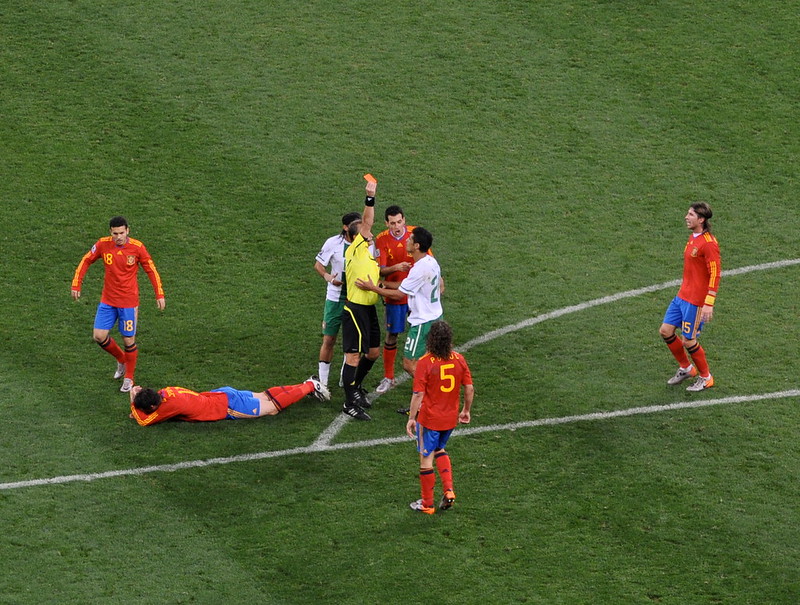
There is also a tactical reality underneath all the emotion. Losing a player rarely just costs a team one body. It costs them their structure, their pressing triggers, their defensive shape, and often forces a reorganisation mid-match that opposition players are far better placed to exploit than the shell shocked team trying to implement it. Southampton conceding eighteen goals across two separate nine nil defeats in a single Premier League season is not really about individual quality collapsing. It is about a system built for eleven players being asked to function with ten against sides that simply kept their composure and kept scoring.
I think that is ultimately the real lesson buried inside all of these stories. A red card rarely just removes a player from the pitch. It removes a plan, and watching what happens to a team once that plan disappears tells you almost everything about the psychological fragility that exists just beneath the surface of even the most comfortable looking scoreline.